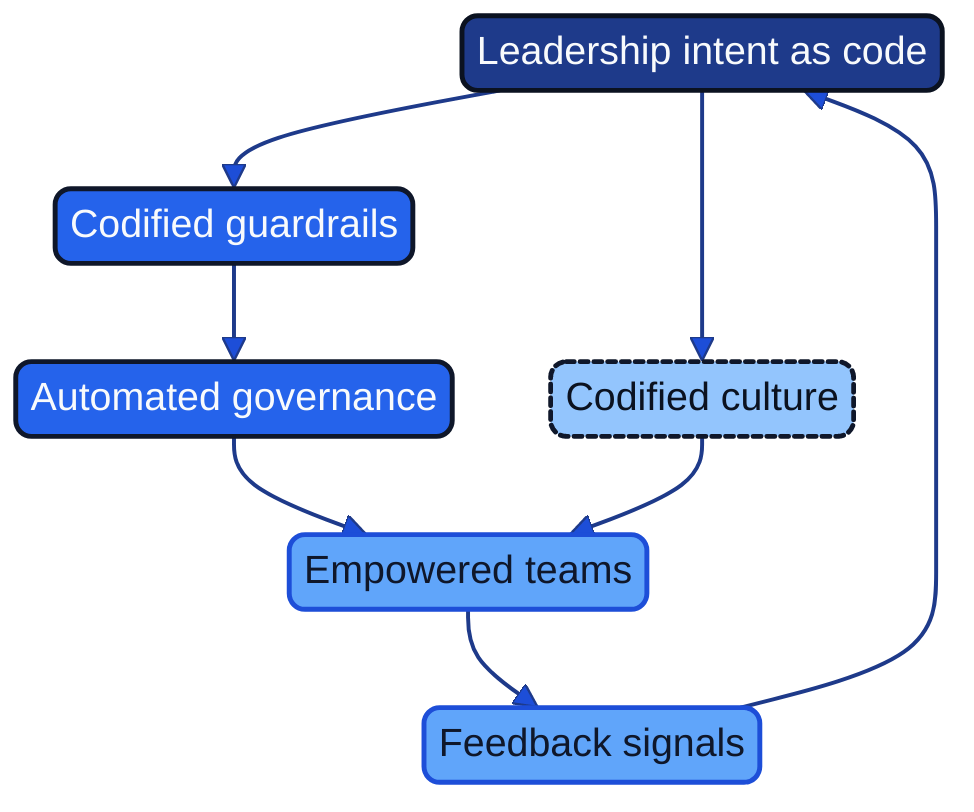
Management as Code (MaC) extends the well-established principles of Infrastructure as Code and Architecture as Code into the realm of organisational leadership. It treats management intent, governance routines, and decision frameworks as executable artefacts that can be versioned, tested, automated, and refined. In organisations where the entire delivery pipeline is codified, management practices that remain trapped in meetings, slide decks, or undocumented intuition quickly become bottlenecks. A MaC discipline eliminates that bottleneck by encoding strategic direction, operational constraints, and cultural values into the same repositories that power the technology stack. This chapter explores how MaC manifests in fully code-based environments, how management roles adapt to DevOps loops, and how tooling such as GitHub can embed leadership into the change lifecycle while addressing budgeting, capability development, and the orchestration of multiple teams or teams-of-teams.
By the end of this chapter, you will be able to:
At its core, MaC is the systematic translation of management artefacts into reproducible code. Policies, playbooks, delegation models, role definitions, and decision guardrails are captured as declarative specifications that tooling can enforce. Rather than issuing static policy documents, leadership teams create repositories that contain structured definitions for escalation thresholds, strategic objectives and key results (OKRs)—a lineage that runs back to the management by objectives described by Drucker (1954) Source [104]—and the criteria for portfolio prioritisation. Automation hooks process these definitions to trigger workflows, generate dashboards, or enforce access controls. By storing these assets in Git repositories, management directives acquire the same benefits as other code: auditability, peer review, continuous integration, and rollback.
Primary topics explored
- Introduction
- Learning Objectives
- Defining Management as Code
- Principles of MaC in Code-First Organisations
- Embedding Management in the DevOps Loop
- Governance and Policy Automation
About Architecture as Code
Infrastructure as Code represents a fundamental change in how we manage and develop IT infrastructure. This book provides organisations with practical guidance for implementing IaC principles whilst fulfilling local compliance requirements and optimising costs.
The book covers everything from fundamental principles and tools to advanced implementation strategies, security aspects, and organisational changes required for successful IaC adoption.
IT architects, DevOps teams, developers, and decision-makers within organisations.

Gunnar Nordqvist
Conceived, directed and published the books of The Transformed Architecture.
Continue with the full chapter
Chapter 19: Management as Code in Architecture as Code gives the detailed explanations, practical examples and implementation patterns behind this summary.
This whitepaper belongs to “Organisation and Leadership” and is one of 38 drawn from the manuscript.