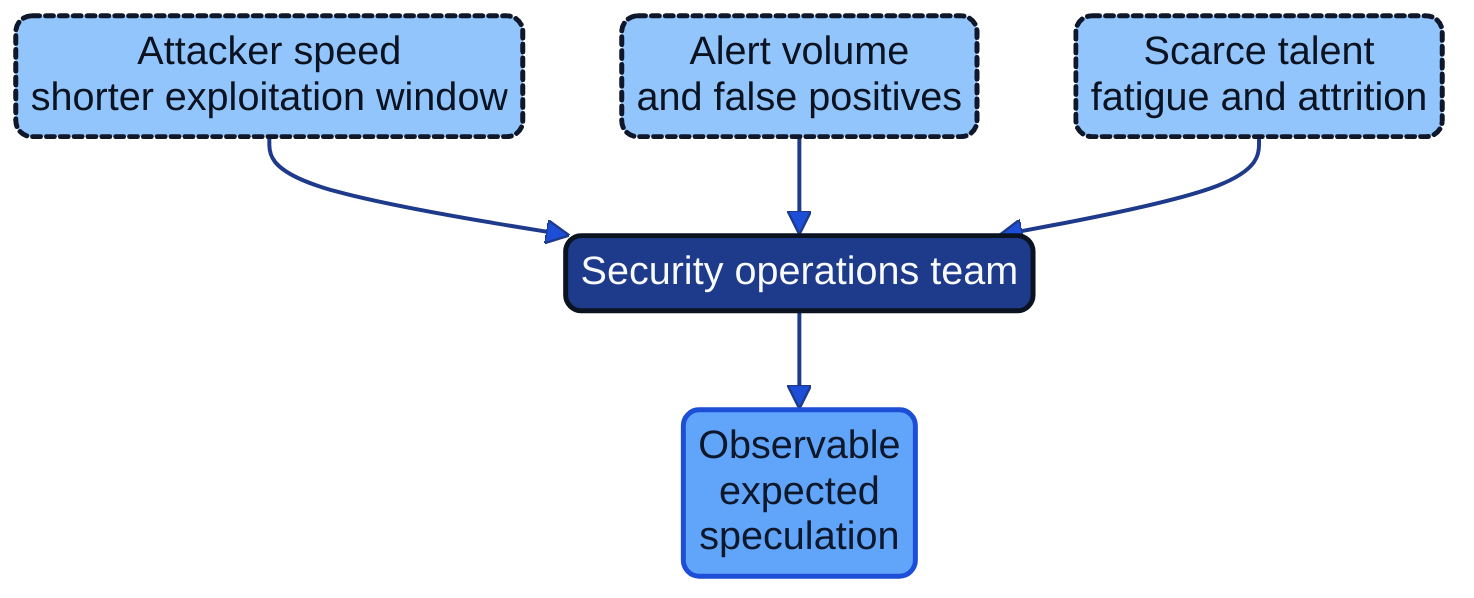
This chapter sets out the pressure that makes the transformation of the blue team a matter of necessity rather than choice, and it keeps to what the sources measured. It concerns all five functions. B1 Anticipate feels it as advisories and disclosures that arrive faster than they can be read, B2 Detect as telemetry and false positives, B3 Investigate as a queue that grows while the people who work it are few, B4 Respond as a shrinking interval in which containment still matters, and B5 Learn as the first activity dropped when the other four are under strain. It describes three pressures in turn, adversaries that use AI, an alert queue that can exceed human capacity and a scarcity of skilled people, and for each it states what the evidence shows, in whom and over what period, what it does not show, and whether the outlook is observable, expected or speculation.
The chapter builds on conclusions of the earlier volumes. AI Platform and Security, Chapter 18, concluded that AI is both a target and a source of threat and that security operations must run faster than a monthly patch cycle, with patch velocity as a measured service level, detection at machine speed with the authority to act, and human verification as the bottleneck of AI-enabled defence (63, Nordqvist, 2026). AI Governance, Chapter 24, concluded that patch decisions for known-exploited vulnerabilities must be delegated in advance, because a weekly change advisory board cannot sit in their path (62, Nordqvist, 2026). AI Threat, Chapters 14 and 25, added that automation erodes the skills of the people who must catch its errors and that agents acting beyond their mandate are an observable pattern (65, Nordqvist, 2026). AI Red Team, Chapter 2 (64, Nordqvist, 2026), and AI Threat, Chapter 18 (65, Nordqvist, 2026), assemble the threat evidence from the standpoint of the organisation and of the threat register. This chapter takes the standpoint of the team: what the shift looks like from the chair of the person who triages the queue, and what it means for the people on the rota.
The pressure begins with arithmetic that every SOC lead already knows. A tier 1 analyst has a fixed number of productive hours in a shift, a triage step has a minimum duration if it is done properly, and the alerts arrive at a rate that the analyst does not control. Capacity is the product of the first two and demand is the third. When demand exceeds capacity the queue does one of three things: it grows, it is closed without being read, or it is cut by suppressing detections. All three are familiar, and all three move risk from the visible queue into the invisible estate.
Primary topics explored
- A team at the edge of its capacity
- Adversaries with AI
- The collapsing exploitation window
- Telemetry and the alert queue
- Scarce talent and strained people
- What the pressure does not justify
About AI Blue
AI Blue is Book 8 of The Transformed Architecture. It examines how the blue team, the people and functions that defend an organisation, is transformed when artificial intelligence takes part in their work: anticipating, detecting, investigating, responding and learning, the team's own AI and how to verify and protect it, operating models, roles, decision rights, regulation and measurement, and the careers and wellbeing of the people involved, for European enterprises and public authorities.
It builds on the conclusions of Architecture as Code, AI Governance, AI Platform and Security, AI Red Team, AI Threat, The Transformed Security Architect and AI Boss.
Chief information security officers, heads of security operations, SOC managers, analysts, detection engineers and incident commanders, security and AI architects, boards and management bodies, procurement leads, works councils and unions, data protection and audit functions, and public-sector leaders.

Gunnar Nordqvist
Conceived, directed and published the books of The Transformed Architecture.
Continue with the full chapter
Chapter 3: The Pressure on the Blue Team: Machine-Speed Adversaries, Alert Volume and Scarce Talent in AI Blue gives the detailed explanations, practical examples and implementation patterns behind this summary.
This whitepaper belongs to “The Blue Team in Question” and is one of 32 drawn from the manuscript.