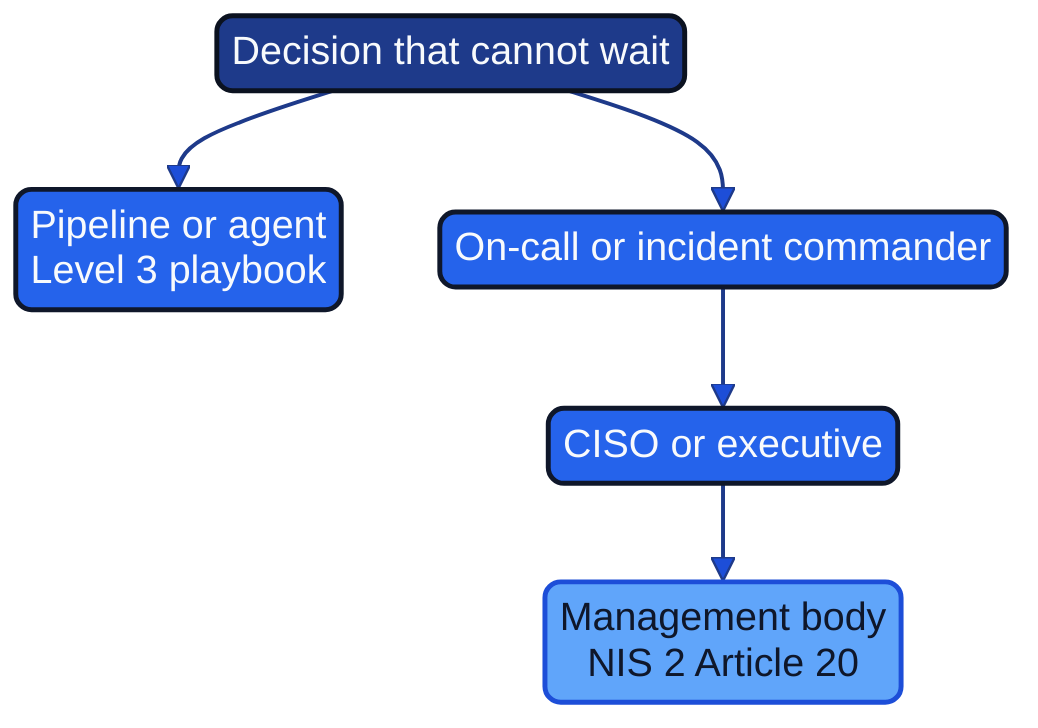
Chapter 10 fixed the action classes of a response, the playbook manifest, the break-glass credential and the stop path. It did not settle who holds the decisions that surround those actions: who may isolate a production system, disable an account, take a citizen-facing service offline, tell a regulator, tell the people affected, refuse a ransom or stop an agent, and how quickly each holder must answer. This chapter assigns those rights. It concerns B3 Investigate, where the evidence that a decision rests on is assembled, and B4 Respond, where the decision is taken and recorded. It applies decision tiers, stop decisions named in advance and the rule that the right to stop is cheaper than the right to continue, and it shows how the same table has to hold across several legal regimes. The regulatory map itself is the subject of Chapter 19, and the role charters that carry these rights are the subject of Chapter 17.
The decisions in this chapter share one property: the threat, the reporting clocks or both set the time in which they must be taken, and a committee cannot meet in that time. A decision right is therefore a requirement on the organisation in the same sense as a latency requirement on a service. It has a holder, a response time, an evidence standard and a record, and it is tested.
Take the night of 2027-04-12 described in Chapter 10. Within about eight minutes of the first flag three decisions were taken. A playbook isolated workstation WS-PL-0518 at Level 3 Bounded. The agent then proposed isolating WS-PL-0731, a host tagged shared and claims-settlement, and the night incident commander approved that at Level 2 Supervised in 38 seconds. The shift lead, Piotr Nowak, invoked the stop at 02:19:05 and reversed the second isolation at 02:22:15. The decision-rights file of this chapter did not yet exist on that night (AIDR-0776 is dated 2027-06-14), and the second isolation shows why it is needed. A shared claims-settlement host is a production host, and the file's decision D4 gives that decision to the SOC lead; the incident commander on shift is the deputy and approves at Level 2 only when the SOC lead cannot be reached in the decision time. The commander approved because the approval screen showed an ordinary proposal and did not show the tags, so the holder of the decision was never tried. That is no failing of the commander. It is the dependence on whoever happens to be awake and on what the screen shows, which a decision-rights table removes.
Primary topics explored
- Decisions that cannot wait
- Decision tiers
- Stop decisions
- Disclosure decisions
- Delegation to agents
- The record
About AI Blue
AI Blue is Book 8 of The Transformed Architecture. It examines how the blue team, the people and functions that defend an organisation, is transformed when artificial intelligence takes part in their work: anticipating, detecting, investigating, responding and learning, the team's own AI and how to verify and protect it, operating models, roles, decision rights, regulation and measurement, and the careers and wellbeing of the people involved, for European enterprises and public authorities.
It builds on the conclusions of Architecture as Code, AI Governance, AI Platform and Security, AI Red Team, AI Threat, The Transformed Security Architect and AI Boss.
Chief information security officers, heads of security operations, SOC managers, analysts, detection engineers and incident commanders, security and AI architects, boards and management bodies, procurement leads, works councils and unions, data protection and audit functions, and public-sector leaders.

Gunnar Nordqvist
Conceived, directed and published the books of The Transformed Architecture.
Continue with the full chapter
Chapter 18: Decision Rights and Escalation: Who May Contain, Isolate and Disclose in AI Blue gives the detailed explanations, practical examples and implementation patterns behind this summary.
This whitepaper belongs to “The Team in the Organisation” and is one of 32 drawn from the manuscript.