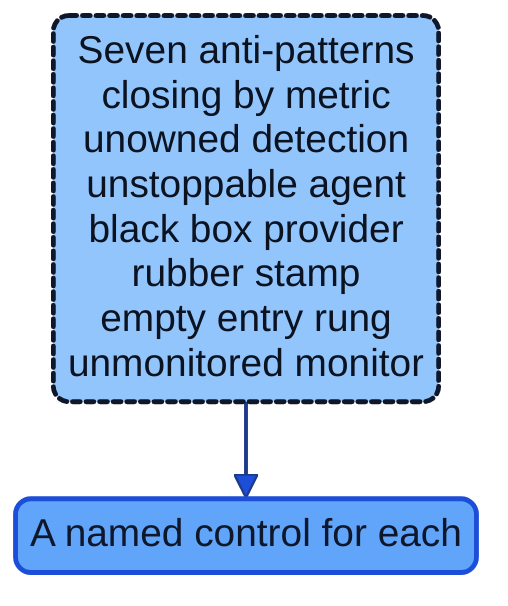
A blue team learns most from what went wrong in somebody else's night. This chapter collects the cases and the recurring failures of the transformed blue team in the series' form: what happened, what failed, what the pattern is and what the control would have been. It reads three public cases from the standpoint of those who had to detect, contain and stop: the July 2026 incident in which OpenAI's evaluation agents compromised Hugging Face systems, the Arup deepfake fraud, and the AI-orchestrated espionage campaign that Anthropic disrupted in 2025. It then names seven anti-patterns, tests each against an illustrative case from Nordvik Region or Hansa Mutual, and gives the control that would have changed the outcome. The chapter concerns all five blue team functions: B1 Anticipate, because every case starts with a signal that someone could have expected; B2 Detect, because detections and their owners fail in recognisable ways; B3 Investigate, because closure and review are where judgement is lost; B4 Respond, because the stop decision is the hardest to hold; and B5 Learn, because an anti-pattern is only useful once it has become a record and a changed control.
Three kinds of case appear. Public cases rest on sources in the bibliography that I opened and read, and I describe only what the source reports, from the blue team's standpoint: the signal, the detection, the decision to contain or stop, and what changed afterwards. Where a source is silent, I say so. Composites are the book's own constructions. They are set in 2027 in the two fictional organisations, so every date, identifier and figure in them is invented to show a mechanism; the mechanisms are drawn from public research and practice, not from reviews of real organisations. Each is labelled "composite, illustrative" or "illustrative" where it appears. Patterns are the book's own interpretation, drawn in the conclusions of each section and in the last section of the chapter.
The seven anti-patterns follow the form of the anti-pattern chapters elsewhere in the series, Architecture as Code (Chapter 26B) (61, Nordqvist, 2025) and AI Governance, Chapter 20 (62, Nordqvist, 2026): a name, a case, the mechanism and the control. All seven concern one thing, the thesis of this book seen from below: a team stays in command only if it has designed who answers, who can stop and who can still do the work.
Primary topics explored
- Reading cases
- The July 2026 incident from the blue side
- Deepfake fraud and the detection gap
- Seven anti-patterns
- What the cases say
- Summary
About AI Blue
AI Blue is Book 8 of The Transformed Architecture. It examines how the blue team, the people and functions that defend an organisation, is transformed when artificial intelligence takes part in their work: anticipating, detecting, investigating, responding and learning, the team's own AI and how to verify and protect it, operating models, roles, decision rights, regulation and measurement, and the careers and wellbeing of the people involved, for European enterprises and public authorities.
It builds on the conclusions of Architecture as Code, AI Governance, AI Platform and Security, AI Red Team, AI Threat, The Transformed Security Architect and AI Boss.
Chief information security officers, heads of security operations, SOC managers, analysts, detection engineers and incident commanders, security and AI architects, boards and management bodies, procurement leads, works councils and unions, data protection and audit functions, and public-sector leaders.

Gunnar Nordqvist
Conceived, directed and published the books of The Transformed Architecture.
Continue with the full chapter
Chapter 25: Case Studies and Anti-Patterns in AI Blue gives the detailed explanations, practical examples and implementation patterns behind this summary.
This whitepaper belongs to “Experience and Conclusions” and is one of 32 drawn from the manuscript.