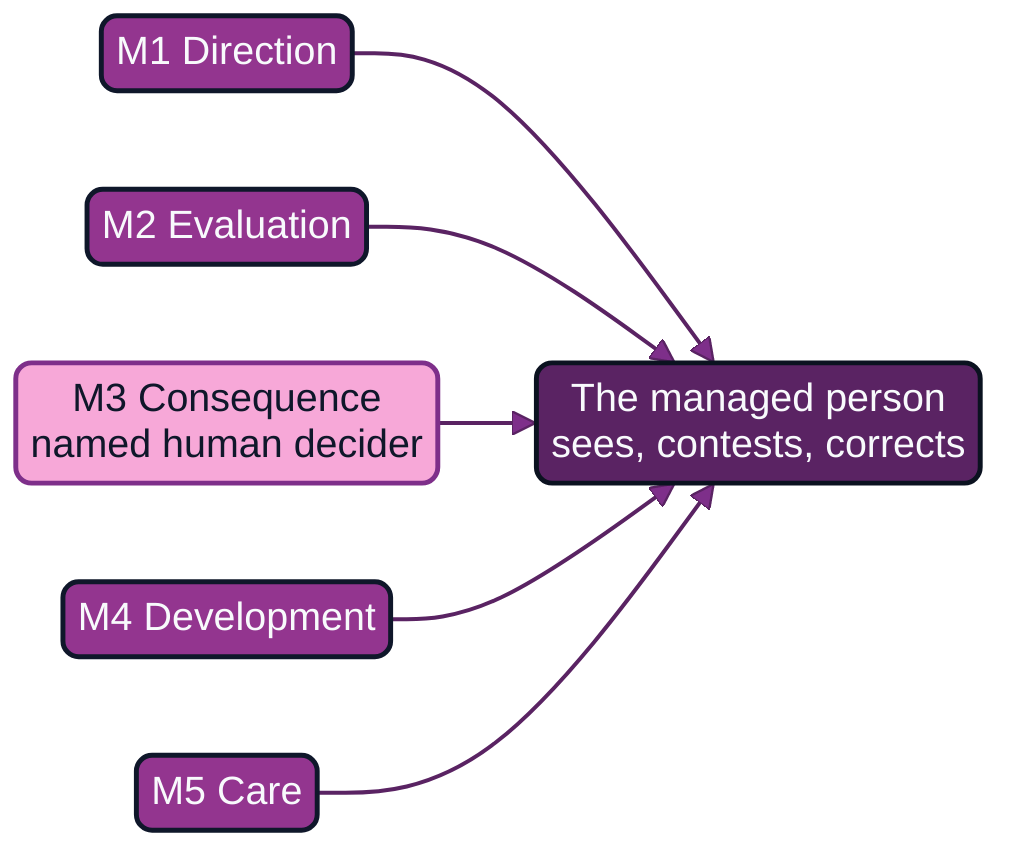
The six earlier books in this series were about systems and the people who govern them. This book is about the people whom systems now help to manage, and about the managers who are asked, in turn, to manage software. Its question is the one in its title: when artificial intelligence takes over parts of the manager's work, who is the boss, and who answers for what happens to the person being managed? The book answers by dividing management into five functions that can be delegated, measured and governed one by one: M1 Direction, M2 Evaluation, M3 Consequence, M4 Development and M5 Care. This chapter states the question, the thesis, the functions, why the question is European and urgent in 2026, and the two organisations the reader will follow.
In a ward of one of Nordvik Region's two local hospitals, a four-week roster appears in the unit manager's approval queue. ShiftWise, the rostering system the Region procured under tender NR-2025-089, drafted it from demand forecasts, staff preferences, competences and working-time rules; the manager approves it, and the system offers the remaining open shifts to staff who opted in. In the Strandvik home-care unit, Mikael Strand is preparing for the moment when the same system starts to draft his staff's visit routes, with how many minutes between doors.
In Hamburg, Hansa Mutual's claims-triage agent, an autonomous production agent, places a motor claim in the queue of one of the twenty or so handlers in Jana Petersen's team. The allocation follows rules that the group head of claims operations owns. Jana can reassign it; most days she does not need to, and some days she does not notice that she might have. From January her team will also pilot directing a small set of agents, although she has twelve years in claims and has never managed software.
Primary topics explored
- Who is the boss?
- The AI boss is not science fiction
- The question the series had not asked
- The working thesis
- Five functions and five degrees
- Why Europe, and why now
About AI Boss
AI Boss is Book 7 of The Transformed Architecture. It examines what happens when artificial intelligence takes the manager's chair: algorithmic management of direction, evaluation, consequence, development and care, the effects on people, the management of AI agents, Europe's legal answer, and how to design an accountable AI boss, for European enterprises and public authorities.
It builds on the conclusions of Architecture as Code, AI Governance, AI Platform and Security, AI Red Team, AI Threat and The Transformed Security Architect.
Executives, line managers, HR and people leaders, works councils and trade unions, public employers, architects and AI governance leads, data protection and legal officers, procurement and programme leaders, and risk, compliance and audit.

Gunnar Nordqvist
Conceived, directed and published the books of The Transformed Architecture.
Continue with the full chapter
Chapter 1: Introduction: Who Is the Boss? in AI Boss gives the detailed explanations, practical examples and implementation patterns behind this summary.
This whitepaper belongs to “The Question” and is one of 37 drawn from the manuscript.