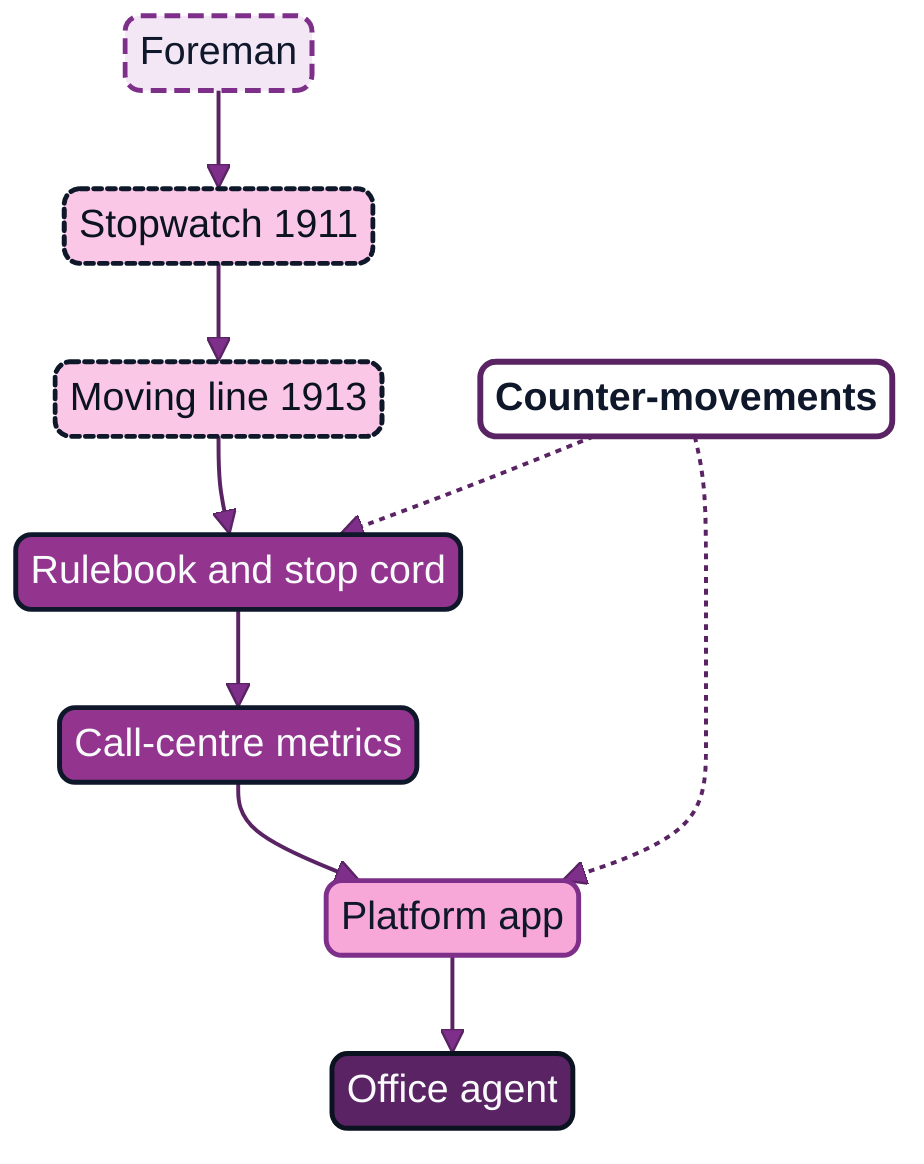
The AI boss has ancestors, and a reader who does not know them will mistake the old for the new. This chapter follows a century of managing by measurement, from the stopwatch to the office agent, and asks of each step which of the five management functions of Chapter 2 was handed to a system. M1 Direction and M2 Evaluation were measured first; M3 Consequence followed whenever a measure was tied to pay or a job; M4 Development and M5 Care were defended by the counter-movements. Algorithmic management, the chapter argues, inherits scientific management's ambition and adds three properties: direction and evaluation at the scale and speed of software, opacity to the people managed, and the possibility of a consequence for a person without a human decision. The claim that this is Taylorism plus three properties is the book's interpretation, which Part II tests.
Richard Edwards called the regime of the nineteenth-century workshop simple control: the owner or the foreman directed work, watched it, hired, paid, disciplined and dismissed, all in person and largely at will (94, Edwards, 1979). All five functions sat in one person, and the worker could only leave or act with others.
Frederick Winslow Taylor set out to replace that judgement with measurement. His diagnosis was "soldiering", workers deliberately restricting output, and his remedy made managers gather "all of the traditional knowledge which in the past has been possessed by the workmen" and reduce it to rules (82, Taylor, 1911). The central device was the task: work planned by management a day in advance, with written instructions specifying "not only what is to be done but how it is to be done and the exact time allowed for doing it", and a bonus of 30 to 100 per cent for meeting it. In his own account of loading pig iron at Bethlehem Steel, the standard rose from about 12.5 to 47 tons per man per day for a wage raised from $1.15 to $1.85. Taylor stated the principle without ambiguity: "In the past the man has been first; in the future the system must be first."
Primary topics explored
- The foreman and the one best way
- The moving line and the five-dollar day
- Deskilling and control
- The counter-movements
- The control revolution and the smart machine
- Call centres, warehouses and the quantified workplace
About AI Boss
AI Boss is Book 7 of The Transformed Architecture. It examines what happens when artificial intelligence takes the manager's chair: algorithmic management of direction, evaluation, consequence, development and care, the effects on people, the management of AI agents, Europe's legal answer, and how to design an accountable AI boss, for European enterprises and public authorities.
It builds on the conclusions of Architecture as Code, AI Governance, AI Platform and Security, AI Red Team, AI Threat and The Transformed Security Architect.
Executives, line managers, HR and people leaders, works councils and trade unions, public employers, architects and AI governance leads, data protection and legal officers, procurement and programme leaders, and risk, compliance and audit.

Gunnar Nordqvist
Conceived, directed and published the books of The Transformed Architecture.
Continue with the full chapter
Chapter 3: From Scientific Management to Algorithmic Management: A Century of Managing by Measurement in AI Boss gives the detailed explanations, practical examples and implementation patterns behind this summary.
This whitepaper belongs to “The Question” and is one of 37 drawn from the manuscript.