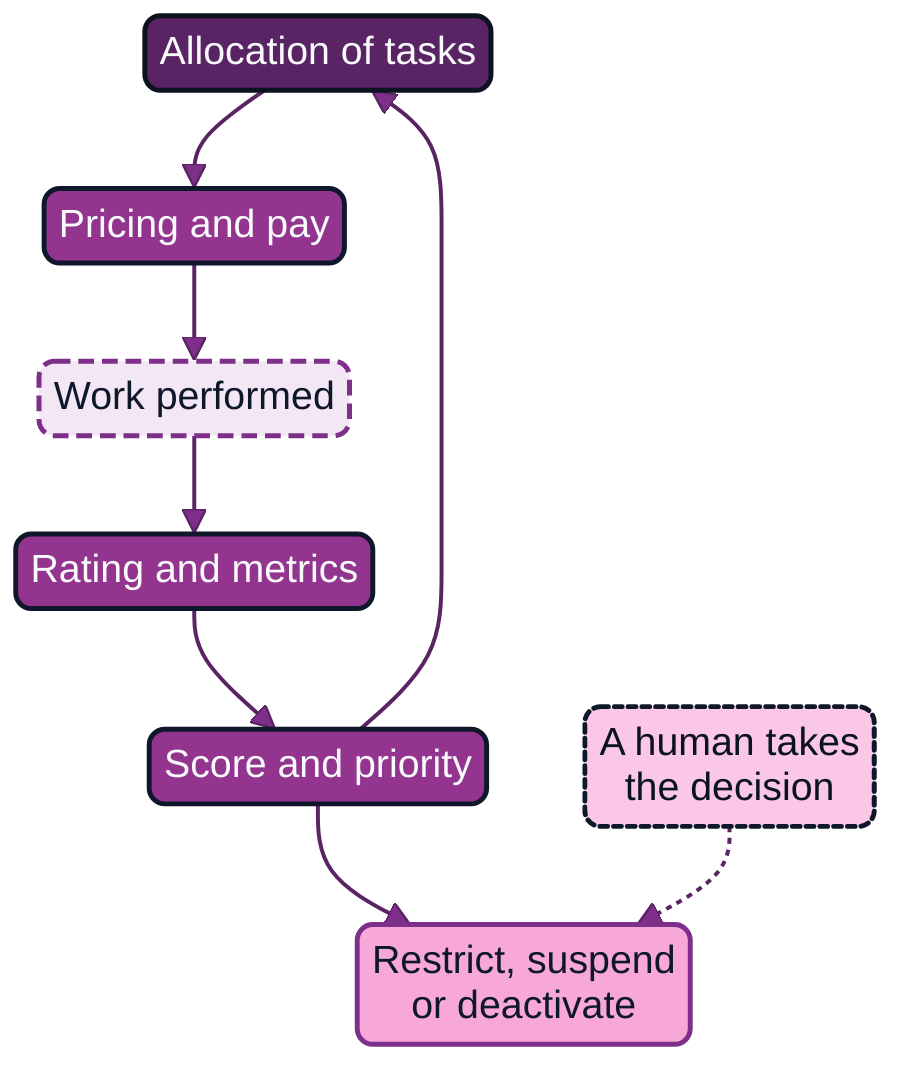
Nowhere is the AI boss older or better documented than on the digital labour platforms of ride-hailing and food delivery. Software assigns the next ride or order, sets the pay, collects a customer rating after every task, turns ratings and acceptance into a score that sets priority for the best shifts, and can switch off a person's access to work. Courts and regulators have tested these systems for a decade, and this chapter reads that record for what it teaches every employer, because shift-offer and allocation systems inside ordinary organisations increasingly work the same way. It concerns M1 Direction, because the platform assigns and paces the work; M2 Evaluation, because ratings and metrics rate the person who does it; and M3 Consequence, because pay, priority and deactivation determine income and access to work.
The term algorithmic management entered the literature through a study of how Uber and Lyft drivers responded when algorithms assigned work, provided informational support and evaluated their performance, and how they used online forums to make sense of those features (113, Lee et al., 2015). Assigning is M1 Direction and evaluating is M2 Evaluation; informing, which sounds neutral, is the channel through which direction is exercised without the appearance of an instruction. Möhlmann and colleagues, in a grounded study of Uber drivers supplemented by interviews with Uber executives and engineers, showed that the same algorithms both match tasks to workers and control how the work is done (123, Möhlmann et al., 2021).
The UK Supreme Court described the control concretely in 2021, when it held Uber's drivers to be workers. Uber fixed the remuneration, dictated the contract terms, monitored acceptance and cancellation and logged drivers off for ten minutes when too many requests were declined, and used passenger ratings on a scale of one to five, with warnings and eventual termination for drivers whose average fell below a required level (59, UK Supreme Court, 2021). Each mechanism is a management function in software: pacing (M1), rating (M2) and removal of access to work (M3).
Primary topics explored
- The algorithm as dispatcher
- What the research measured
- Pay set by software
- Ratings as evaluation
- Deactivation
- Courts and authorities
About AI Boss
AI Boss is Book 7 of The Transformed Architecture. It examines what happens when artificial intelligence takes the manager's chair: algorithmic management of direction, evaluation, consequence, development and care, the effects on people, the management of AI agents, Europe's legal answer, and how to design an accountable AI boss, for European enterprises and public authorities.
It builds on the conclusions of Architecture as Code, AI Governance, AI Platform and Security, AI Red Team, AI Threat and The Transformed Security Architect.
Executives, line managers, HR and people leaders, works councils and trade unions, public employers, architects and AI governance leads, data protection and legal officers, procurement and programme leaders, and risk, compliance and audit.

Gunnar Nordqvist
Conceived, directed and published the books of The Transformed Architecture.
Continue with the full chapter
Chapter 5: Platform Work: The Algorithm as Dispatcher in AI Boss gives the detailed explanations, practical examples and implementation patterns behind this summary.
This whitepaper belongs to “The AI Boss Today” and is one of 37 drawn from the manuscript.