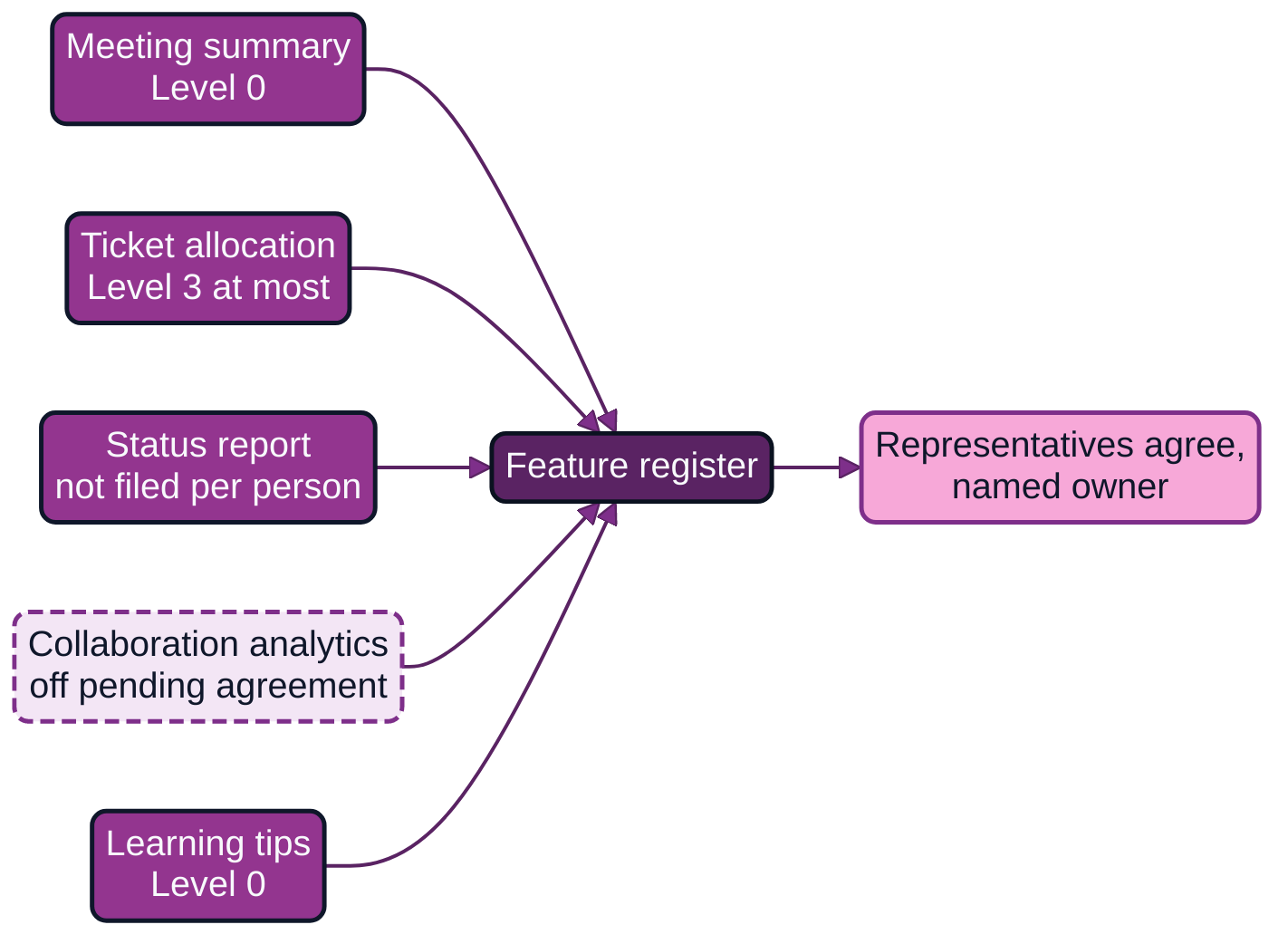
The AI boss of the earlier chapters of Part II is easy to see: a dispatch app, a scanner, a roster. In the office the same functions arrive quietly, as features. An assistant puts a name against each action item of a meeting, a workflow agent places a ticket in one person's list, and an analytics pane shows how fragmented a team's focus time is. None of these features is sold as a manager, and in most organisations nobody decided that it should act as one. This chapter shows how such features come to direct and evaluate knowledge work and how an organisation decides about them. It concerns three management functions: M1 Direction, because assistants and agents assign and sequence work; M2 Evaluation, because summaries, status reports and analytics become inputs to judgements of performance; and M4 Development, because the same features shape who gets the work from which people learn.
A meeting ends, and within a minute every participant has a summary drafted from the transcript: decisions, open questions and action items, each with an owner and often a due date. The owner field is the point at which a summary becomes an instruction. A human minute-taker records an agreement; an assistant infers the owner from the transcript, and may attach the task to the person who raised the problem rather than the one who accepted it. When the summary is distributed and turned into tasks in each person's list, the proposal has been executed: the assistant performed M1 Direction.
Whether that is acceptable depends on the degree of delegation. At Level 0 Advisory the assistant proposes owners and the meeting chair confirms them before anything is distributed. At Level 1 Assisted each owner must accept the task before it appears in the list. At Level 2 Supervised tasks go out automatically and the chair can correct them afterwards. Architecture as Code (Chapter 20) reached the rule that applies here, "agents draft; humans approve", with the named human approval in the audit trail (30, Nordqvist, 2025). For meeting actions the approval is the chair's, and the default of most products, distribution without it, has to be changed deliberately.
Primary topics explored
- The assistant that assigns
- Workflow agents
- Analytics about people
- The agent boss vision
- What was measured
- The transparency paradox
About AI Boss
AI Boss is Book 7 of The Transformed Architecture. It examines what happens when artificial intelligence takes the manager's chair: algorithmic management of direction, evaluation, consequence, development and care, the effects on people, the management of AI agents, Europe's legal answer, and how to design an accountable AI boss, for European enterprises and public authorities.
It builds on the conclusions of Architecture as Code, AI Governance, AI Platform and Security, AI Red Team, AI Threat and The Transformed Security Architect.
Executives, line managers, HR and people leaders, works councils and trade unions, public employers, architects and AI governance leads, data protection and legal officers, procurement and programme leaders, and risk, compliance and audit.

Gunnar Nordqvist
Conceived, directed and published the books of The Transformed Architecture.
Continue with the full chapter
Chapter 10: Knowledge Work: The AI Manager Enters the Office in AI Boss gives the detailed explanations, practical examples and implementation patterns behind this summary.
This whitepaper belongs to “The AI Boss Today” and is one of 37 drawn from the manuscript.