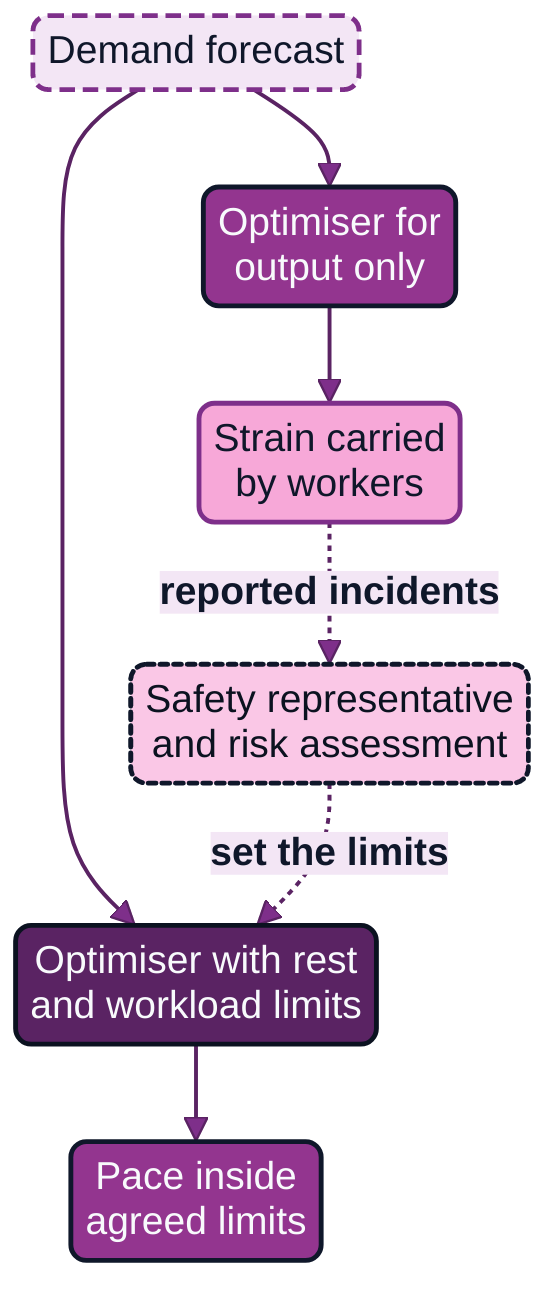
A manager who sets the pace of work has always also been the person placed to notice when the pace harms someone: the shift leader who adds a visit to a route sees the assistant nurse come back late and exhausted. Algorithmic management separates the two. The system that sequences visits, allocates claims or offers open shifts performs M1 Direction at machine speed, while the duty of care, M5 Care, stays with an employer whose line managers may no longer see the work as it is done. This chapter presents what research measured about strain, pace, schedules and injury, sets out what occupational safety and health law requires, and stages the debate between those who see algorithmic direction as a machine for externalising strain and those who see in it the first manager that never forgets a rest rule.
The chapter builds on three conclusions of the earlier volumes: human command is built, with an interruption path outside the system and approval quality reported in aggregate (F52, F53; AI Red Team, Chapters 6 and 15) (33, Nordqvist, 2026); oversight quality is measured at team level (F66; AI Threat, Chapters 6 and 14) (34, Nordqvist, 2026); and stop decisions are named in advance (F19; AI Governance, Chapter 13) (31, Nordqvist, 2026). It addresses Q11, what replaces the manager's judgement in care for health, and contributes to Q4, whether algorithmic management works when measured in health as well as output.
The research that matters most here was written about control, effort and reward, not about algorithms, and it applies because algorithmic management changes exactly those variables.
Primary topics explored
- Pace, strain and recovery
- Monitored pace and injury
- Schedules and health
- The employer's duty
- National rules
- The debate
About AI Boss
AI Boss is Book 7 of The Transformed Architecture. It examines what happens when artificial intelligence takes the manager's chair: algorithmic management of direction, evaluation, consequence, development and care, the effects on people, the management of AI agents, Europe's legal answer, and how to design an accountable AI boss, for European enterprises and public authorities.
It builds on the conclusions of Architecture as Code, AI Governance, AI Platform and Security, AI Red Team, AI Threat and The Transformed Security Architect.
Executives, line managers, HR and people leaders, works councils and trade unions, public employers, architects and AI governance leads, data protection and legal officers, procurement and programme leaders, and risk, compliance and audit.

Gunnar Nordqvist
Conceived, directed and published the books of The Transformed Architecture.
Continue with the full chapter
Chapter 14: Health, Pace and Burnout: Occupational Safety Under Algorithmic Direction in AI Boss gives the detailed explanations, practical examples and implementation patterns behind this summary.
This whitepaper belongs to “What It Does to People” and is one of 37 drawn from the manuscript.