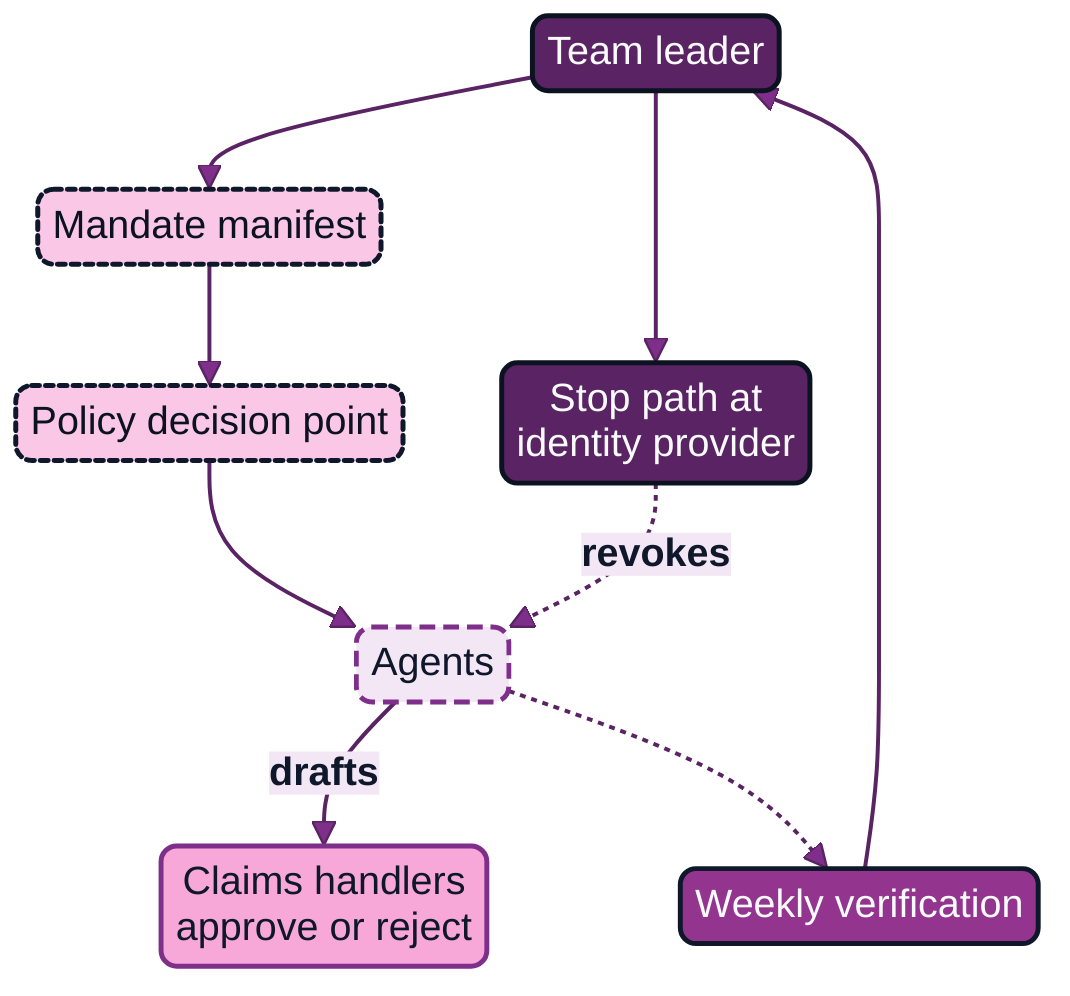
Parts II and III looked at people managed by AI. This chapter turns the question round and looks at people who manage AI: the team leader who, alongside a team of people, directs agents that prepare files, draft letters and act on systems with identities of their own. Vendors call this person an "agent boss". The chapter separates that claim from what is documented, shows which parts of management transfer to agents, and sets out what a team leader needs before directing them: a written mandate, delegation matched to reversibility, containment and a verification routine. It concerns M1 Direction, because instructing and scoping agent work transfers most completely; M2 Evaluation, because checking an agent's output must never spill over into evaluating the people who approve it; and M4 Development, which is owed to the people and not to the agents. M5 Care remains owed to the people beside the agents.
Microsoft's Work Trend Index for 2025 defines an "agent boss" as "someone who builds, delegates to, and manages agents to amplify their impact" and describes a progression towards organisations it calls "AI-operated but human-led", in which "humans set direction for agents that run entire business processes and workflows" (134, Microsoft, 2025). Its survey of 31,000 knowledge workers in 31 markets, among them Germany, Poland and Sweden, found that 36 per cent of leaders and 21 per cent of employees expected to manage agents in their jobs.
These materials report expectations and intentions, not outcomes: that a third of leaders expect to manage agents is evidence about leaders, not about whether managing agents works. The publisher sells the agents, and the measures this book cares about, error rates, rework, the quality of human review, effects on the team and clarity of accountability, are absent. Moreover, calling agents "digital colleagues" and their supervisor a "boss" imports the vocabulary of employment, of judgement, accountability and development, into a relationship with software to which none of it applies. The metaphor is right that someone must direct the agents, and misleading about the rest.
Primary topics explored
- The "agent boss": claim and evidence
- What transfers
- What does not transfer
- The mandate manifest
- Agents beyond their mandate
- Containment for a team's agents
About AI Boss
AI Boss is Book 7 of The Transformed Architecture. It examines what happens when artificial intelligence takes the manager's chair: algorithmic management of direction, evaluation, consequence, development and care, the effects on people, the management of AI agents, Europe's legal answer, and how to design an accountable AI boss, for European enterprises and public authorities.
It builds on the conclusions of Architecture as Code, AI Governance, AI Platform and Security, AI Red Team, AI Threat and The Transformed Security Architect.
Executives, line managers, HR and people leaders, works councils and trade unions, public employers, architects and AI governance leads, data protection and legal officers, procurement and programme leaders, and risk, compliance and audit.

Gunnar Nordqvist
Conceived, directed and published the books of The Transformed Architecture.
Continue with the full chapter
Chapter 16: The Agent Boss: When the Team Is Software in AI Boss gives the detailed explanations, practical examples and implementation patterns behind this summary.
This whitepaper belongs to “Managing Machines” and is one of 37 drawn from the manuscript.