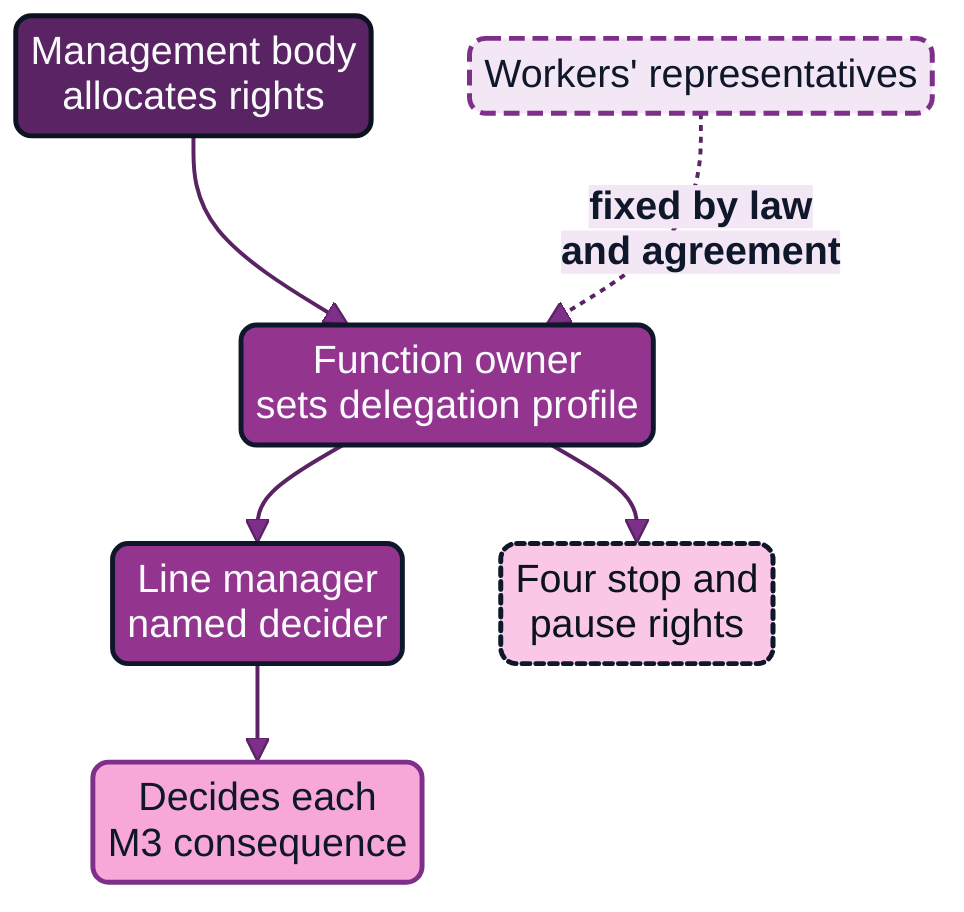
Part IV has shown people managing agents, agents orchestrating agents, mixed teams and the narrowing route into management, and each chapter left open who holds which right. This chapter writes down that allocation per role, function and system, as an artefact that can be read, negotiated, tested and changed. It concerns all five functions: M1 Direction and M2 Evaluation, which may be delegated to AI under conditions; M3 Consequence, where every decision about a person ends with a named human decider; and M4 Development and M5 Care, which stay with the manager and the employer. It also assigns the right to stop or pause the management system itself, and states the book's answers to Q1 and Q2 as rules.
The chapter builds on four earlier conclusions: decision tiers and stop rights named in advance (F17 to F19; AI Governance, Chapter 13) (31, Nordqvist, 2026); named owners and authorities for every machine identity (F51; AI Red Team, Chapter 6) (33, Nordqvist, 2026); the right to stop assigned before the crisis and cheaper to exercise than the right to continue (F63; AI Threat, Chapter 30) (34, Nordqvist, 2026); and roles as versioned artefacts with written decision rights and accountability that cannot be delegated to a system (F73, F74, F78; The Transformed Security Architect, Chapters 4, 17 and 18) (36, Nordqvist, 2026).
A decision right answers four questions about one class of decision: who may take it, who must be consulted or agree first, who may stop or reverse it, and who answers for it afterwards. In most organisations the answers are spread across policies, agreements, job descriptions and habit, which worked while every decision passed through a line manager who held the rights by default, but not once a system ranks applicants and allocates claims in the gaps between the documents.
Primary topics explored
- Decision rights as an artefact
- Who may delegate
- Direction and evaluation
- Consequence
- Development and care
- Stop and pause
About AI Boss
AI Boss is Book 7 of The Transformed Architecture. It examines what happens when artificial intelligence takes the manager's chair: algorithmic management of direction, evaluation, consequence, development and care, the effects on people, the management of AI agents, Europe's legal answer, and how to design an accountable AI boss, for European enterprises and public authorities.
It builds on the conclusions of Architecture as Code, AI Governance, AI Platform and Security, AI Red Team, AI Threat and The Transformed Security Architect.
Executives, line managers, HR and people leaders, works councils and trade unions, public employers, architects and AI governance leads, data protection and legal officers, procurement and programme leaders, and risk, compliance and audit.

Gunnar Nordqvist
Conceived, directed and published the books of The Transformed Architecture.
Continue with the full chapter
Chapter 20: Decision Rights in the Management Chain: Who May Direct, Evaluate, Reward and Dismiss in AI Boss gives the detailed explanations, practical examples and implementation patterns behind this summary.
This whitepaper belongs to “Managing Machines” and is one of 37 drawn from the manuscript.