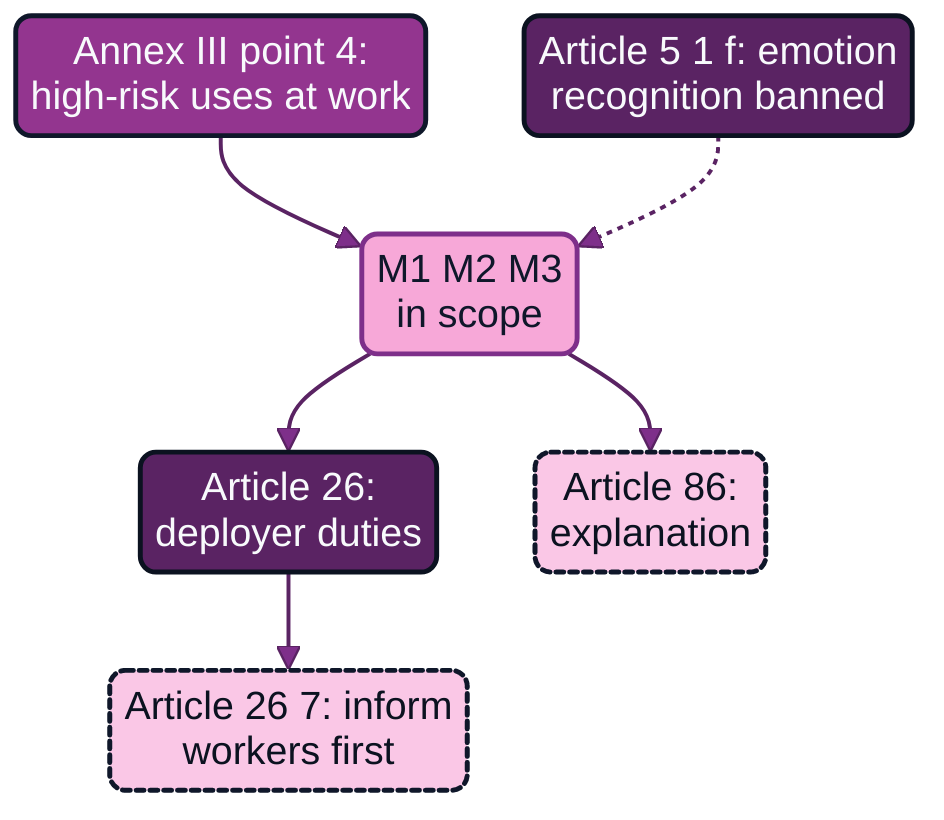
Part V asks what European law already says about the allocation of decision rights that Chapter 20 set out, starting with the instrument that names work most directly. Regulation (EU) 2024/1689, the AI Act, classifies AI used in employment and workers' management as high-risk, prohibits one practice at the workplace outright, places duties on the employer that deploys a high-risk system and gives the people affected a right to an explanation (1, European Union, 2024). Regulation (EU) 2026/1744, the Digital Omnibus on AI, has since changed when most of those duties apply and how AI literacy is framed, while leaving the employment provisions in place (2, European Union, 2026). This chapter reads those provisions as organisational and architectural implications, not legal advice. It concerns M1 Direction, because the Act lists the allocation of tasks; M2 Evaluation, because it lists monitoring and evaluation and prohibits emotion recognition at work; M3 Consequence, because it lists recruitment, promotion, termination and terms of work; and M5 Care, because the duty to inform workers and the prohibition protect voice, health and dignity.
The AI Act regulates by risk and by role: a provider develops an AI system and places it on the market under its own name, and a deployer uses it under its authority (Article 3). An employer that buys a rostering system is a deployer; one that builds its own allocation agent is both. Annex III lists the uses that make a system high-risk, and its point 4 is headed "Employment, workers' management and access to self-employment". Recital 57 gives the reason: such systems "may have an appreciable impact on future career prospects, livelihoods of those persons and workers' rights" and may perpetuate historical patterns of discrimination (1, European Union, 2024); it includes platform workers, so the Act reaches beyond the employment contract.
Recruitment, terms, promotion and termination are M3 Consequence, task allocation M1 Direction, and monitoring and evaluation M2 Evaluation. M4 Development appears only indirectly: the Commission's draft guidelines on classification treat training as falling within point 4(b) where completing it is a condition of promotion, pay or keeping the job (3, European Commission, 2026). M5 Care is not listed, but the Act's other employment provisions protect it: the prohibition of emotion recognition, the duty to inform workers, and Article 2(11), under which the Act does not preclude laws or collective agreements more favourable to workers.
Primary topics explored
- Employment in the AI Act
- Annex III point 4
- The Article 6(3) derogation
- Prohibited at work
- The deployer's duties
- Impact assessment and explanation
About AI Boss
AI Boss is Book 7 of The Transformed Architecture. It examines what happens when artificial intelligence takes the manager's chair: algorithmic management of direction, evaluation, consequence, development and care, the effects on people, the management of AI agents, Europe's legal answer, and how to design an accountable AI boss, for European enterprises and public authorities.
It builds on the conclusions of Architecture as Code, AI Governance, AI Platform and Security, AI Red Team, AI Threat and The Transformed Security Architect.
Executives, line managers, HR and people leaders, works councils and trade unions, public employers, architects and AI governance leads, data protection and legal officers, procurement and programme leaders, and risk, compliance and audit.

Gunnar Nordqvist
Conceived, directed and published the books of The Transformed Architecture.
Continue with the full chapter
Chapter 21: The AI Act at Work: Annex III Point 4, Prohibited Practices and the Deployer's Duties in AI Boss gives the detailed explanations, practical examples and implementation patterns behind this summary.
This whitepaper belongs to “Europe's Answer” and is one of 37 drawn from the manuscript.