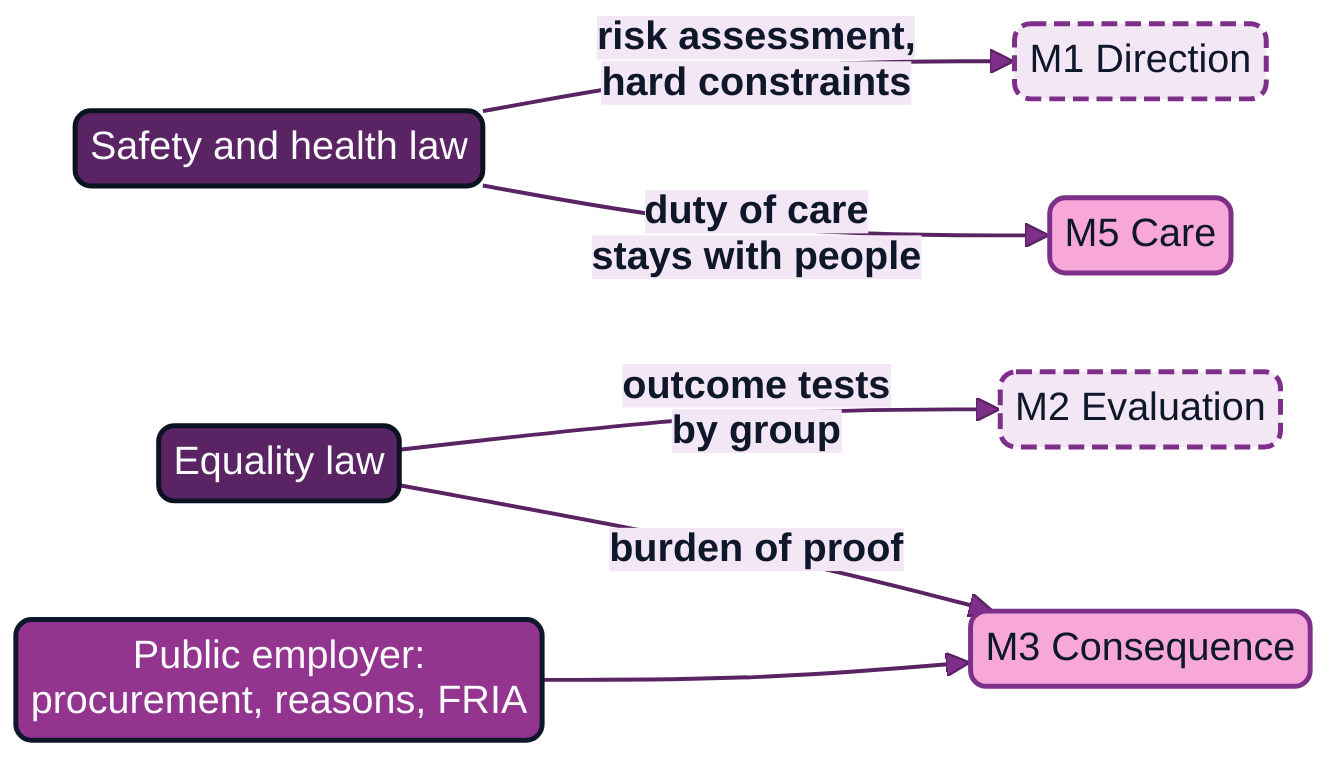
This chapter turns from instruments written for algorithms to three older bodies of law that bind every employer: occupational safety and health law, which makes the employer answerable for the pace algorithmic direction sets; equality law, which makes it answerable for the outcomes of its rules by group, including rules a supplier configured; and, for a public authority, administrative law, the Charter and public procurement. The chapter concerns M5 Care, because safety and health are the duty of care written into law, and M3 Consequence, because pay, promotion, hiring and access to work are where unequal treatment becomes harm; it touches M1 Direction wherever a schedule sets the pace or distributes opportunity. It answers Q10, how a public authority remains a model employer when it procures the AI boss, and Q11, what replaces the manager's judgement in the duty of care.
The three fields are technology-neutral, attach to outcomes whatever their cause, and place the duty on the employer, who cannot pass it to a supplier. The Framework Directive says so in terms: enlisting external services does not discharge the employer from its responsibility (Article 5(2)) (39, Council of the European Communities, 1989). Equality law reaches the same result through the burden of proof, which falls on the employer once a worker shows facts from which discrimination may be presumed (44, Council of the European Union, 2000). An employer therefore needs evidence it can produce itself, and where the system is procured that evidence exists only if the contract requires it.
Chapter 14 assembled the evidence on pace and strain; this section asks what an employer must be able to show.
Primary topics explored
- Three duties that stay with the employer
- Occupational safety and health under algorithmic direction
- Equality and non-discrimination: proxies and the burden of proof
- The public authority as employer
- Procurement as the decisive moment
- Equality testing as a duty written into the delegation profile
About AI Boss
AI Boss is Book 7 of The Transformed Architecture. It examines what happens when artificial intelligence takes the manager's chair: algorithmic management of direction, evaluation, consequence, development and care, the effects on people, the management of AI agents, Europe's legal answer, and how to design an accountable AI boss, for European enterprises and public authorities.
It builds on the conclusions of Architecture as Code, AI Governance, AI Platform and Security, AI Red Team, AI Threat and The Transformed Security Architect.
Executives, line managers, HR and people leaders, works councils and trade unions, public employers, architects and AI governance leads, data protection and legal officers, procurement and programme leaders, and risk, compliance and audit.

Gunnar Nordqvist
Conceived, directed and published the books of The Transformed Architecture.
Continue with the full chapter
Chapter 24: Occupational Safety, Equality Law and the Public Authority as Employer in AI Boss gives the detailed explanations, practical examples and implementation patterns behind this summary.
This whitepaper belongs to “Europe's Answer” and is one of 37 drawn from the manuscript.