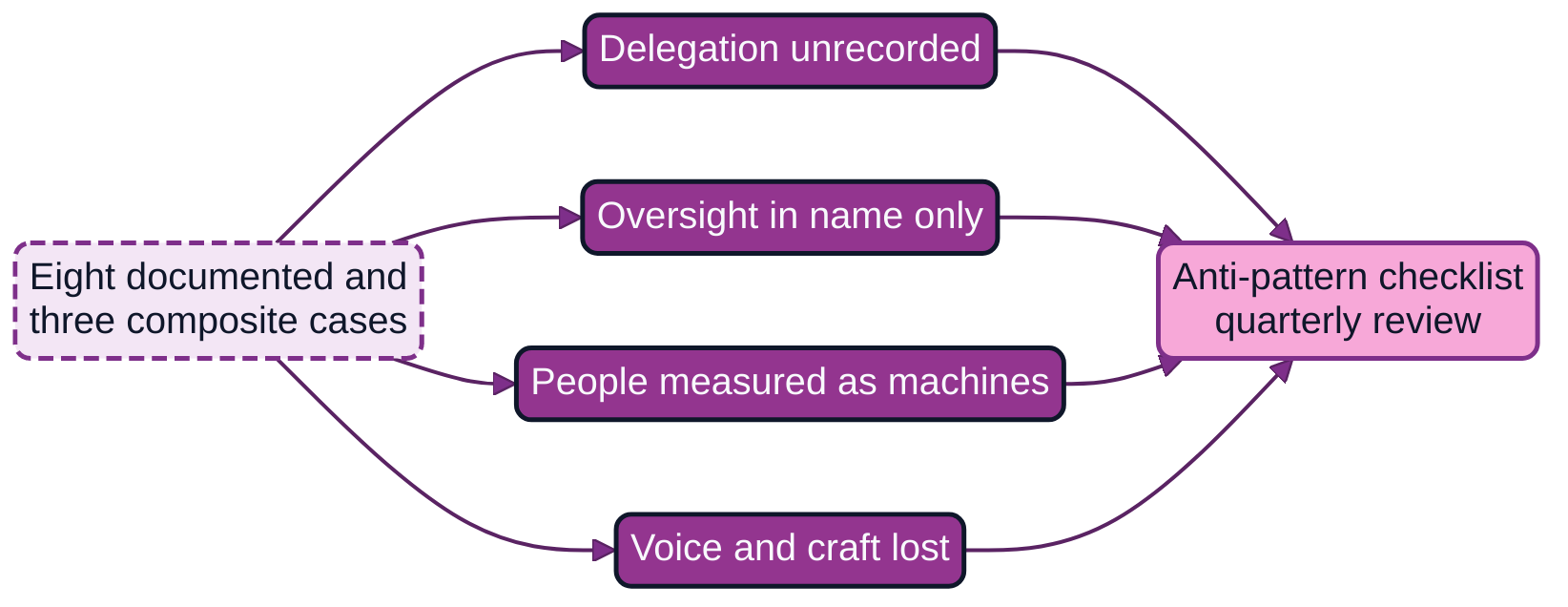
Part VII turns from design to experience. Chapter 30 followed two fictional organisations through a year; this chapter looks at what happened to real ones. It retells eight documented cases in one frame, adds three composite cases, and distils twelve anti-patterns into a checklist that an organisation, a works council or a union can run against its own delegation register. The cases touch all five management functions: M1 Direction in dispatch, pace and allocation, M2 Evaluation in scores and ratings, M3 Consequence in hiring, deactivation and dismissal, M4 Development in the junior work that disappears, and M5 Care in rest, health and voice. Most of the harm sits where a system built for M1 Direction or M2 Evaluation came, without anyone deciding it, to carry M3 Consequence.
An anti-pattern is a reasonable-looking solution that repeatedly produces the same harm. Architecture as Code (Chapter 26B) catalogued the anti-patterns of architecture programmes (30, Nordqvist, 2025), AI Governance, Chapter 20, those of enterprise AI programmes (31, Nordqvist, 2026), and The Transformed Security Architect, Chapter 24, those of a security architecture practice (36, Nordqvist, 2026); this chapter does the same for the AI boss.
The eight real cases are observable and draw on sources earlier chapters cite; several are reports, not judgments. Each states the degree of delegation as observed, which is often higher than the one recorded (Chapter 4), what was missing and the lesson as a rule. The three composite cases are illustrative: invented organisations combining patterns from earlier chapters.
Primary topics explored
- How to read the cases
- Eight documented cases
- Three composite cases
- The anti-patterns
- Reviewing against the checklist
- Summary
About AI Boss
AI Boss is Book 7 of The Transformed Architecture. It examines what happens when artificial intelligence takes the manager's chair: algorithmic management of direction, evaluation, consequence, development and care, the effects on people, the management of AI agents, Europe's legal answer, and how to design an accountable AI boss, for European enterprises and public authorities.
It builds on the conclusions of Architecture as Code, AI Governance, AI Platform and Security, AI Red Team, AI Threat and The Transformed Security Architect.
Executives, line managers, HR and people leaders, works councils and trade unions, public employers, architects and AI governance leads, data protection and legal officers, procurement and programme leaders, and risk, compliance and audit.

Gunnar Nordqvist
Conceived, directed and published the books of The Transformed Architecture.
Continue with the full chapter
Chapter 31: Case Studies and Anti-Patterns in AI Boss gives the detailed explanations, practical examples and implementation patterns behind this summary.
This whitepaper belongs to “Experience and Verdict” and is one of 37 drawn from the manuscript.