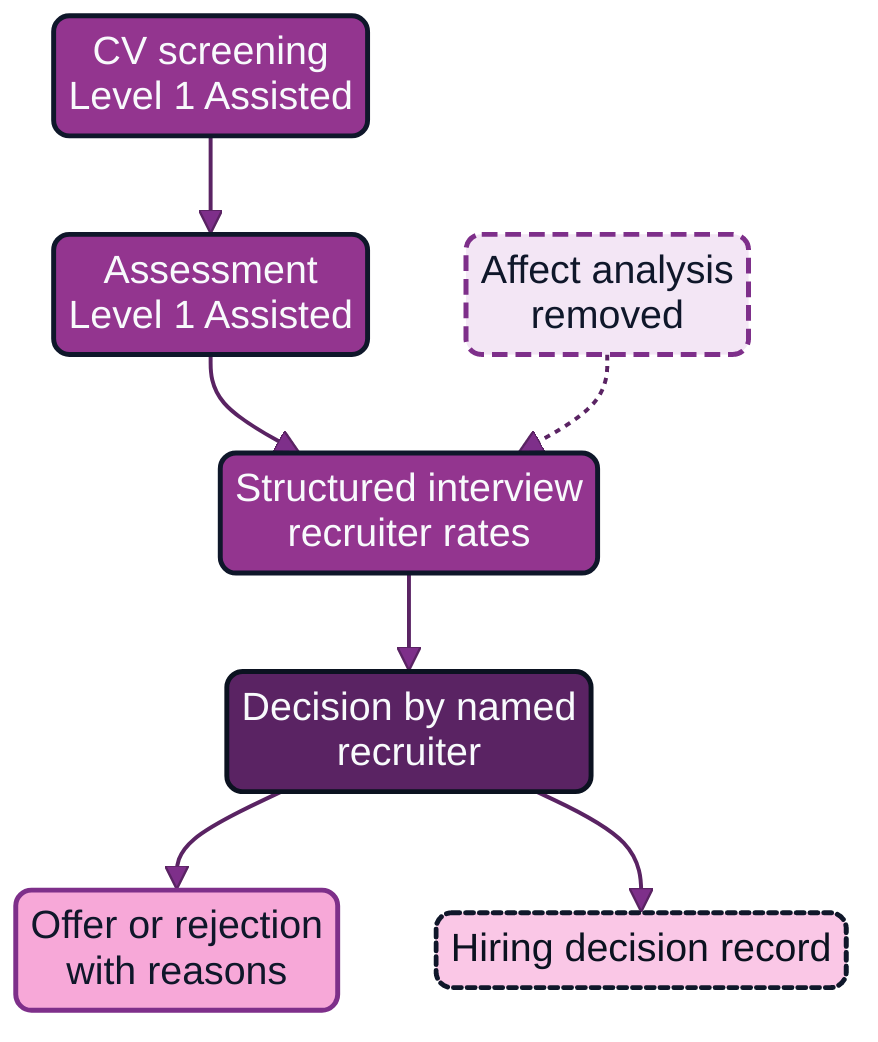
Hiring is where most people first meet the AI boss, often before they know who the human boss will be. A job advertisement is shown to some people and not to others, an applicant-tracking system ranks the applications, an online test scores the shortlist, and a video-interview platform turns a recorded conversation into a number. Together these steps shape who gets access to work, which is why this chapter treats hiring as M3 Consequence; the ranking and scoring along the way are M2 Evaluation of people who are not yet employees and often do not know that a system read their application. The chapter describes the automated funnel, its documented failures, the record of human recruiters, the limits of audits, the AI Act and co-determination over selection guidelines, and ends with how a recruiter keeps the decision and the record rather than signing a ranking.
AI now appears at all five stages of hiring: targeted advertising selects who sees the vacancy; applicant-tracking modules parse and rank CVs; assessments are scored by models trained on past employees; one-way video interviews are transcribed and scored, in some products with analysis of voice and face; and a chatbot communicates the decision.
The AI Act names this funnel. Annex III, point 4(a), lists as high-risk "AI systems intended to be used for the recruitment or selection of natural persons, in particular to place targeted job advertisements, to analyse and filter job applications, and to evaluate candidates" (1, European Union, 2024), and the Commission's draft guidelines of May 2026 read selection to cover "the analysis of applications, automated shortlisting, scoring, ranking, or assigning predictive scores of job suitability" (3, European Commission, 2026).
Primary topics explored
- The automated funnel
- What went wrong, documented
- Human discretion as the baseline
- Audits and their limits
- Annex III point 4(a)
- No emotion recognition
About AI Boss
AI Boss is Book 7 of The Transformed Architecture. It examines what happens when artificial intelligence takes the manager's chair: algorithmic management of direction, evaluation, consequence, development and care, the effects on people, the management of AI agents, Europe's legal answer, and how to design an accountable AI boss, for European enterprises and public authorities.
It builds on the conclusions of Architecture as Code, AI Governance, AI Platform and Security, AI Red Team, AI Threat and The Transformed Security Architect.
Executives, line managers, HR and people leaders, works councils and trade unions, public employers, architects and AI governance leads, data protection and legal officers, procurement and programme leaders, and risk, compliance and audit.

Gunnar Nordqvist
Conceived, directed and published the books of The Transformed Architecture.
Continue with the full chapter
Chapter 7: Hiring by Machine: Screening, Scoring and Automated Interviews in AI Boss gives the detailed explanations, practical examples and implementation patterns behind this summary.
This whitepaper belongs to “The AI Boss Today” and is one of 37 drawn from the manuscript.