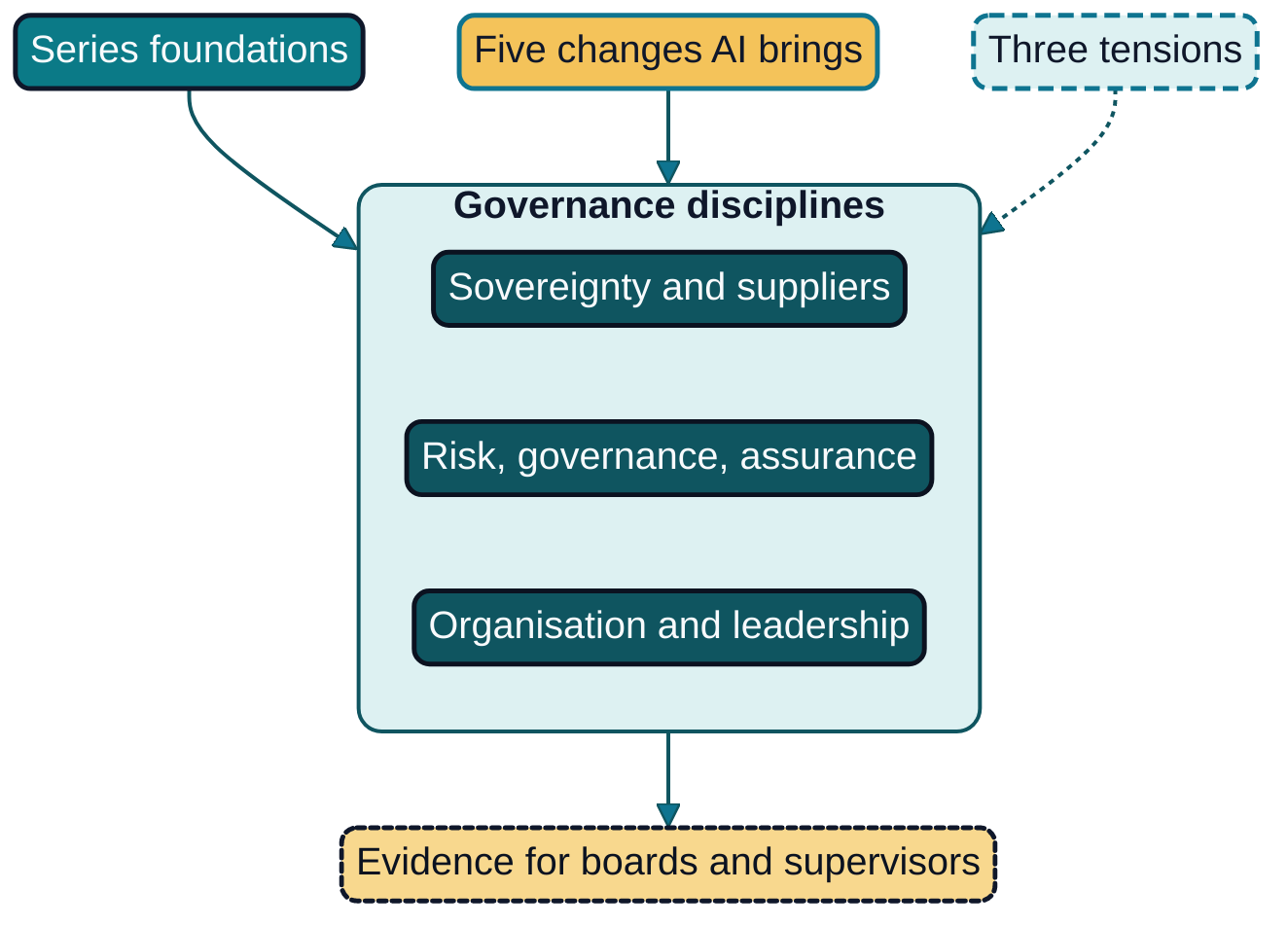
AI governance is the system of decisions, controls and evidence through which an organisation keeps its use of artificial intelligence within the intent it has declared. This chapter sets out what that discipline is, why AI breaks the assumptions of classical IT governance, and why European organisations feel the break sharply. It introduces three recurring tensions, the six usage modes of large language models and the two fictional organisations that run through the book, and it places the book within The Transformed Architecture.
Failed AI governance programmes usually mistake one part of governance for the whole. AI governance is not a committee, because a forum that meets monthly cannot govern systems that change weekly. It is not a policy binder, because a policy that no control enforces is a statement of hope. It is not an ethics statement: the OECD Recommendation on Artificial Intelligence and the Council of Europe Framework Convention give a sound vocabulary for values (22, OECD, 2019), (21, Council of Europe, 2024), but a commitment to fairness says nothing about which system was tested against which threshold, with what result. Nor is it legal compliance alone, since many decisions that matter most, such as which assistant staff may use or how much authority an agent receives, fall outside the AI Act's high-risk categories.
Governance is the connection between those parts: the system that turns intent into decisions, decisions into controls and controls into evidence, and that feeds the evidence back to the people who must answer for the result. ISO/IEC 42001 describes an AI management system in similar terms, as the policies, objectives, processes, roles and controls through which an organisation directs its AI (32, ISO/IEC, 2023). However, the standard is deliberately silent on implementation, which is where most programmes falter.
Primary topics explored
- What AI governance is, and what it is not
- Why AI breaks the assumptions of classical IT governance
- The European context
- Six usage modes in brief
- Three recurring tensions
- Purpose, readers and scope of this book
About AI Governance
AI Governance is Book 2 of The Transformed Architecture. It shows how large European enterprises and public authorities decide what artificial intelligence is used for, classify and manage its risks, meet the obligations of the EU AI Act and its neighbours, choose and contract their suppliers, organise the forums that take decisions, and produce the evidence that shows it is all true.
It builds on the conclusions of Architecture as Code.
Chief risk and compliance officers, AI governance boards, CIOs and chief architects, and senior officials in public authorities.

Gunnar Nordqvist
Conceived, directed and published the books of The Transformed Architecture.
Continue with the full chapter
Chapter 1: Introduction to AI Governance in AI Governance gives the detailed explanations, practical examples and implementation patterns behind this summary.
This whitepaper belongs to “Foundations” and is one of 32 drawn from the manuscript.