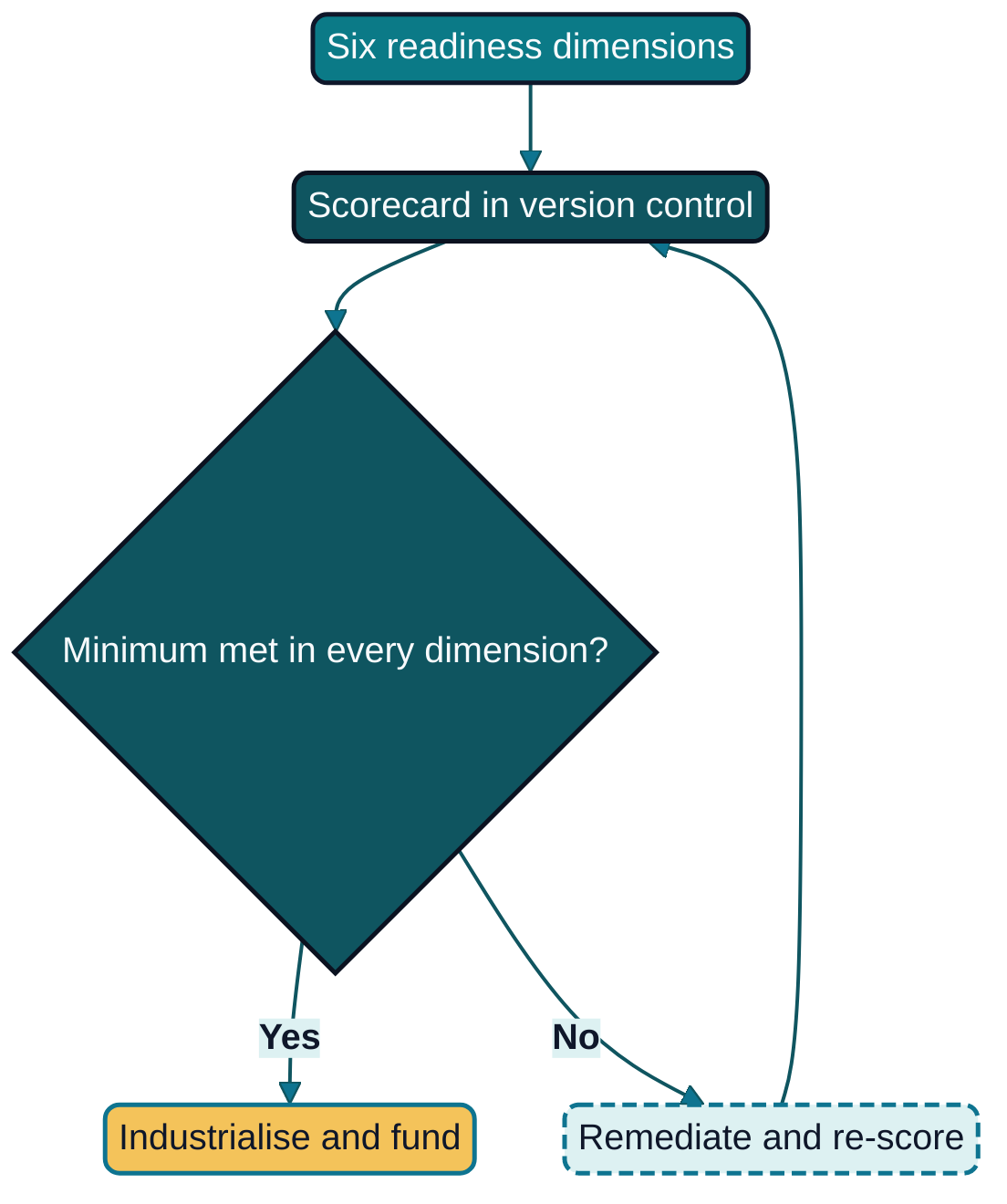
Most organisations that struggle with AI do not fail at modelling. They fail because they committed budget to industrialising AI before their data, platform, governance, skills or culture could carry the load. This chapter gives a structured way to judge readiness before the money is spent, against the standard that Chapters 3 and 4 have set. It examines six dimensions, draws out the requirements specific to public authorities, and codifies the assessment as a scorecard that lives in version control. The approach extends the readiness guide in Architecture as Code (Chapter 26A), which asked the same question of architecture practice in general (66, Nordqvist, 2025).
Paleyes, Urma and Lawrence (2022) found that difficulties in published machine learning deployments cluster at every lifecycle stage, from data management to deployment, trust and security (55, Paleyes et al., 2022), and Sculley et al. (2015) that the model code is a small fraction of a production system (48, Sculley et al., 2015). The difficulties lie in the organisation around the model. In the pattern I see, a pilot succeeds because a motivated team worked around every missing prerequisite by hand, is approved for scale, and the workarounds collapse. The readiness assessment makes them visible before the scale decision: it is not a maturity ranking but a list of the things that will break.
Data readiness is the dimension most often overestimated, because every organisation has a great deal of data and very few have data ready to train or ground a model.
Primary topics explored
- Why readiness comes before budget
- Data readiness
- Platform readiness
- Governance readiness
- Skills readiness
- Cultural readiness
About AI Governance
AI Governance is Book 2 of The Transformed Architecture. It shows how large European enterprises and public authorities decide what artificial intelligence is used for, classify and manage its risks, meet the obligations of the EU AI Act and its neighbours, choose and contract their suppliers, organise the forums that take decisions, and produce the evidence that shows it is all true.
It builds on the conclusions of Architecture as Code.
Chief risk and compliance officers, AI governance boards, CIOs and chief architects, and senior officials in public authorities.

Gunnar Nordqvist
Conceived, directed and published the books of The Transformed Architecture.
Continue with the full chapter
Chapter 5: Prerequisites and Readiness for Enterprise AI in AI Governance gives the detailed explanations, practical examples and implementation patterns behind this summary.
This whitepaper belongs to “Foundations” and is one of 32 drawn from the manuscript.