A pipeline that applies a rule identically to every change proves consistency, not soundness. This chapter turns from enforcement to substance: what a fair system, an intelligible output and an effective human intervention require. It takes the seven requirements of the European Commission's High-Level Expert Group as its frame, works through transparency and explainability, examines fairness metrics and the trade-offs between them, and describes the human oversight patterns that Article 14 of Regulation (EU) 2024/1689 (the AI Act) expects, closing with a fairness configuration, an oversight design, and a fundamental rights impact assessment that belong in version control. The underlying conviction is the one that runs through Architecture as Code: a requirement that cannot be expressed as an artefact in the repository will not survive contact with a delivery schedule (66, Nordqvist, 2025).
The Ethics Guidelines for Trustworthy AI, published by the High-Level Expert Group on Artificial Intelligence in 2019, state that trustworthy AI is lawful, ethical, and robust, and set out seven requirements: human agency and oversight; technical robustness and safety; privacy and data governance; transparency; diversity, non-discrimination and fairness; societal and environmental well-being; and accountability (12, AI HLEG, 2019). The Assessment List for Trustworthy AI (ALTAI) of 2020 turns each requirement into questions a team can answer about a specific system (13, AI HLEG, 2020). The guidelines are not law, but they shaped the AI Act. UNESCO's Recommendation on the Ethics of Artificial Intelligence of 2021 sets out comparable values (29, UNESCO, 2021), and its Ethical Impact Assessment, aimed particularly at governments procuring or deploying AI, can be run alongside ALTAI (31, UNESCO, n.d.).
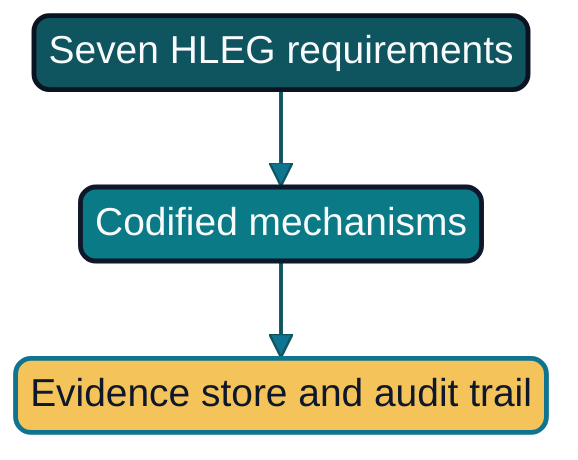
The architectural task is to attach a mechanism and an evidence source to each requirement, as Figure 10.1 does. Human agency becomes an override path, a stop path, and a role; robustness becomes an evaluation suite and runtime guardrails; privacy becomes data contracts and data protection impact assessment (DPIA) records; transparency becomes model cards, disclosure, and content marking; fairness becomes a fairness configuration with thresholds; well-being becomes the impact assessment of Chapter 8 and an energy budget; and accountability becomes the evidence store of Chapter 11. This chapter concentrates on the three that most often lack a mechanism in practice: transparency, fairness, and oversight.
Primary topics explored
- The seven requirements as design input
- Transparency and explainability
- What the system does
- What the system does not do
- What information is used
- Your rights
About AI Governance
AI Governance is Book 2 of The Transformed Architecture. It shows how large European enterprises and public authorities decide what artificial intelligence is used for, classify and manage its risks, meet the obligations of the EU AI Act and its neighbours, choose and contract their suppliers, organise the forums that take decisions, and produce the evidence that shows it is all true.
It builds on the conclusions of Architecture as Code.
Chief risk and compliance officers, AI governance boards, CIOs and chief architects, and senior officials in public authorities.

Gunnar Nordqvist
Conceived, directed and published the books of The Transformed Architecture.
Continue with the full chapter
Chapter 10: Trustworthy AI: Transparency, Fairness and Human Oversight in AI Governance gives the detailed explanations, practical examples and implementation patterns behind this summary.
This whitepaper belongs to “Risk, Governance, Trust and Assurance” and is one of 32 drawn from the manuscript.