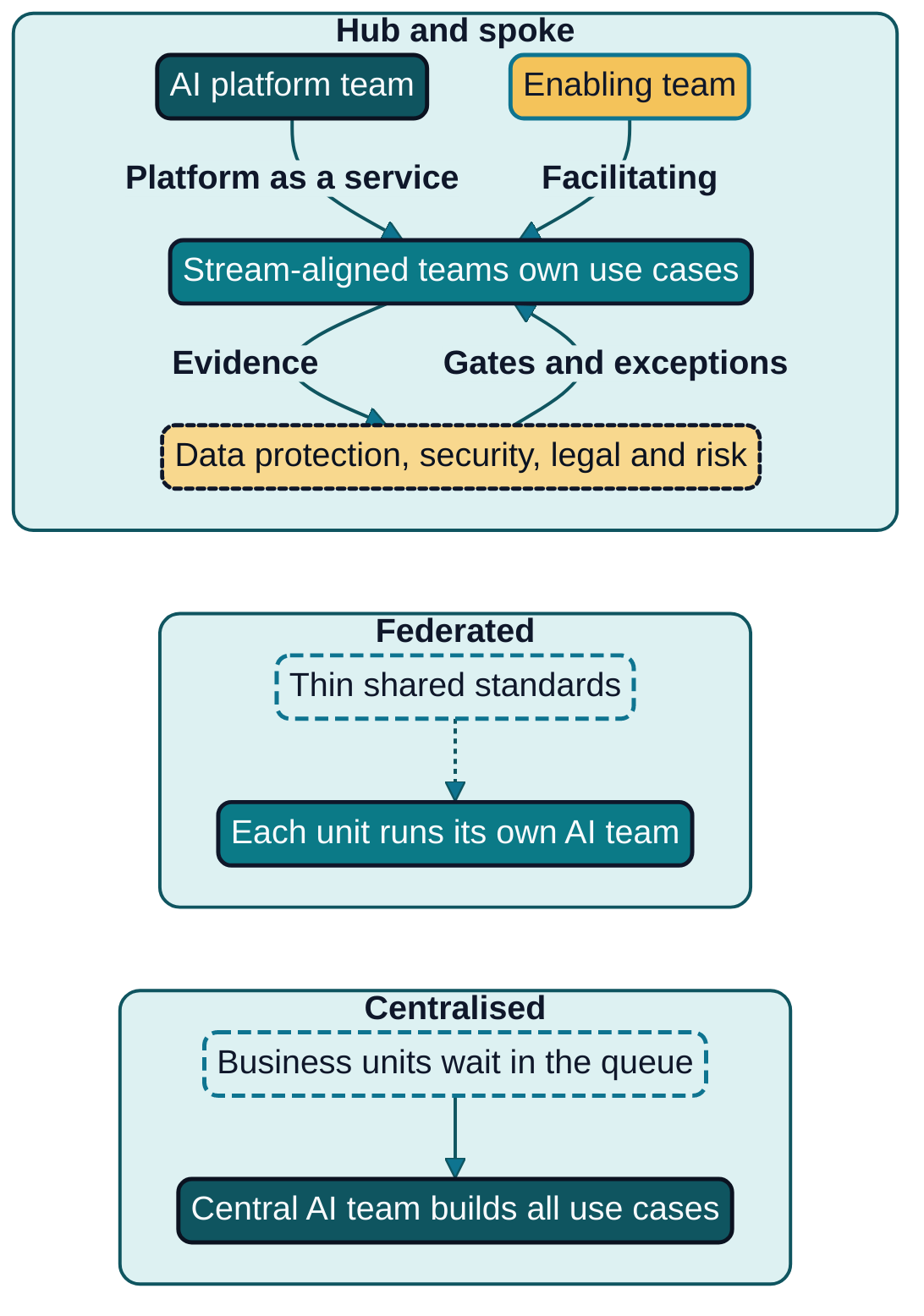
Every item of the evidence that Chapter 11 described is produced by someone in a role, inside a team, under a reporting line, and Part IV turns to that organisation, beginning with its shape. An AI programme fails organisationally long before it fails technically: the platform is sound and the models evaluate well, yet nothing ships, because nobody can say who owns the use case, who may approve it, or who answers when it misbehaves. This chapter describes the operating models, the platform and enabling teams, and the place of the control functions. It ends with a team topology and a responsibility matrix expressed as code, because an operating model that exists only in an organisation chart cannot be tested.
Conway (1968) observed that organisations design systems whose structure copies their communication structure (59, Conway, 1968), and Architecture as Code (Chapter 17) applied the observation to infrastructure and platform teams (66, Nordqvist, 2025). AI systems obey the law with unusual fidelity because their data, models, infrastructure, policies and oversight are owned by different groups. Where those groups do not talk, the seam that is missing in the organisation is the one that fails in production.
A citizen-facing assistant built by a digital team with a vendor's model and a records office's documents typically lacks lineage and version trace, and the data protection officer learns of it at launch, not because anybody chose that design but because the organisation had no place where those concerns met. Organisational design for AI creates those places on purpose and codifies them so that they persist when people move on.
Primary topics explored
- Conway's law applied to AI
- Three operating models
- The AI platform team and enabling teams
- Enablement team will
- Enablement team will not
- Exit criteria (all required)
About AI Governance
AI Governance is Book 2 of The Transformed Architecture. It shows how large European enterprises and public authorities decide what artificial intelligence is used for, classify and manage its risks, meet the obligations of the EU AI Act and its neighbours, choose and contract their suppliers, organise the forums that take decisions, and produce the evidence that shows it is all true.
It builds on the conclusions of Architecture as Code.
Chief risk and compliance officers, AI governance boards, CIOs and chief architects, and senior officials in public authorities.

Gunnar Nordqvist
Conceived, directed and published the books of The Transformed Architecture.
Continue with the full chapter
Chapter 12: Organisational Design for AI in AI Governance gives the detailed explanations, practical examples and implementation patterns behind this summary.
This whitepaper belongs to “Organisation and Leadership” and is one of 32 drawn from the manuscript.