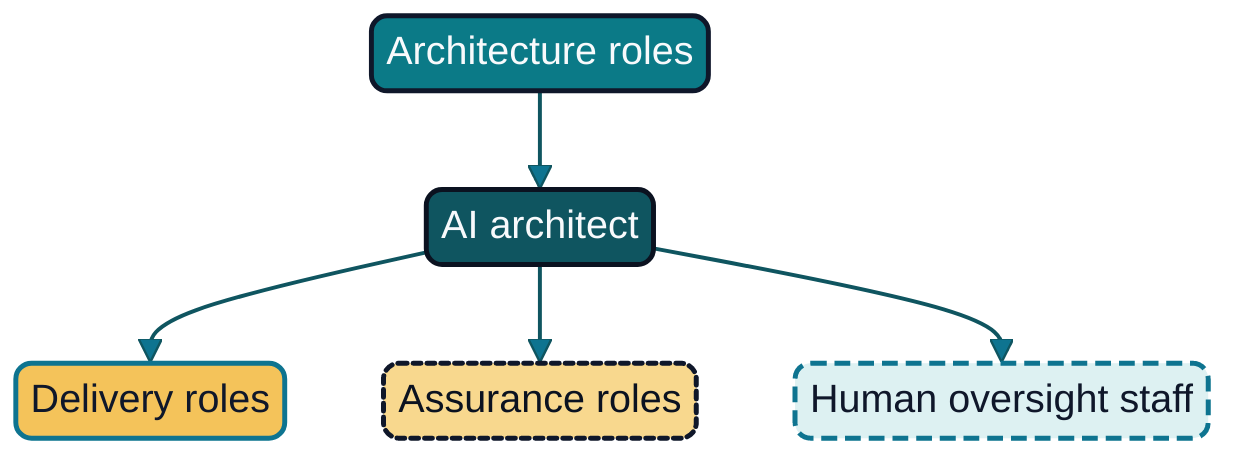
The operating model of Chapter 12 names teams and gates, and the forums of Chapter 13 name the bodies that decide; this chapter names the people in them. Large organisations adopting AI discover that the scarce resource is not compute or budget but competence: the ability to decide which model is good enough, to read a model card critically, to design an oversight path a caseworker will use, and to tell a supervisory authority what the system does. This chapter defines the AI architect and the delivery and assurance roles around it, sets out the AI literacy obligation of Article 4 of Regulation (EU) 2024/1689, the AI Act, and offers a competence framework as code before asking whether to hire or to upskill.
Every organisation that has industrialised AI has someone doing the AI architect's job, because AI systems cut across the boundaries of the existing architecture roles. The enterprise architect owns the target landscape, the solution architect one system, the data architect the data estate and the security architect the threat model. An AI system needs all four and adds a fifth concern none of them owns: the model as a derived, probabilistic, degrading component whose behaviour must be evaluated rather than specified.
The AI architect owns the architectural treatment of that fifth concern. In practice this means owning the AI Decision Records for a portfolio of use cases, applying the organisation's reference architecture to each, defining the evaluation strategy that decides whether a model is acceptable, contributing technical input to risk classification (Chapter 8), and designing the human oversight path that Article 14 of the AI Act requires providers to build into high-risk systems and Article 26(2) requires deployers to staff. The AI architect also holds the three tensions of Chapter 1, speed against control, autonomy against accountability and innovation against sovereignty, and makes them explicit in each decision rather than leaving them to whoever shouts loudest. This chapter treats the role as a governance position, accountable for the decisions rather than for the tooling.
Primary topics explored
- The AI architect
- Delivery and assurance roles
- Accountabilities
- Decision rights
- Does not
- Competence and literacy (AI Act Article 4)
About AI Governance
AI Governance is Book 2 of The Transformed Architecture. It shows how large European enterprises and public authorities decide what artificial intelligence is used for, classify and manage its risks, meet the obligations of the EU AI Act and its neighbours, choose and contract their suppliers, organise the forums that take decisions, and produce the evidence that shows it is all true.
It builds on the conclusions of Architecture as Code.
Chief risk and compliance officers, AI governance boards, CIOs and chief architects, and senior officials in public authorities.

Gunnar Nordqvist
Conceived, directed and published the books of The Transformed Architecture.
Continue with the full chapter
Chapter 14: Competence, Roles and the AI Architect in AI Governance gives the detailed explanations, practical examples and implementation patterns behind this summary.
This whitepaper belongs to “Organisation and Leadership” and is one of 32 drawn from the manuscript.