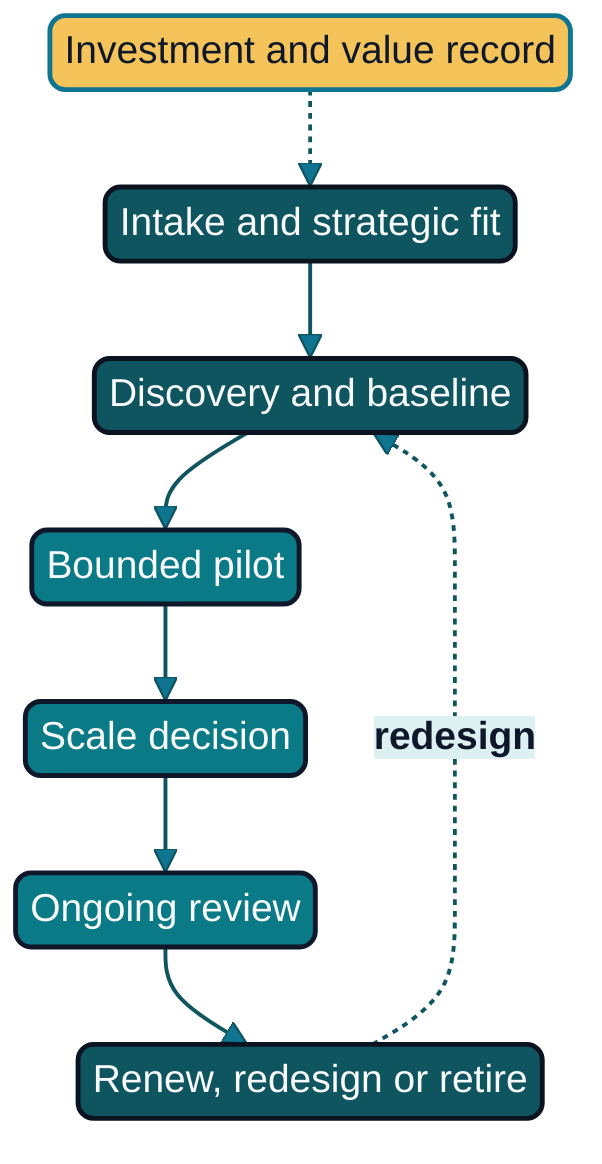
Chapter 16 gave the AI portfolio a version-controlled register, falsifiable value hypotheses and evidence-gated funding tranches. This companion chapter answers the question that register exists to settle: whether to fund, continue, scale, constrain or stop an AI system when its costs are variable and its benefits uncertain. Classical IT investment appraisal assumed a licence fee known in advance and a benefit estimated once. Neither holds for systems built on large language models, whose cost follows consumption and whose benefit is a hypothesis until measured in production. The chapter treats this as a governance problem: who owns the money, what evidence each decision needs, which gates an investment passes through, how to compare an AI system fairly with the alternatives, and how public bodies should think about value when success cannot be a margin. Metering, quotas, routing and caching appear only as controls that a decision depends on.
A conventional application costs roughly the same to run whether it is used lightly or heavily. A system built on a large language model is priced by what it consumes, and that is decided at run time by the length of each request, the model that answers it, the number of attempts and the number of users. The FinOps Foundation lists the pricing models an organisation meets: on-demand pricing per token, call or hour; provisioned capacity billed whether used or not; and commitment discounts (207, FinOps Foundation, 2026). An organisation that budgets for AI as for office software will be surprised either by a bill it did not forecast or by reserved capacity it did not use. Each driver of variability needs its own control.
"Tokenomics" also names the economics of cryptocurrency, with which this subject has nothing to do. Storment defines token economics as the discipline through which AI consumption is metered, attributed and connected to business outcomes, a token in AI being a unit of computation, not of ownership (209, Storment, 2026), and this book uses the term in that sense only. FinOps, in the Foundation's definition, is an operational framework and cultural practice that maximises the business value of technology and creates financial accountability through collaboration between engineering, finance and business teams (208, FinOps Foundation, n.d.). The Foundation's 2026 survey shows how quickly this became mainstream: 98 per cent of respondents managed AI spend, up from 31 per cent two years earlier, and the challenges they named were visibility, allocation and determining AI value (211, FinOps Foundation, 2026).
Primary topics explored
- Why AI costs run away
- Why a demonstration is not evidence of value
- Who owns the money and who decides
- The investment gate lifecycle
- Controls that keep spend inside intent
- Handling uncertain benefits honestly
About AI Governance
AI Governance is Book 2 of The Transformed Architecture. It shows how large European enterprises and public authorities decide what artificial intelligence is used for, classify and manage its risks, meet the obligations of the EU AI Act and its neighbours, choose and contract their suppliers, organise the forums that take decisions, and produce the evidence that shows it is all true.
It builds on the conclusions of Architecture as Code.
Chief risk and compliance officers, AI governance boards, CIOs and chief architects, and senior officials in public authorities.

Gunnar Nordqvist
Conceived, directed and published the books of The Transformed Architecture.
Continue with the full chapter
Chapter 16A: Governing AI Economics: Cost, Value and Portfolio Decisions in AI Governance gives the detailed explanations, practical examples and implementation patterns behind this summary.
This whitepaper belongs to “Organisation and Leadership” and is one of 32 drawn from the manuscript.