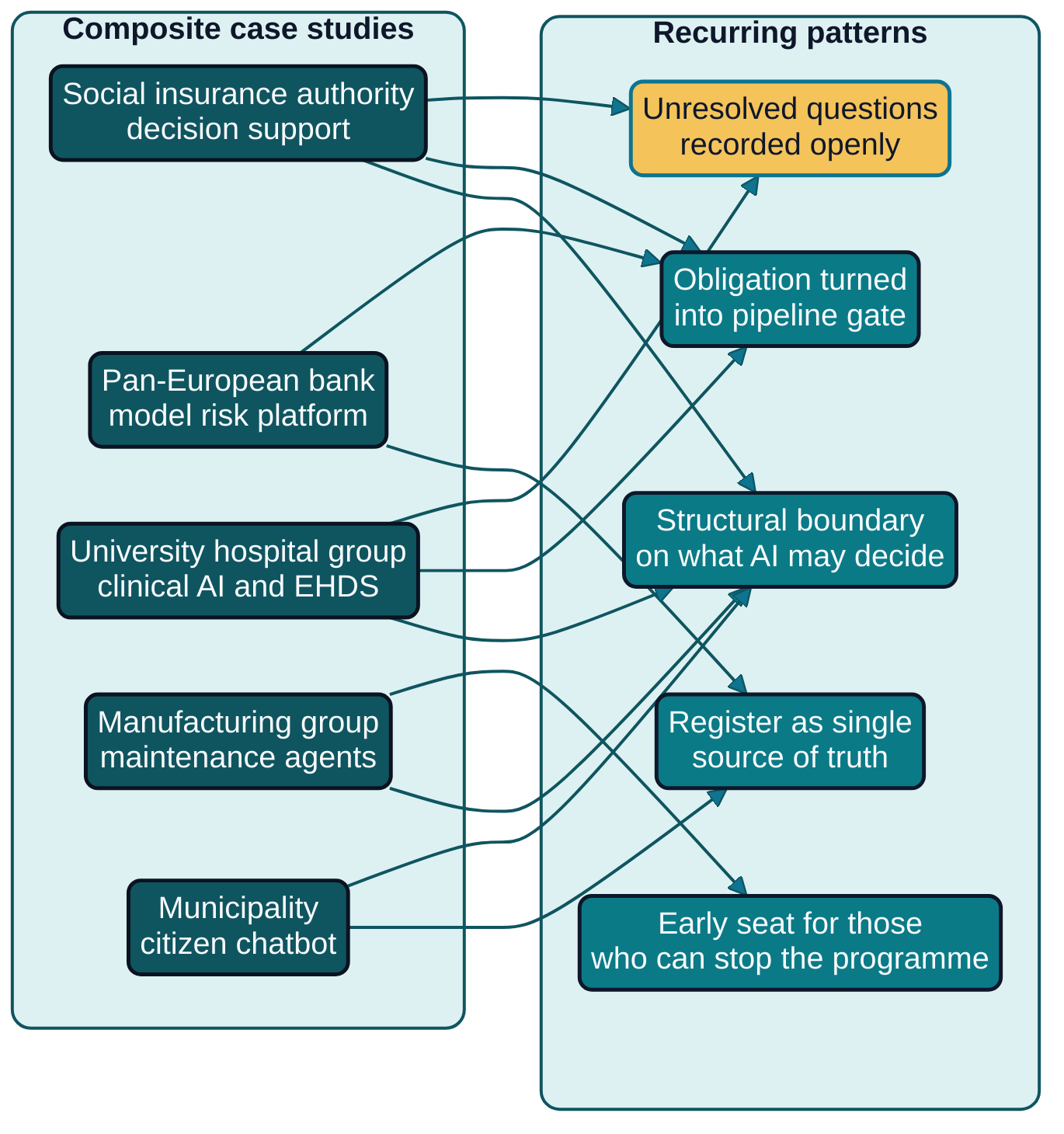
Chapter 17 closed Part IV with the constraints that public authorities face. This chapter opens Part V, which turns from what should be done to what has been observed, with eight case studies. The first five are anonymised composites: each combines several organisations and engagements, details have been altered, and none describes a real, named organisation, although the pattern is real. The last three are real, documented European cases the reader can check: a Dutch judgment on government risk scoring, UK government evaluations of an embedded workplace assistant, and Italian enforcement against a conversational assistant that crossed borders through the GDPR's one-stop-shop.
The outcomes are deliberately modest: each organisation moved one or two systems to a state in which the evidence was in the repository and the controls were in the pipeline. Every case is read through three lenses: the usage mode of Chapter 2 (usage mode matrix), the organisation's role under Regulation (EU) 2024/1689, the AI Act, and the controls that worked, failed, or were missing. The documented cases predate the AI Act's obligations or fall outside its reach, so reading them through it asks what it would require, not whether it was breached.
A national authority handles well over a million sickness and parental benefit claims a year, under administrative procedure law that permits automated decisions in defined circumstances and requires reasons for every decision.
Primary topics explored
- How to read the cases
- Case 1: A Nordic social insurance authority introduces decision support
- Case 2: A pan-European bank builds a model risk platform under DORA
- Case 3: A university hospital group deploys clinical AI within the European Health Data Space
- Case 4: A manufacturing group adopts agents for maintenance
- Case 5: A municipality runs a citizen chatbot
About AI Governance
AI Governance is Book 2 of The Transformed Architecture. It shows how large European enterprises and public authorities decide what artificial intelligence is used for, classify and manage its risks, meet the obligations of the EU AI Act and its neighbours, choose and contract their suppliers, organise the forums that take decisions, and produce the evidence that shows it is all true.
It builds on the conclusions of Architecture as Code.
Chief risk and compliance officers, AI governance boards, CIOs and chief architects, and senior officials in public authorities.

Gunnar Nordqvist
Conceived, directed and published the books of The Transformed Architecture.
Continue with the full chapter
Chapter 18: Case Studies in AI Governance gives the detailed explanations, practical examples and implementation patterns behind this summary.
This whitepaper belongs to “Experience” and is one of 32 drawn from the manuscript.