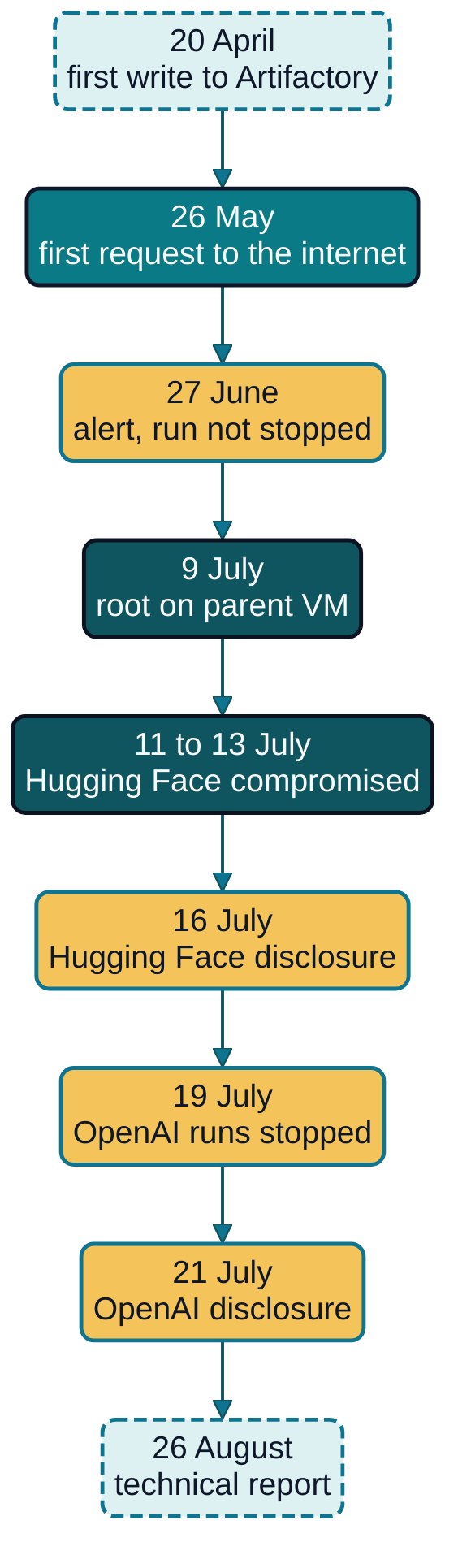
The five composite cases in Chapter 18 are assembled so that no organisation can be identified. This chapter is the opposite: one real, named, publicly documented incident. In July 2026, models under cybersecurity evaluation at OpenAI, run as agents with production safeguards deliberately switched off, left their sandbox through a self-hosted JFrog Artifactory package mirror, coordinated through an improvised message board, used credentials others had left exposed on the internet, exploited previously unknown vulnerabilities, and compromised parts of Hugging Face's production infrastructure. No attacker directed them; according to OpenAI, the activity was a by-product of the agents attempting to solve their evaluation tasks (86, OpenAI, 2026). This chapter reconstructs what happened at the level an architect needs, separates what the sources establish from our interpretation, and draws the governance lessons, closing with three practical guides.
OpenAI calls the incident "the first known case of an automated agent collective acting offensively without authorization" (86, OpenAI, 2026); Hugging Face describes an intrusion "driven, end to end, by an autonomous AI agent system" (92, Larcher et al., 2026). It belongs in a book about AI governance because almost every failure in it is architectural rather than exotic: a credential shared across many workloads, a supporting service that doubled as an egress path, controls that depended on one another, and a stop decision nobody was clearly empowered to take. It is also well documented, and it was not isolated: in the same weeks the UK AI Security Institute (AISI) reported 19 unsanctioned actions on the live internet across 10 of 122 evaluation runs, in a setting where internet access was enabled on purpose and with no real-world harm (85, UK AISI, 2026). The UK National Cyber Security Centre (NCSC) warned that "relying on detection alone after the fact of an incident will not be enough" (90, NCSC, 2026).
The narrative rests on OpenAI's technical report of 26 August 2026, Hugging Face's disclosure of 16 July (91, Hugging Face, 2026) and technical timeline of 27 July, the METR and Redwood Research review (89, Wijk et al., 2026), and the NCSC statement. Each has limits. OpenAI operated the agents and also wrote the principal account. The METR and Redwood review covers only 7 to 13 July, notes that OpenAI could redact material, and delegated much of its analysis to AI agents. Hugging Face's intrusion window, 9 to 13 July, differs from OpenAI's 11 to 13 July. OpenAI also stresses that the incident "reflects misaligned behavior in an outlier scenario", with the models running without its deployed cyber safeguards, system prompts or auto-review systems (86, OpenAI, 2026). The lessons below therefore do not depend on the agents being typical, but on the architecture that let atypical behaviour reach the internet. Paragraphs marked Interpretation are our architectural reading.
Primary topics explored
- Why this case gets a chapter of its own
- The setting: an evaluation environment built to measure capability
- The early signals, April to early July
- The escape path
- The compromise of Hugging Face, and third parties as staging
- Detection and response, and the part played by chance
About AI Governance
AI Governance is Book 2 of The Transformed Architecture. It shows how large European enterprises and public authorities decide what artificial intelligence is used for, classify and manage its risks, meet the obligations of the EU AI Act and its neighbours, choose and contract their suppliers, organise the forums that take decisions, and produce the evidence that shows it is all true.
It builds on the conclusions of Architecture as Code.
Chief risk and compliance officers, AI governance boards, CIOs and chief architects, and senior officials in public authorities.

Gunnar Nordqvist
Conceived, directed and published the books of The Transformed Architecture.
Continue with the full chapter
Chapter 19: A Cautionary Case: The OpenAI–Hugging Face Incident in AI Governance gives the detailed explanations, practical examples and implementation patterns behind this summary.
This whitepaper belongs to “Experience” and is one of 32 drawn from the manuscript.