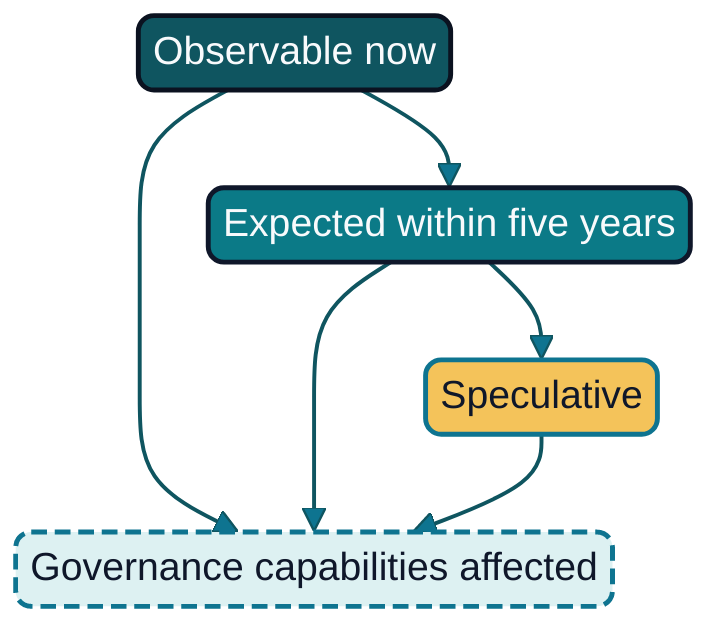
Part V tested the book's argument against practice, and Chapter 21 distilled what works today. Part VI turns to what comes next. This chapter looks at the developments most likely to reshape AI governance over the next five years, as an analytical outlook rather than a forecast. Each section separates what can be observed today, with sources, from what can be expected and from what is speculation, and the chapter ends with a horizon register that puts the outlook under version control.
This chapter borrows the architecture radar practice of Architecture as Code (Chapter 25) (66, Nordqvist, 2025): state each trend, classify the evidence, assign a horizon, name the decision it affects, and set a review date. Three horizons are used. Observable covers developments already visible in adopted legislation, published guidance, cited standards or production systems; expected covers developments with strong evidence but uncertain timing or form within five years; and speculation covers developments that are plausible and consequential but not yet evidenced.
The labels matter because a governance arrangement built on a speculative trend should be reversible, while one built on an observable trend may be committed to. A date in adopted legislation is observable, but a date in a Commission proposal is not, as the Digital Omnibus showed when the co-legislators replaced the Commission's proposed mechanism with fixed dates. The author's own projections, which go further than the evidence, are kept for Chapter 24 (Reflections on Each Part).
Primary topics explored
- Reading an outlook responsibly
- The AI Act's remaining phases
- Guidelines, codes of practice and standards
- Enforcement and supervisory expectations
- Beyond the Union: the EEA, the United Kingdom and Switzerland
- Agents and accountability
About AI Governance
AI Governance is Book 2 of The Transformed Architecture. It shows how large European enterprises and public authorities decide what artificial intelligence is used for, classify and manage its risks, meet the obligations of the EU AI Act and its neighbours, choose and contract their suppliers, organise the forums that take decisions, and produce the evidence that shows it is all true.
It builds on the conclusions of Architecture as Code.
Chief risk and compliance officers, AI governance boards, CIOs and chief architects, and senior officials in public authorities.

Gunnar Nordqvist
Conceived, directed and published the books of The Transformed Architecture.
Continue with the full chapter
Chapter 22: Future Trends in AI Governance gives the detailed explanations, practical examples and implementation patterns behind this summary.
This whitepaper belongs to “Future and Conclusions” and is one of 32 drawn from the manuscript.