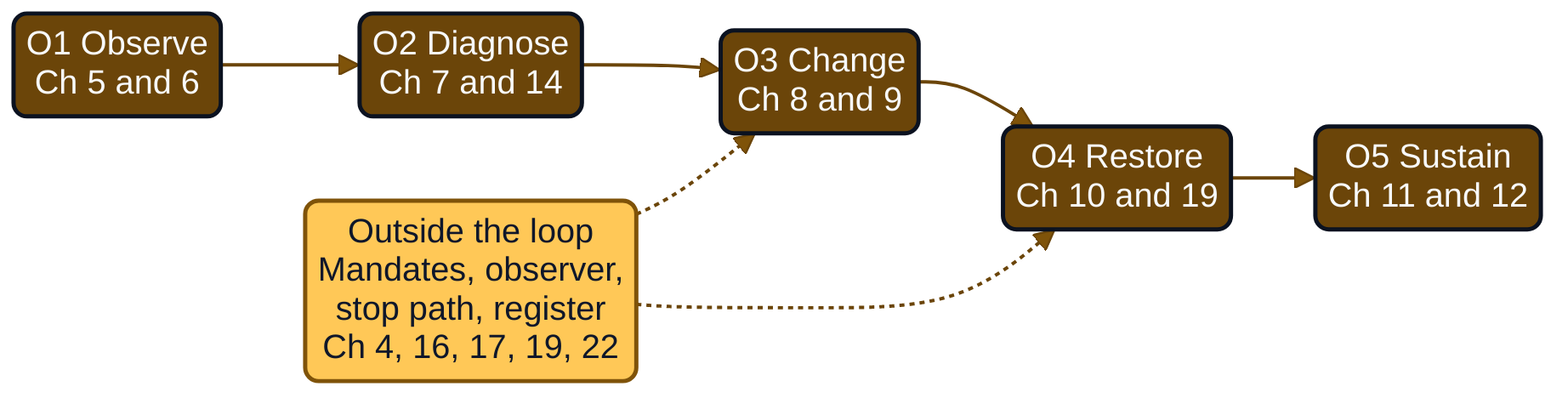
IT operations is the function that keeps services running every day: it sees what the estate is doing, finds out what has gone wrong, changes the estate without breaking it, brings services back when they fail and keeps the whole fit for the next year. This book asks what happens to that function when AI takes part in it, and what happens when the operator's own AI becomes one of the most privileged workloads that the organisation runs. It concerns all five functions of the operations loop that Chapter 4 defines: O1 Observe, O2 Diagnose, O3 Change, O4 Restore and O5 Sustain. This chapter states the question, the thesis, the vocabulary and the rules of the book, introduces the two fictional organisations that run through it, and gives each kind of reader a path.
The book is written for the people who answer for services: chief information officers and heads of operations, site reliability engineering (SRE) and platform leads, incident commanders and on-call engineers, service-desk leads, resilience officers, architects, and the boards and supervisors who receive the evidence. It is also written for the works councils, unions and data protection officers who must agree how on-call rotas and operations tools treat the people who use them. Its subject is European enterprises and public authorities, so the law that governs their operations is part of the argument from the start.
Two organisations, a Nordic regional authority and a German insurance group, receive on the same night a release that breaks sign-in to a public portal. The scenario is illustrative; it is not one of the book's incident records, and it is told here to show what the rest of the book is about. The organisations are fictional and are introduced below.
Primary topics explored
- Two nights, one outage
- Operations with AI in 2026
- Why a book on operations
- The working thesis
- Five functions and five degrees
- Usage modes and degrees of delegation
About AI Operations
AI Operations is Book 10 of The Transformed Architecture. It takes IT operations as its subject and asks what happens when AI takes part in it: the five operations functions (observe, diagnose, change, restore, sustain), the autonomy budget and the Level 4 prohibitions, the observer principle, resilience as a claim that needs evidence, operating AI systems, the operator's own AI as Tier 0 and how to defend it, operating models, decision rights, regulation (DORA, NIS 2, the AI Act), and the people involved, for European enterprises and public authorities.
It builds on the conclusions of Architecture as Code, AI Governance, AI Platform and Security, AI Red Team, AI Threat, The Transformed Security Architect, AI Boss, AI Blue and AI Purple.
CIOs and heads of IT operations, SRE and platform leads, incident commanders and on-call engineers, service-desk and service-management leads, FinOps and capacity managers, architects, CISOs and heads of resilience and third-party risk, boards and management bodies, procurement and vendor managers, supervisors and auditors, works councils and unions, data protection officers, and public-sector leaders.

Gunnar Nordqvist
Conceived, directed and published the books of The Transformed Architecture.
Continue with the full chapter
Chapter 1: Introduction: Operations with AI in AI Operations gives the detailed explanations, practical examples and implementation patterns behind this summary.
This whitepaper belongs to “The Operations in Question” and is one of 35 drawn from the manuscript.