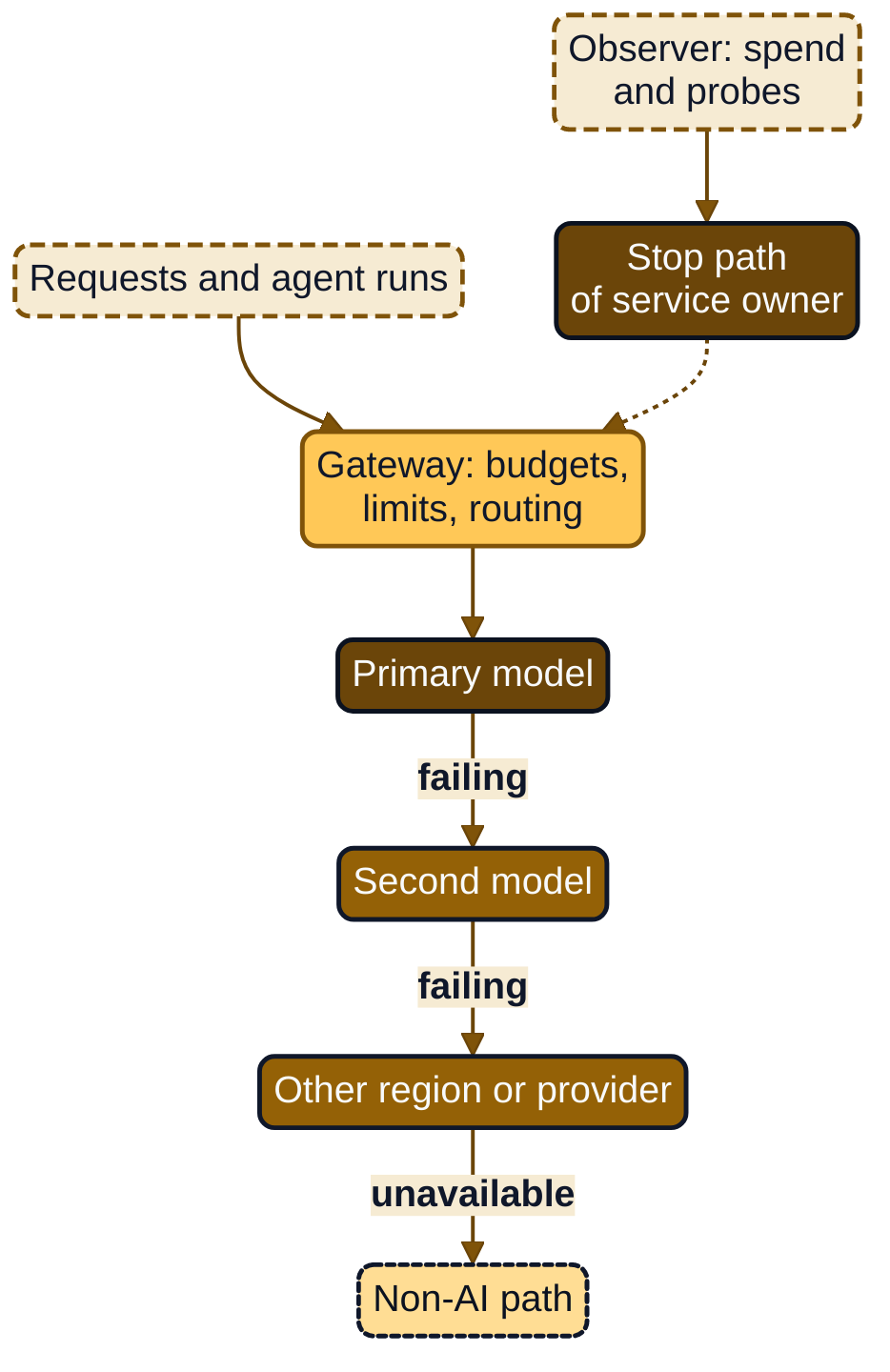
An AI service has a bill that moves with use, a latency that moves with load and a quality that can move without anyone touching it. This chapter treats the economics of running AI as an operations problem: what a request costs in tokens, accelerator time, seconds and energy, how latency and quality objectives are traded against cost, how a service falls back when its primary path fails, and how an agent's spend is bounded when it can loop. The operator's question is what to spend, where and with which stop. The chapter concerns O5 Sustain, because capacity, cost and energy are the quantities that keep an estate fit over time, and O1 Observe, because none of them can be governed unless the cost, the latency, the quality and the energy of each AI service are measured at the point where they arise and by something that does not depend on the service.
The chapter builds on the earlier volumes. AI Governance, Chapter 6, set a risk-tiered position that decides which models may handle which data (F30) (296, Nordqvist, 2026), and its Chapter 16A treated cost and portfolio decisions, so this chapter takes the decision to fund a service as made and concerns how the running spend is bounded. AI Platform and Security, Chapter 13, defined sovereignty as verifiable properties (F47), and its Chapter 22 set out cost, capacity and sustainability for the platform (297, Nordqvist, 2026). AI Threat, Chapters 25 and 26, recorded the pattern of agents acting beyond their mandate and the erosion of fallbacks (F67, F69) (299, Nordqvist, 2026). AI Blue, Chapters 16 and 28, concluded that a contract right is only a promise until a test shows it works (F111) (302, Nordqvist, 2026). AI Purple, Chapter 14, described the loop's own AI as narrow functions under mandates with budgets, circuit breakers and a drilled stop (F130). Chapter 4 defines the autonomy budget, the action classes and the observer principle applied here.
The cost of an AI request is easy to state for a metered API and harder to state for capacity the organisation holds, and the two cases need different arithmetic before they can be compared.
Primary topics explored
- What a request costs
- Capacity
- Latency and quality objectives
- Fallbacks
- Energy
- Guardrails for agents
About AI Operations
AI Operations is Book 10 of The Transformed Architecture. It takes IT operations as its subject and asks what happens when AI takes part in it: the five operations functions (observe, diagnose, change, restore, sustain), the autonomy budget and the Level 4 prohibitions, the observer principle, resilience as a claim that needs evidence, operating AI systems, the operator's own AI as Tier 0 and how to defend it, operating models, decision rights, regulation (DORA, NIS 2, the AI Act), and the people involved, for European enterprises and public authorities.
It builds on the conclusions of Architecture as Code, AI Governance, AI Platform and Security, AI Red Team, AI Threat, The Transformed Security Architect, AI Boss, AI Blue and AI Purple.
CIOs and heads of IT operations, SRE and platform leads, incident commanders and on-call engineers, service-desk and service-management leads, FinOps and capacity managers, architects, CISOs and heads of resilience and third-party risk, boards and management bodies, procurement and vendor managers, supervisors and auditors, works councils and unions, data protection officers, and public-sector leaders.

Gunnar Nordqvist
Conceived, directed and published the books of The Transformed Architecture.
Continue with the full chapter
Chapter 15: The Economics of AI Operations: Tokens, GPUs, Latency and Energy in AI Operations gives the detailed explanations, practical examples and implementation patterns behind this summary.
This whitepaper belongs to “Operating AI Systems” and is one of 35 drawn from the manuscript.