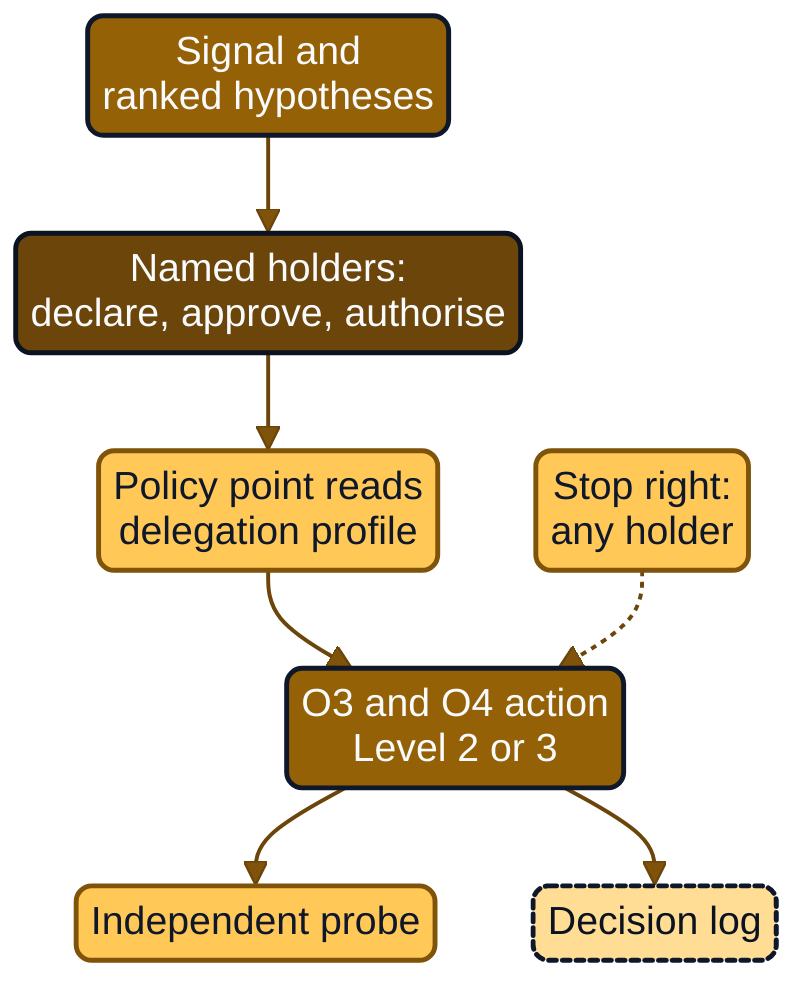
On a bad night an operations organisation takes decisions that no runbook takes for it: whether to declare an incident, who commands it, whether to stop an agent, whether to approve a change that has had no review, whether to move traffic to another site, whether to restore over data that exists, whether to break a freeze. This chapter concerns O2 Diagnose, where the incident is declared and commanded, O3 Change, where change authority decides what may enter production and on what evidence, and O4 Restore, where failover, restore and the stop of an agent are decided. Its subject is who holds each decision, who deputises, how quickly the holder must answer, what evidence the holder needs and what record the decision leaves, written as a requirement into a delegation profile that a policy decision point outside the agents can read.
The chapter builds on conclusions of the earlier volumes. Decisions are tiered and routed to the lowest tier that can take them with evidence, and the tier policy is data that changes by pull request (AI Governance, Chapter 13, F17); forums decide what pipelines cannot (F18); stop decisions are named in advance (F19) (296, Nordqvist, 2026). Decision rights to stop, pause, deny or reverse are assigned before the crisis to holders who can act within the time the threat allows, and the right to stop must be cheaper to exercise than the right to continue (AI Threat, Chapter 30, F63) (299, Nordqvist, 2026). The transformed team is an artefact with a delegation profile per function and action class, in which the lowest ceiling governs and an unlisted action is undelegated (AI Blue, Chapter 4, F93); accountability does not pass to a tool (F100); and a decision right has a holder, two deputies, a response time, an evidence standard and a record (AI Blue, Chapter 18, F107) (302, Nordqvist, 2026). AI Purple, Chapter 20, added a decision-rights file of ten decisions, the rule that position governs, and risk acceptance routed by severity with an expiry (F134). This chapter applies that method to operations, beside the observer principle of Chapters 4 and 17.
A decision right is the authority to take a defined decision and to be obeyed. Weill and Ross organised their study of information technology governance around decision rights, the question of who holds the authority to decide what (277, Weill & Ross, 2004). Operations has always had such rights in practice and has seldom written them down. Written down, a right becomes testable, and the test is the point. An incident that takes forty minutes to find a person who may authorise a failover has lost the forty minutes whether or not the failover was the right decision.
Primary topics explored
- Decision rights as requirements
- The incident commander
- Change authority
- Failover and stop
- Risk acceptance
- Delegation profiles and the register
About AI Operations
AI Operations is Book 10 of The Transformed Architecture. It takes IT operations as its subject and asks what happens when AI takes part in it: the five operations functions (observe, diagnose, change, restore, sustain), the autonomy budget and the Level 4 prohibitions, the observer principle, resilience as a claim that needs evidence, operating AI systems, the operator's own AI as Tier 0 and how to defend it, operating models, decision rights, regulation (DORA, NIS 2, the AI Act), and the people involved, for European enterprises and public authorities.
It builds on the conclusions of Architecture as Code, AI Governance, AI Platform and Security, AI Red Team, AI Threat, The Transformed Security Architect, AI Boss, AI Blue and AI Purple.
CIOs and heads of IT operations, SRE and platform leads, incident commanders and on-call engineers, service-desk and service-management leads, FinOps and capacity managers, architects, CISOs and heads of resilience and third-party risk, boards and management bodies, procurement and vendor managers, supervisors and auditors, works councils and unions, data protection officers, and public-sector leaders.

Gunnar Nordqvist
Conceived, directed and published the books of The Transformed Architecture.
Continue with the full chapter
Chapter 22: Decision Rights, Change Authority and the Incident Commander in AI Operations gives the detailed explanations, practical examples and implementation patterns behind this summary.
This whitepaper belongs to “Operations in the Organisation” and is one of 35 drawn from the manuscript.