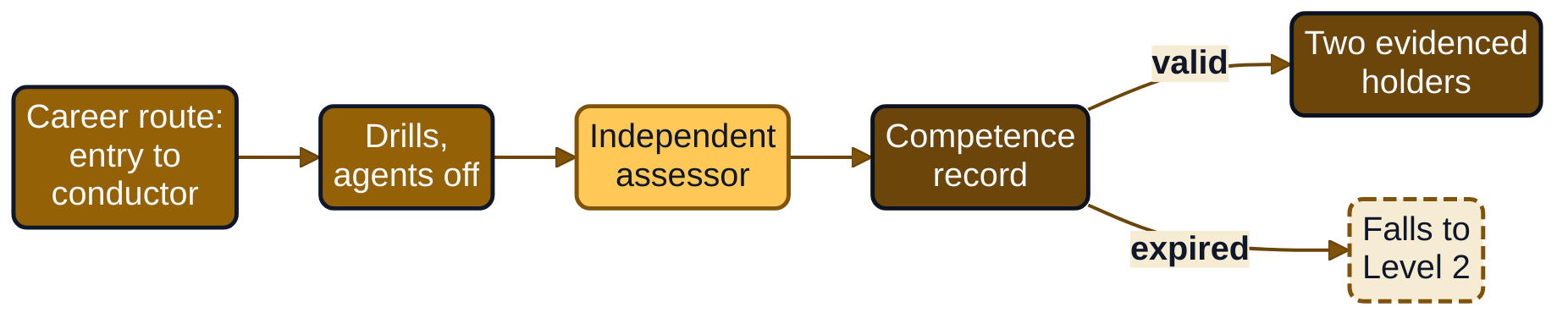
An operations loop that agents run for most of the working day still depends on people for the hours when it fails. This chapter asks what those people need to know, how the knowledge decays beside reliable automation, how it is kept, where the next operators come from when entry-level tasks are automated, and how competence is evidenced, so that a claim such as "our operators can recover this service" has a test and a date behind it. It concerns all five operations functions by name: O1 Observe, where reading raw telemetry is a skill that summaries erode; O2 Diagnose, where forming and testing a hypothesis is the skill least easily regained once lost; O3 Change, where reviewing an agent's proposal is the new craft; O4 Restore, where manual operation is the last line when the agents or their platform are unavailable; and O5 Sustain, where the craft is kept fit by record, drill and rota. The chapter ends in a debate on whether automation will deskill operators, with a verdict.
The chapter builds on conclusions that the earlier volumes reached for other roles. Architecture as Code (Chapter 18) managed competence as a skills matrix by level (295, Nordqvist, 2025). AI Governance, Chapter 14, assessed competence by practical demonstration and agreed its use with employee representatives (296, Nordqvist, 2026). AI Threat, Chapters 6 and 14, collected the evidence that reliance on AI reduces recall and checking and that automating junior work removes the route by which experts are made (299, Nordqvist, 2026). The Transformed Security Architect, Chapters 15, 21 and 22, designed the keeping of a craft (300, Nordqvist, 2026). AI Blue, Chapters 17, 22 and 23, set the rule that with fewer than two evidenced holders a Level 3 class falls back to Level 2 and treated the apprenticeship problem for analysts (302, Nordqvist, 2026), and AI Purple, Chapter 24, did the same for the red craft (304, Nordqvist, 2026). This chapter applies their instruments to operations.
The competences below are the book's own analysis, written as capabilities that can be observed in an exercise and not as traits, in five areas.
Primary topics explored
- What an operator needs now
- What the evidence says about skill beside automation
- Keeping the craft
- The early-career route
- Frameworks, law and records
- The debate
About AI Operations
AI Operations is Book 10 of The Transformed Architecture. It takes IT operations as its subject and asks what happens when AI takes part in it: the five operations functions (observe, diagnose, change, restore, sustain), the autonomy budget and the Level 4 prohibitions, the observer principle, resilience as a claim that needs evidence, operating AI systems, the operator's own AI as Tier 0 and how to defend it, operating models, decision rights, regulation (DORA, NIS 2, the AI Act), and the people involved, for European enterprises and public authorities.
It builds on the conclusions of Architecture as Code, AI Governance, AI Platform and Security, AI Red Team, AI Threat, The Transformed Security Architect, AI Boss, AI Blue and AI Purple.
CIOs and heads of IT operations, SRE and platform leads, incident commanders and on-call engineers, service-desk and service-management leads, FinOps and capacity managers, architects, CISOs and heads of resilience and third-party risk, boards and management bodies, procurement and vendor managers, supervisors and auditors, works councils and unions, data protection officers, and public-sector leaders.

Gunnar Nordqvist
Conceived, directed and published the books of The Transformed Architecture.
Continue with the full chapter
Chapter 26: Competences and Keeping the Operator's Craft in AI Operations gives the detailed explanations, practical examples and implementation patterns behind this summary.
This whitepaper belongs to “People and Career” and is one of 35 drawn from the manuscript.