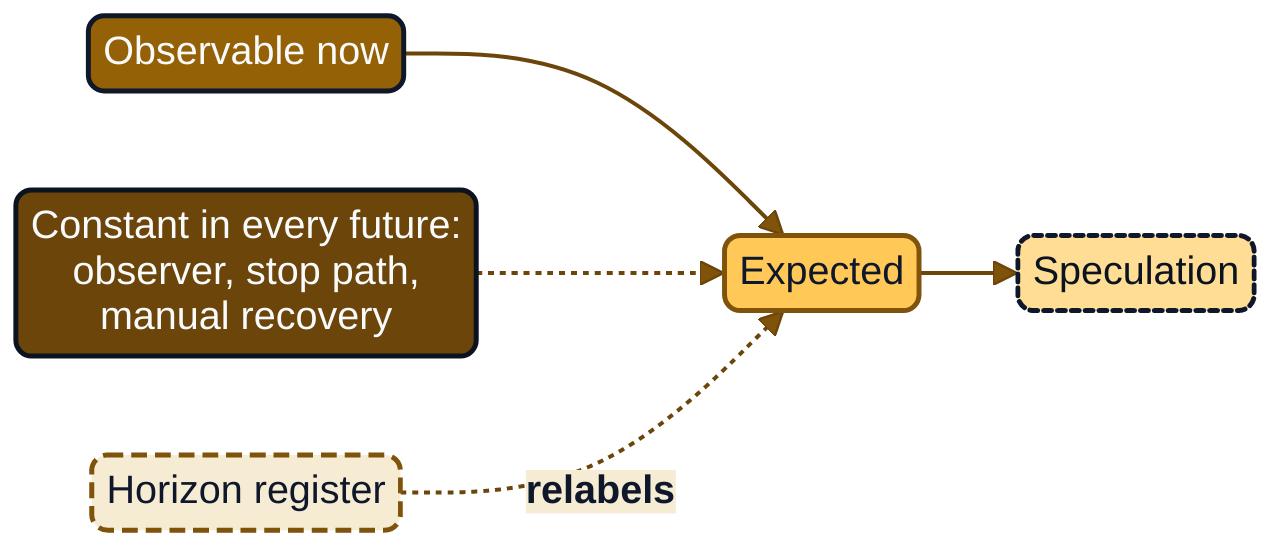
This chapter looks ahead at operations with the series' discipline and asks the question that the book has so far kept at arm's length: will anyone be on call in 2036, or will operations converge into agents and provider-run services with no person who can take over? It concerns all five operations functions, O1 Observe, O2 Diagnose, O3 Change, O4 Restore and O5 Sustain, because each is a candidate for further automation and because the answer decides who holds the observer, the stop path and the manual capability that Chapters 4, 17 and 19 made the safety net. The chapter treats the outlook as a horizon register, states the evidence under each label, stages the debate between concern and calm, and then gives the author's own projection, labelled as such, with the evidence that would change it.
Three earlier volumes asked the same kind of question about a neighbouring function. AI Blue, Chapters 24 and 28, asked whether there will be a security operations centre in 2036 and kept an accountable function wherever a person must verify and stop the AI (302, Nordqvist, 2026). The Transformed Security Architect, Chapters 23 and 27, kept the role wherever accountability for a boundary must be human (300, Nordqvist, 2026). AI Purple, Chapter 25, asked whether red and blue will be separate teams and concluded that independence is needed in every future, while where it lives is open (304, Nordqvist, 2026). This chapter does not repeat those answers. It builds on an outlook governed as a horizon register, in which observable trends justify commitment, expected ones preparation and speculative ones reversibility, with the author's judgement kept apart from the findings (AI Governance, Chapters 22 and 24) (296, Nordqvist, 2026), and it asks what is particular to operations: the oldest automation in the series, the credentials that make the operator's AI a Tier 0 asset and a duty of the management body that no tool can take over.
The table lists the items in the figure.
Primary topics explored
- A horizon register for operations
- What is observable
- What is expected
- What is speculation
- Limits: compute, energy, regulation and trust
- Three futures for 2036
About AI Operations
AI Operations is Book 10 of The Transformed Architecture. It takes IT operations as its subject and asks what happens when AI takes part in it: the five operations functions (observe, diagnose, change, restore, sustain), the autonomy budget and the Level 4 prohibitions, the observer principle, resilience as a claim that needs evidence, operating AI systems, the operator's own AI as Tier 0 and how to defend it, operating models, decision rights, regulation (DORA, NIS 2, the AI Act), and the people involved, for European enterprises and public authorities.
It builds on the conclusions of Architecture as Code, AI Governance, AI Platform and Security, AI Red Team, AI Threat, The Transformed Security Architect, AI Boss, AI Blue and AI Purple.
CIOs and heads of IT operations, SRE and platform leads, incident commanders and on-call engineers, service-desk and service-management leads, FinOps and capacity managers, architects, CISOs and heads of resilience and third-party risk, boards and management bodies, procurement and vendor managers, supervisors and auditors, works councils and unions, data protection officers, and public-sector leaders.

Gunnar Nordqvist
Conceived, directed and published the books of The Transformed Architecture.
Continue with the full chapter
Chapter 27: The Future of Operations: Will Anyone Be on Call in 2036? in AI Operations gives the detailed explanations, practical examples and implementation patterns behind this summary.
This whitepaper belongs to “People and Career” and is one of 35 drawn from the manuscript.