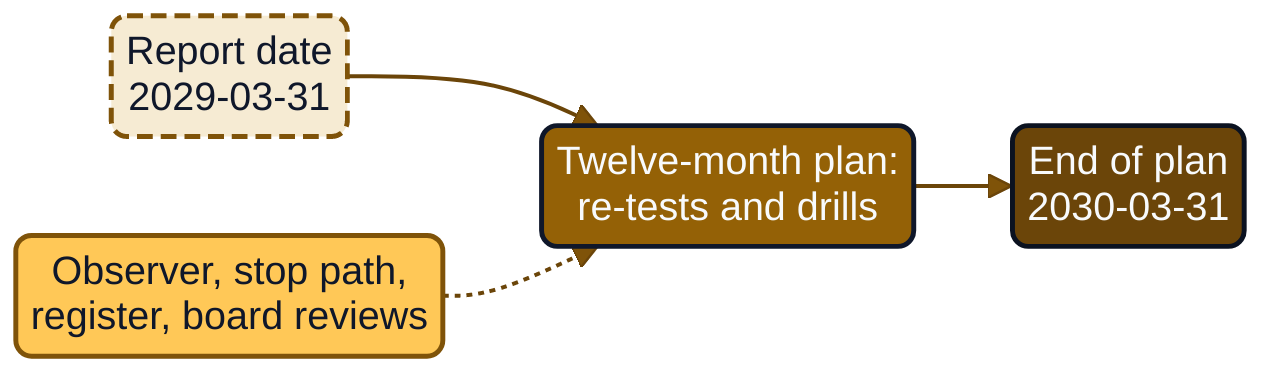
Two questions were put to the two organisations in September 2028, and both are answered in this chapter on the date the first reports fall due, 2029-03-31. The regional executive committee of Nordvik Region asked its Head of IT and Digitalisation what operations becomes when the platform team's tools and the providers' AI act on the estate, and what the Region can prove about recovery (AIDR-0900). The risk committee of Hansa Mutual's executive board asked the group chief information officer whether the autonomy of the IT-operations agent can extend from restart, certificate renewal and scaling to rollback and failover, and what evidence the group would show a supervisor (AIDR-0950). The chapter draws the book's conclusions for each organisation, sets a twelve-month plan for each, names the five decisions that go to each board, defines the indicators by which the book's own claims will be tested, and lists the risks that would change the plan. It concerns all five operations functions: O1 Observe, O2 Diagnose, O3 Change, O4 Restore and O5 Sustain.
The chapter is dated 2029-03-31, month 7 of the year told in Chapter 29, and states only what was known on that date; the plan it sets begins on 2029-04-01, and Chapter 29 shows, with hindsight, how its first five months went (for example the portal re-test that failed on 2029-04-10 and passed on 2029-06-05). Where the two chapters seem to differ, the date of each decides. The chapter adds no new theory. Its conclusions are the book's own, drawn from Chapters 2 to 28, and every fact about the two organisations is one that those chapters establish. The plans are decisions that illustrative organisations could take. They are not forecasts, and where a sentence looks forward it carries one of the three labels of AI Governance, Chapter 22: observable, expected or speculation (296, Nordqvist, 2026). The external sources cited support the parts that rest on law, on public post-incident reports and on research. The plans themselves are recommendations for fictional organisations, and Chapter 31 judges the thesis they test.
The thesis of the book has five parts (Chapter 1), and each has a consequence that holds for any organisation. The list below states the consequences in the form in which the plans use them. Each is the book's own conclusion, supported by the sources the earlier chapters cite.
Primary topics explored
- What the book concludes
- Nordvik Region: the answer to AIDR-0900
- Hansa Mutual: the answer to AIDR-0950
- Decisions for the board
- The twelve-month plans
- Indicators of the book's own claims
About AI Operations
AI Operations is Book 10 of The Transformed Architecture. It takes IT operations as its subject and asks what happens when AI takes part in it: the five operations functions (observe, diagnose, change, restore, sustain), the autonomy budget and the Level 4 prohibitions, the observer principle, resilience as a claim that needs evidence, operating AI systems, the operator's own AI as Tier 0 and how to defend it, operating models, decision rights, regulation (DORA, NIS 2, the AI Act), and the people involved, for European enterprises and public authorities.
It builds on the conclusions of Architecture as Code, AI Governance, AI Platform and Security, AI Red Team, AI Threat, The Transformed Security Architect, AI Boss, AI Blue and AI Purple.
CIOs and heads of IT operations, SRE and platform leads, incident commanders and on-call engineers, service-desk and service-management leads, FinOps and capacity managers, architects, CISOs and heads of resilience and third-party risk, boards and management bodies, procurement and vendor managers, supervisors and auditors, works councils and unions, data protection officers, and public-sector leaders.

Gunnar Nordqvist
Conceived, directed and published the books of The Transformed Architecture.
Continue with the full chapter
Chapter 30: Nordvik Region and Hansa Mutual: Conclusions for Two Organisations in AI Operations gives the detailed explanations, practical examples and implementation patterns behind this summary.
This whitepaper belongs to “Experience and Conclusions” and is one of 35 drawn from the manuscript.