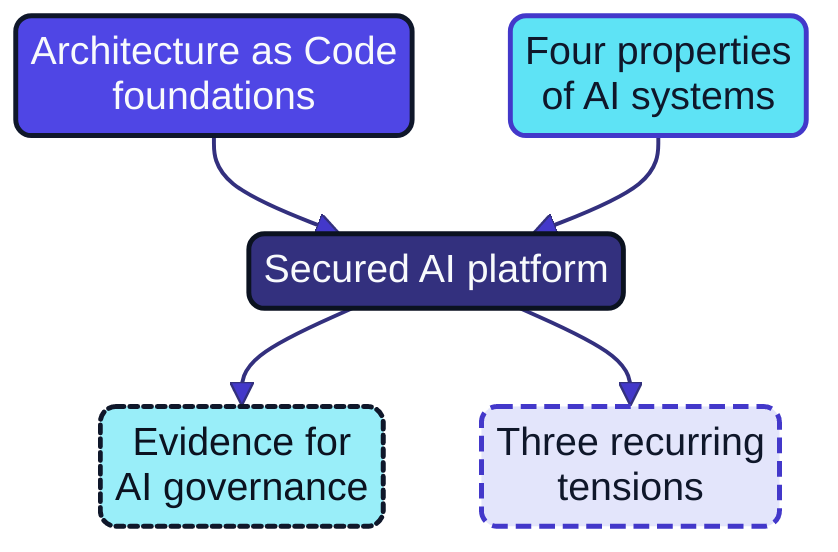
This book is about building and securing the platform on which artificial intelligence runs in large European enterprises and public authorities: the data, model and prompt pipelines, the retrieval stores and agent runtimes, the gateways and compute, and the security controls that keep all of it within its mandate. This chapter explains why such a platform is an architectural and security problem rather than a question of which model to buy, and defines the terms the book relies on.
Most organisations begin with a model-selection question: which provider, which model, which licence. It is the smallest part of the problem. A model choice is revisited every few months, whereas the platform around it, with its identity integration, data boundaries, gateways, evaluation suites, logs and stop paths, outlives many such choices. In the estates I have reviewed, incidents and audit findings trace back less to the model than to what it was allowed to see and do.
A large language model (LLM) samples one acceptable answer from many, and produces another when its prompt, sampling settings or version change. The AI Act, Regulation (EU) 2024/1689, builds this into its definition: under Article 3(1) an AI system infers from its input how to generate output (1, European Union, 2024), and ISO/IEC 22989 organises its terminology around the same split between training and inference (25, ISO/IEC, 2022).
Primary topics explored
- Why an AI platform is an architectural and security problem
- A working definition of AI Architecture
- Purpose, readers and scope
- How this book fits The Transformed Architecture
- European law as platform requirements
- The usage modes as a red thread
About AI Platform and Security
AI Platform and Security is Book 3 of The Transformed Architecture. It shows how large European enterprises and public authorities build, secure and operate the platform on which artificial intelligence runs: data, models and DevSecMLOps, retrieval and agents, infrastructure and sovereignty, AI security engineering, evaluation, observability and cost.
The companion volume AI Governance covers risk management, governance, assurance, organisation and leadership; Architecture as Code supplies the underlying discipline.
Platform engineers, security architects, MLOps teams, AI architects and technical decision-makers.

Gunnar Nordqvist
Conceived, directed and published the books of The Transformed Architecture.
Continue with the full chapter
Chapter 1: Introduction to AI Platform and Security in AI Platform and Security gives the detailed explanations, practical examples and implementation patterns behind this summary.
This whitepaper belongs to “Foundations” and is one of 29 drawn from the manuscript.