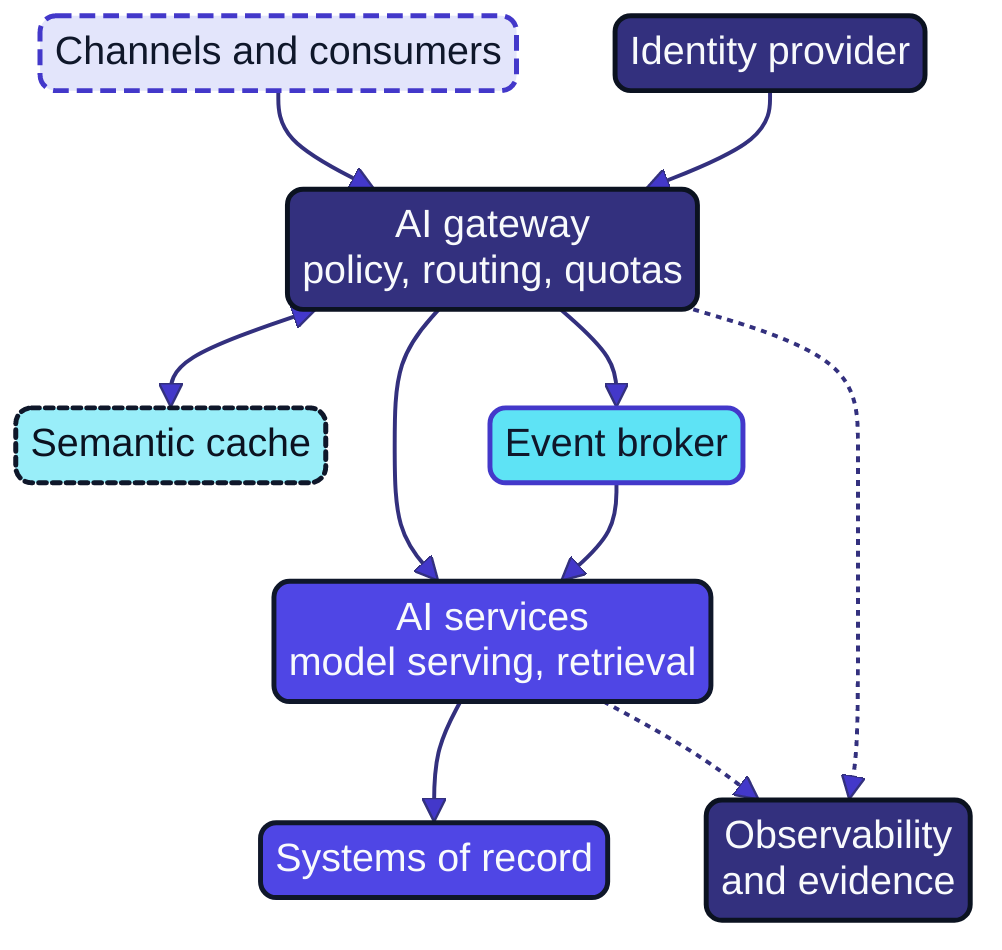
Chapter 11 gave agents explicit boundaries; this chapter, which closes Part II, turns to the landscape those agents and every other AI service must connect to. Most of the value of a model, and most of its risk, is realised when its output reaches a case file, an order, or a citizen. The chapter covers the AI gateway as integration seam, synchronous and event-driven integration, legacy systems of record, delegated authority, contracts for probabilistic services, and the interoperability duties of public bodies.
Classical integration assumes that a service returns the same answer for the same request and that a failure is an exception rather than a plausible-looking result. An AI service breaks both assumptions: identical requests may produce different outputs, and the most dangerous failure is a fluent, wrong response that passes every schema check.
Zaharia and colleagues describe the shift from models to compound AI systems, in which the model is one component among retrievers, tools, control logic, and the ordinary services of the enterprise (63, Zaharia et al., 2024). Integration architecture is where that composition happens, and Richards and Ford remind us that reliability, auditability, and security are achieved by structure, not by intention (80, Richards & Ford, 2020).
Primary topics explored
- The integration problem AI introduces
- The AI gateway as the integration seam
- Synchronous and event-driven integration
- Integrating with legacy systems of record
- Identity propagation and delegated authority
- API contracts for probabilistic services
About AI Platform and Security
AI Platform and Security is Book 3 of The Transformed Architecture. It shows how large European enterprises and public authorities build, secure and operate the platform on which artificial intelligence runs: data, models and DevSecMLOps, retrieval and agents, infrastructure and sovereignty, AI security engineering, evaluation, observability and cost.
The companion volume AI Governance covers risk management, governance, assurance, organisation and leadership; Architecture as Code supplies the underlying discipline.
Platform engineers, security architects, MLOps teams, AI architects and technical decision-makers.

Gunnar Nordqvist
Conceived, directed and published the books of The Transformed Architecture.
Continue with the full chapter
Chapter 12: Integrating AI into the Enterprise Landscape in AI Platform and Security gives the detailed explanations, practical examples and implementation patterns behind this summary.
This whitepaper belongs to “Data, Models and DevSecMLOps” and is one of 29 drawn from the manuscript.