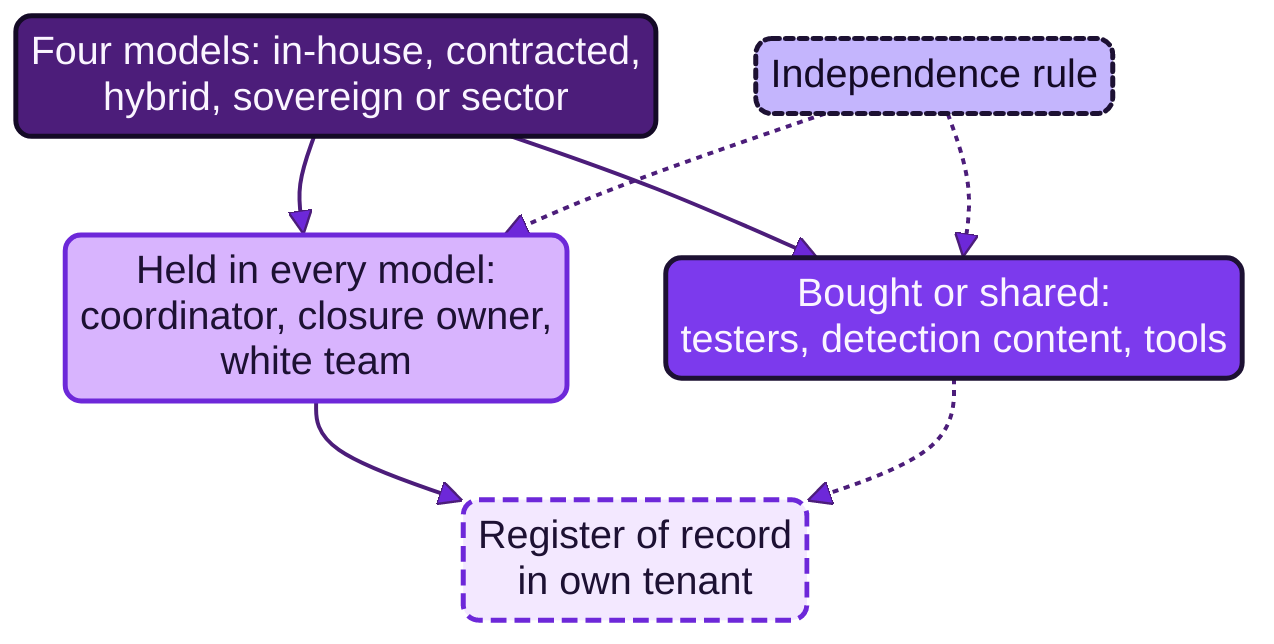
Part V takes the loop out of the exercise and puts it into the organisation. Chapter 17 asked what "covered" means and Chapter 18 asked how a loop is measured. This chapter asks who runs the loop. The question has two halves. The first is structural: whether the red side, the detection side and the register are run by the organisation's own people, bought from a contracted tester and a managed provider, split between the two, or drawn from a pooled sector capability. The second is individual: which roles a working loop needs, how each is chartered, and which pairs of roles must never be held by the same person. The chapter concerns all five stages of the purple loop. P1 Target and P4 Improve are the stages that usually stay inside the organisation, P2 Emulate is the stage most often bought, P3 Observe is the stage where the boundary between a customer and a provider is most easily blurred, and P5 Verify is the stage where the independence of the roles decides whether the loop produces evidence or only a record.
The chapter builds on conclusions of the earlier volumes and does not repeat them. AI Blue, Chapter 16, compared in-house, managed, hybrid and sovereign security operations and concluded that, whatever the model, detection content, the decision rights for containment and disclosure, the case record, the ability to leave and enough skill to supervise stay with the organisation (94, Nordqvist, 2026). AI Blue, Chapter 17, set out what happens to the team once the tier-1 pyramid gives way to closure by class, and introduced the purple team coordinator as a role of the blue team's loop. AI Governance, Chapter 12, held that organisational design is architecture by other means, that control functions keep their independence through gates and records rather than meetings, and that exceptions are routed as expiring records (88, Nordqvist, 2026). AI Governance, Chapter 14, added that new roles follow the usage modes. The Transformed Security Architect, Chapter 4, held that a role is itself a versioned artefact, with a charter that states mandate, accountabilities and decision rights (92, Nordqvist, 2026). AI Platform and Security, Chapter 13, defined sovereignty as a set of verifiable properties and not a postcode (89, Nordqvist, 2026). Architecture as Code (Chapter 18) observed that the design of a system mirrors the communication paths of the organisation that builds it (87, Nordqvist, 2025). This chapter's own conclusion is that the loop has a design problem of exactly that kind: the roles and the contracts decide which stage can lie, and the charter is the place to prevent it.
The chapter answers five questions: which operating models can run the loop, which roles it needs, how independence is kept between roles even in a team of six, who owns the findings and the test data, and how testing and simulation tools are procured.
Primary topics explored
- Four operating models
- Roles and charters
- Independence between roles
- Small teams
- Sovereignty and findings
- Procurement
About AI Purple
AI Purple is Book 9 of The Transformed Architecture. It takes the loop between the red team and the blue team as its subject and asks what happens when AI sits on both sides of the table: the five stages of the loop (target, emulate, observe, improve, verify), rules of engagement and safe emulation, continuous emulation, the independence principle, coverage as a claim that needs evidence, the loop's own AI and how to defend it, operating models, decision rights, regulation, and the people involved, for European enterprises and public authorities.
It builds on the conclusions of Architecture as Code, AI Governance, AI Platform and Security, AI Red Team, AI Threat, The Transformed Security Architect, AI Boss and AI Blue.
Chief information security officers, heads of security operations, red-team leads, penetration testers, SOC managers, detection engineers, purple-team coordinators and incident commanders, security and AI architects, boards and management bodies, procurement leads, works councils and unions, data protection and audit functions, and public-sector leaders.

Gunnar Nordqvist
Conceived, directed and published the books of The Transformed Architecture.
Continue with the full chapter
Chapter 19: Operating Models and Team Design: In-House, Contracted, Hybrid and Sovereign Loops in AI Purple gives the detailed explanations, practical examples and implementation patterns behind this summary.
This whitepaper belongs to “The Loop in the Organisation” and is one of 33 drawn from the manuscript.