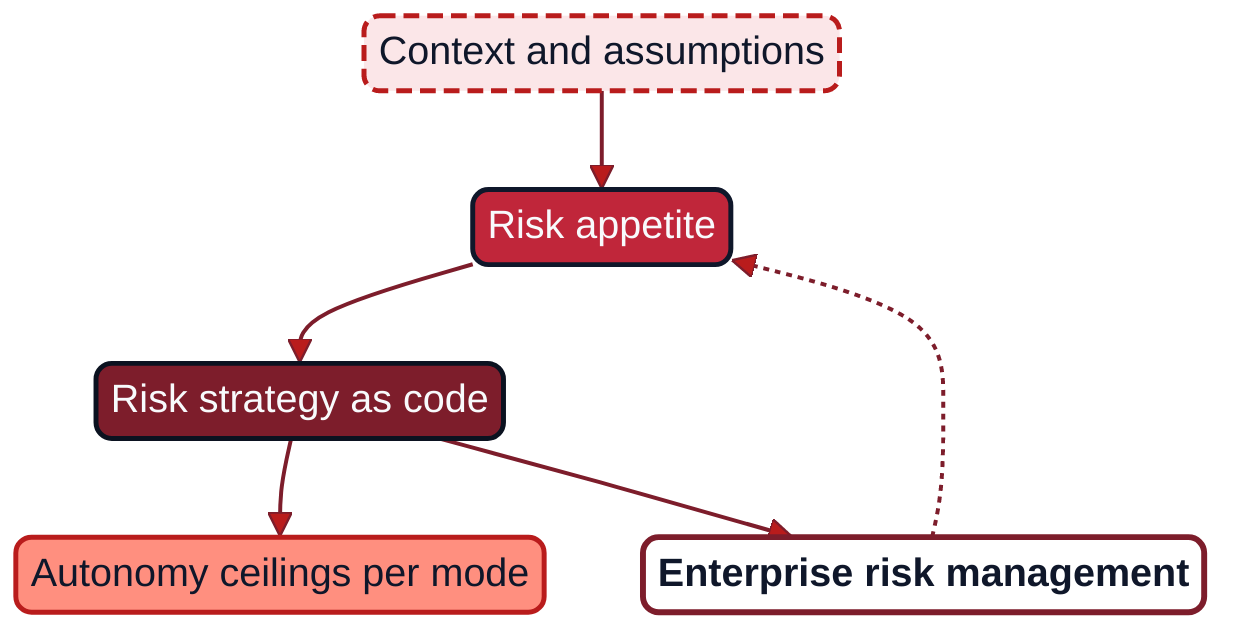
A security strategy rests on an account of what the organisation exists to do and depends on, and a decision about how much risk it will take in pursuit of that purpose. AI changes both: it enters the context as an asset and as an adversary's capability, and the risk strategy as software that drafts and sometimes executes security actions. An organisation that has not written down how much error it tolerates from that software, how far it may act without a person, and which assumptions about attackers no longer hold, has delegated those decisions to its vendors and its adversaries.
This chapter is responsible for two Categories of the Govern Function of NIST CSF 2.0: GV.OC Organizational Context, the understanding of the mission, stakeholder expectations, dependencies and legal, regulatory and contractual requirements that surround cybersecurity risk decisions, and GV.RM Risk Management Strategy, the priorities, constraints, risk tolerance and appetite statements and assumptions that support operational risk decisions (19, NIST, 2024). It treats both through the three focus areas of the NIST Cyber AI Profile (20, NIST, 2025), and ends with a risk-appetite statement written as code, with autonomy ceilings per usage mode and the changes that trigger its review.
GV.OC makes the context of risk decisions explicit, so that each can be traced back to what the organisation is protecting and for whom.
Primary topics explored
- Mission, stakeholders and obligations
- Risk appetite for AI in defence
- Risk assumptions under AI-enabled threats
- Risk strategy as code
- Linking to enterprise risk management
- The strategy across modes, levels and focus areas
About AI Red Team
AI Red Team is Book 4 of The Transformed Architecture. It shows how large European enterprises and public authorities put artificial intelligence to work as an active part of cyber defence: AI-assisted red teaming and adversary emulation, red teaming of AI systems themselves, the AI-assisted security operations centre, detection engineering, threat intelligence, incident response and purple teaming, all under a lawful mandate and with evidence a supervisor can inspect.
It builds on the conclusions of Architecture as Code, AI Governance and AI Platform and Security.
CISOs, SOC leads, red and blue team practitioners, security architects, AI architects and technical decision-makers.

Gunnar Nordqvist
Conceived, directed and published the books of The Transformed Architecture.
Continue with the full chapter
Chapter 5: Organisational Context and Risk Strategy for AI in Cyber Defence in AI Red Team gives the detailed explanations, practical examples and implementation patterns behind this summary.
This whitepaper belongs to “Govern” and is one of 32 drawn from the manuscript.