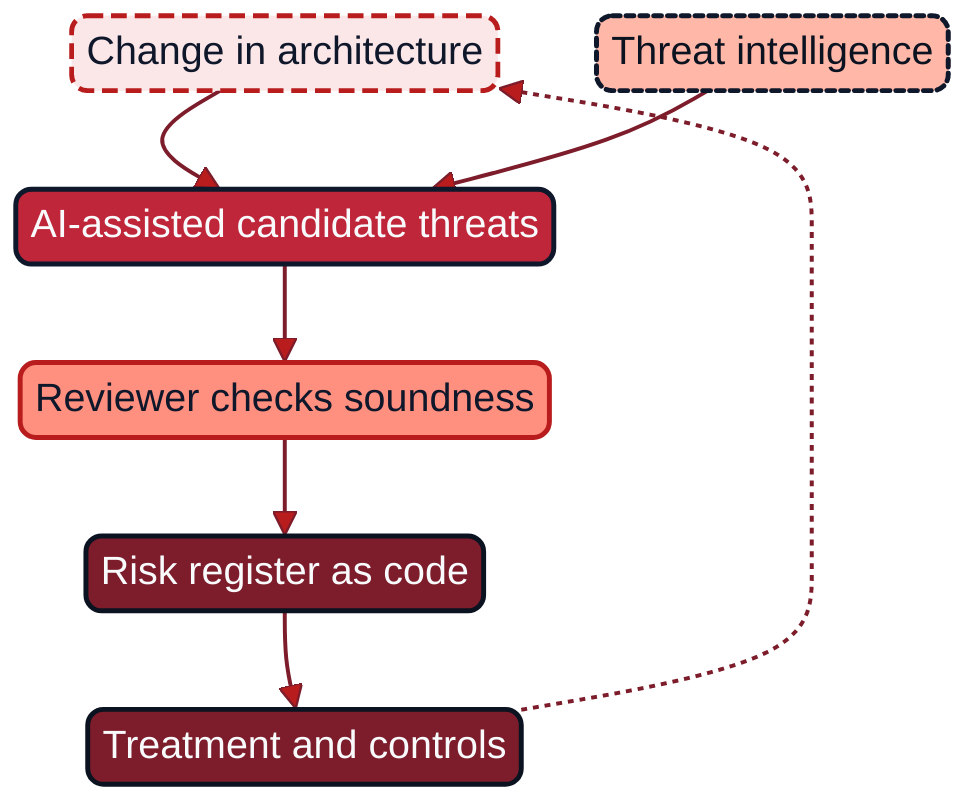
Most organisations still model threats in a workshop: a security architect draws the data flows on a whiteboard, walks through a checklist and files the result. Within weeks a retrieval source is added, a service account gains a permission or an agent is given a new tool, and the model, and the risk scores built on it, describe a system that no longer exists. When adversaries use AI to find and exploit weaknesses faster, that drift becomes the gap through which they arrive.
This chapter shows how AI makes threat modelling continuous and risk assessment evidence-based: threat models generated from architecture code and regenerated on every change, threat intelligence fused with asset and exposure context, attack-path analysis across identity, cloud and AI components, and machine-assisted risk scoring reviewed by named people for soundness. It is responsible for one CSF 2.0 Category, ID.RA Risk Assessment in the Identify Function, whose outcome is that the organisation understands the cybersecurity risk to the organisation, its assets and individuals (19, NIST, 2024), and treats it through the three focus areas of the NIST Cyber AI Profile (20, NIST, 2025).
ID.RA gathers ten Subcategories that read like a description of the loop in Figure 10.1 (19, NIST, 2024). This chapter concentrates on ID.RA-02 to ID.RA-07: threat intelligence is received, threats are identified, impacts and likelihoods are recorded and used to understand inherent risk, responses are prioritised and tracked, and changes and exceptions are assessed for their risk impact. Vulnerabilities and disclosures (ID.RA-01 and ID.RA-08) are the subject of Chapter 11, the integrity of acquisitions and supplier assessment (ID.RA-09 and ID.RA-10) belong to Chapter 8, and the asset inventory and risk appetite on which every score depends come from Chapters 9 and 5.
Primary topics explored
- ID.RA Risk Assessment and what it asks for
- Threat models that keep up with change
- AI-assisted STRIDE and ATLAS analysis
- Threat intelligence in risk assessment
- Attack-path analysis
- Reviewing machine-generated risk
About AI Red Team
AI Red Team is Book 4 of The Transformed Architecture. It shows how large European enterprises and public authorities put artificial intelligence to work as an active part of cyber defence: AI-assisted red teaming and adversary emulation, red teaming of AI systems themselves, the AI-assisted security operations centre, detection engineering, threat intelligence, incident response and purple teaming, all under a lawful mandate and with evidence a supervisor can inspect.
It builds on the conclusions of Architecture as Code, AI Governance and AI Platform and Security.
CISOs, SOC leads, red and blue team practitioners, security architects, AI architects and technical decision-makers.

Gunnar Nordqvist
Conceived, directed and published the books of The Transformed Architecture.
Continue with the full chapter
Chapter 10: AI-Assisted Threat Modelling and Risk Assessment in AI Red Team gives the detailed explanations, practical examples and implementation patterns behind this summary.
This whitepaper belongs to “Identify” and is one of 32 drawn from the manuscript.