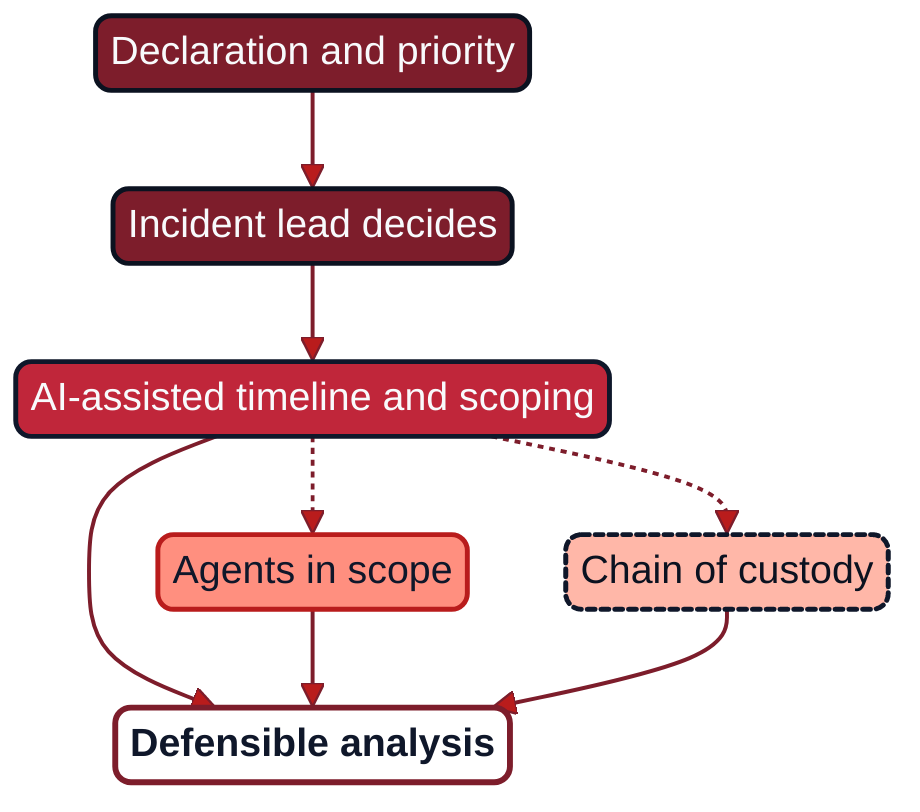
An incident tests every earlier investment in governance, identification, protection and detection under pressure: someone must decide, with incomplete information and little time, that an incident exists, how serious it is, what has happened and which obligations it triggers. AI can shorten almost every step. It can also produce a confident, plausible and wrong account of what happened, and an organisation that acts on it unchecked may contain the wrong systems, report the wrong facts to a supervisor or miss the attacker who is still present.
This chapter applies AI to incident management and analysis without loss of command or defensibility. It is responsible for two Categories of NIST CSF 2.0 in the Respond Function: RS.MA Incident Management, under which the incident response plan is executed with relevant third parties once an incident is declared, and incidents are triaged, categorised, prioritised and escalated, and RS.AN Incident Analysis, under which investigations establish what took place and its root cause, record the actions taken, preserve the integrity and provenance of incident data and estimate the magnitude of the incident (19, NIST, 2024). NIST's revised incident response guidance, SP 800-61 Rev. 3, organises incident response around the CSF 2.0 Functions rather than a separate lifecycle, treating Govern, Identify and Protect as preparation and Detect, Respond and Recover as the response itself (21, NIST, 2025). The chapter treats both Categories through the three focus areas of the NIST Cyber AI Profile (20, NIST, 2025), with particular attention to incidents in which an AI system or agent is itself the subject of the investigation.
The starting point is a conclusion from Architecture as Code (Chapter 9B): manual incident response cannot scale when attacks develop within minutes, compromised components should be redeployed from known-good definitions rather than repaired by hand, and the programme is measured by mean time to detect, mean time to respond and the false-positive ratio (71, Nordqvist, 2025). This chapter builds on that conclusion (F5 in SERIES_FOUNDATIONS.md) and adds the condition that makes it safe: AI speeds up the work of the incident, but the incident remains under human command.
Primary topics explored
- Incident management with AI
- Timelines and scoping
- Defensible analysis
- Incidents involving AI
- Summary
- Sources
About AI Red Team
AI Red Team is Book 4 of The Transformed Architecture. It shows how large European enterprises and public authorities put artificial intelligence to work as an active part of cyber defence: AI-assisted red teaming and adversary emulation, red teaming of AI systems themselves, the AI-assisted security operations centre, detection engineering, threat intelligence, incident response and purple teaming, all under a lawful mandate and with evidence a supervisor can inspect.
It builds on the conclusions of Architecture as Code, AI Governance and AI Platform and Security.
CISOs, SOC leads, red and blue team practitioners, security architects, AI architects and technical decision-makers.

Gunnar Nordqvist
Conceived, directed and published the books of The Transformed Architecture.
Continue with the full chapter
Chapter 20: Incident Management and Analysis with AI in AI Red Team gives the detailed explanations, practical examples and implementation patterns behind this summary.
This whitepaper belongs to “Respond” and is one of 32 drawn from the manuscript.