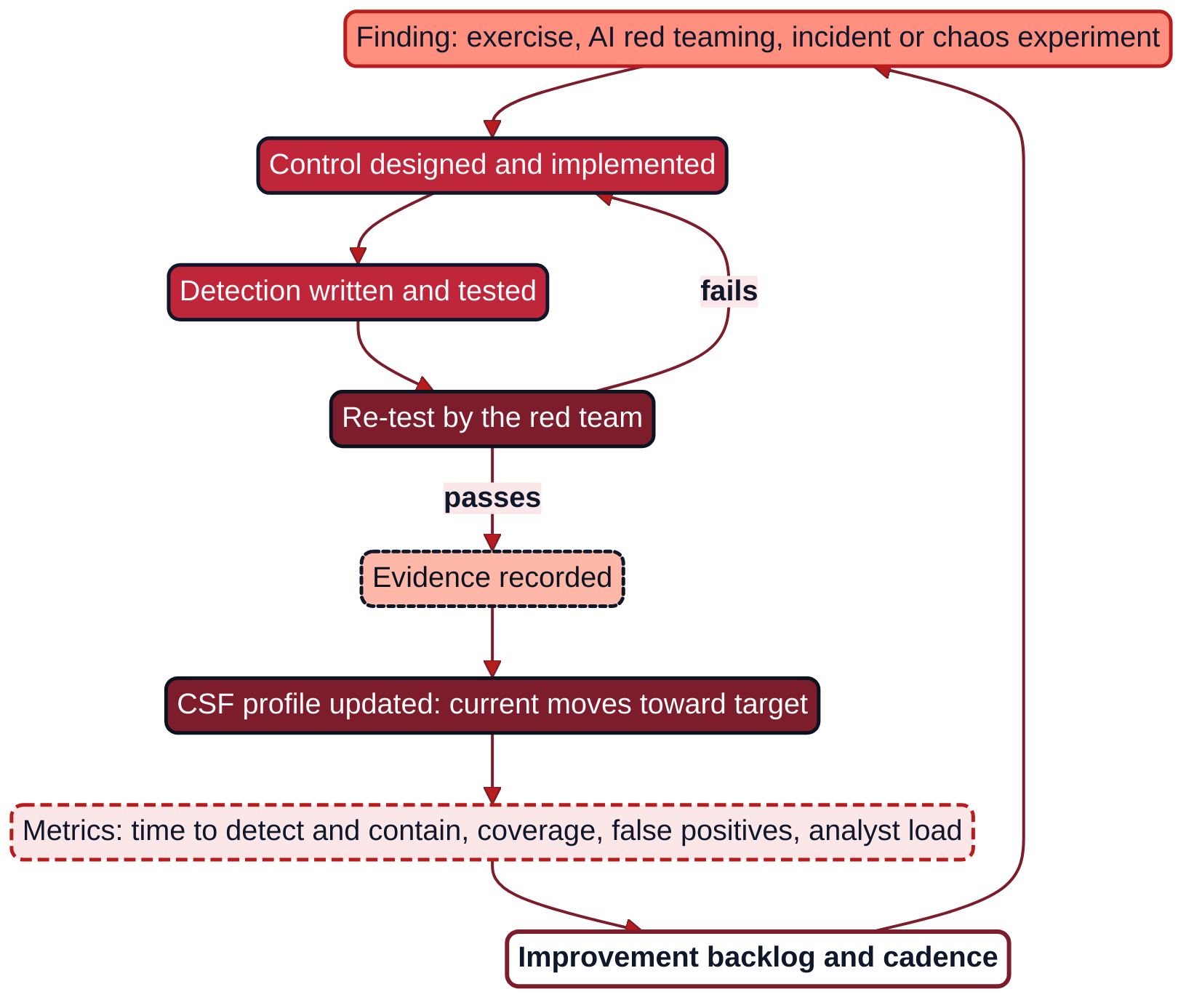
The chapters before this one produce findings: a step that reached its target unseen, a guardrail that a crafted document can steer, a log source that fell silent, a playbook that assumed a human tempo. A finding is valuable only if it changes something, and a change only if someone has shown that it works. This chapter therefore closes the loop across all six CSF Functions: the purple loop, the joint sessions in which red and blue teams run it with AI, the metrics and evaluations that show whether defensive AI improves outcomes, and the programme that governs improvement.
In CSF 2.0 terms the chapter is responsible for two Categories (19, NIST, 2024). ID.IM Improvement asks that improvements are identified across all Functions from evaluations (ID.IM-01), from tests and exercises, including those with suppliers (ID.IM-02), from operational processes (ID.IM-03) and through maintained incident response and other plans (ID.IM-04). GV.OV Oversight asks that outcomes are reviewed (GV.OV-01), the strategy adjusted (GV.OV-02) and risk management performance evaluated (GV.OV-03). Chapter 8 treated GV.OV from the side of the management body; this chapter supplies the evidence that body needs.
A purple team is not a third team alongside the red team, which emulates the adversary, and the blue team, which defends. It is the joint working mode in which the two share what each saw, agree what must change and verify the change together; an organisation without an in-house red team can practise it equally well. What makes it a loop rather than a debrief is a fixed sequence of five states, shown in Figure 26.1, and one exit condition.
Primary topics explored
- The purple loop
- Running a purple session with AI
- Metrics that matter
- Evaluating security AI
- Improvement as a programme
- Summary
About AI Red Team
AI Red Team is Book 4 of The Transformed Architecture. It shows how large European enterprises and public authorities put artificial intelligence to work as an active part of cyber defence: AI-assisted red teaming and adversary emulation, red teaming of AI systems themselves, the AI-assisted security operations centre, detection engineering, threat intelligence, incident response and purple teaming, all under a lawful mandate and with evidence a supervisor can inspect.
It builds on the conclusions of Architecture as Code, AI Governance and AI Platform and Security.
CISOs, SOC leads, red and blue team practitioners, security architects, AI architects and technical decision-makers.

Gunnar Nordqvist
Conceived, directed and published the books of The Transformed Architecture.
Continue with the full chapter
Chapter 26: Purple Teaming, Measurement and Continuous Improvement in AI Red Team gives the detailed explanations, practical examples and implementation patterns behind this summary.
This whitepaper belongs to “Verification, Improvement and Conclusions” and is one of 32 drawn from the manuscript.