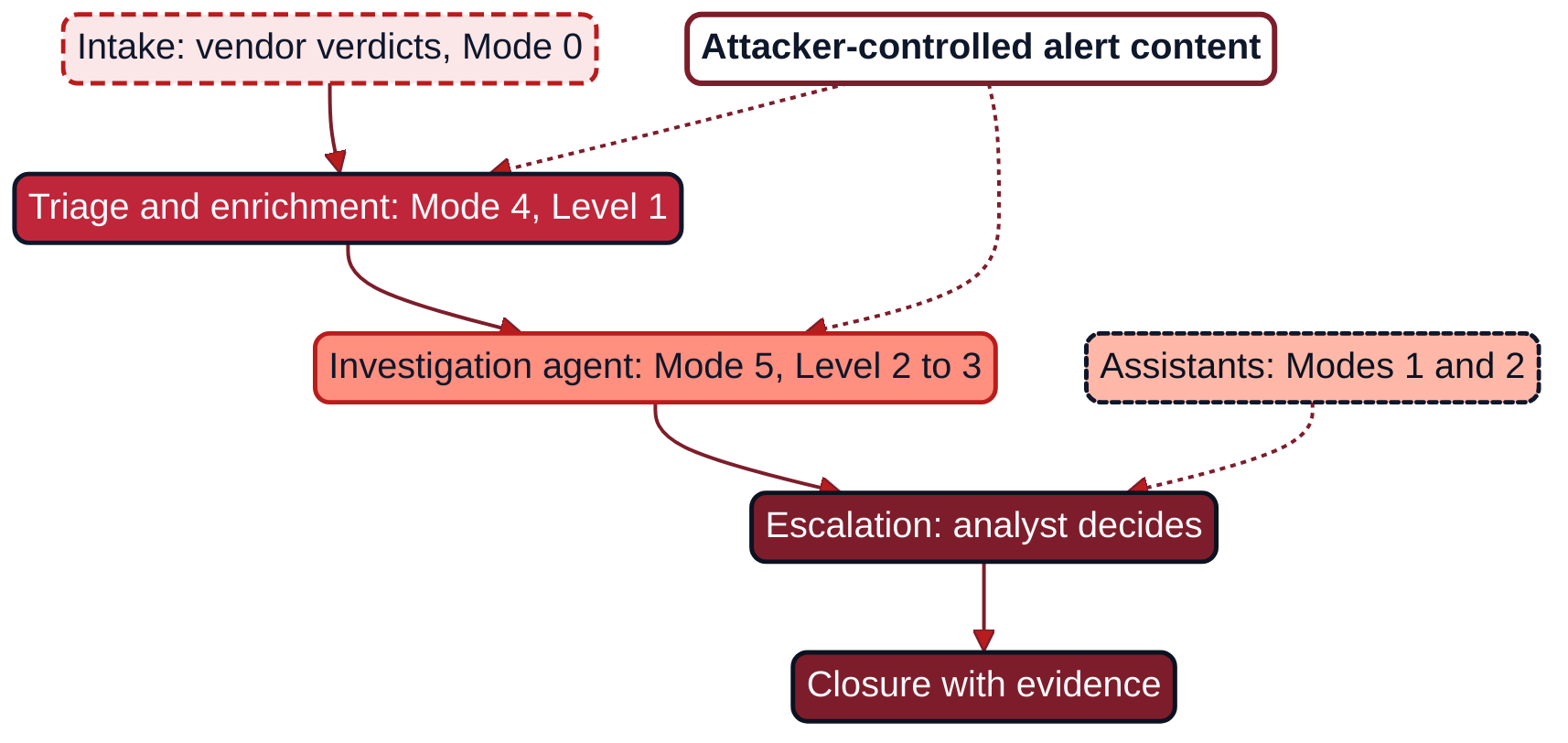
The security operations centre (SOC) is where an organisation finds out that something is wrong, and where most organisations first put AI to work in cyber defence, because alerts arrive faster than people can read them and the few that matter look much like the many that do not. AI that reads, summarises and correlates promises to give analysts back their time. However, it brings new risk into the one function that must not be misled, because much of what a SOC reads is written by the adversary.
This chapter follows the AI-assisted SOC from intake to closure, including investigation agents, the monitoring of AI systems, analysts' command and work with a managed security service provider (MSSP). In NIST CSF 2.0 terms the chapter is responsible for two Categories of the Detect Function: DE.CM Continuous Monitoring, in which assets are monitored to find anomalies, indicators of compromise and other potentially adverse events, and DE.AE Adverse Event Analysis, in which those events are analysed to characterise them and detect cybersecurity incidents (19, NIST, 2024). Chapter 19 treats what feeds the SOC.
Mandiant's M-Trends 2026 reports that global median dwell time rose from 11 to 14 days, that organisations detected malicious activity internally first in 52 per cent of its 2025 investigations, and that the estimated mean time to exploit a vulnerability has fallen below zero, so that exploitation routinely begins before a patch exists (45, Mandiant, 2026). It urges defenders to treat routine malware alerts as indicators of an impending secondary intrusion.
Primary topics explored
- Why the SOC needs AI, and why it must be careful
- The SOC workflow, step by step
- Triage and enrichment with AI
- Investigation agents
- Monitoring AI systems
- Analysts in command
About AI Red Team
AI Red Team is Book 4 of The Transformed Architecture. It shows how large European enterprises and public authorities put artificial intelligence to work as an active part of cyber defence: AI-assisted red teaming and adversary emulation, red teaming of AI systems themselves, the AI-assisted security operations centre, detection engineering, threat intelligence, incident response and purple teaming, all under a lawful mandate and with evidence a supervisor can inspect.
It builds on the conclusions of Architecture as Code, AI Governance and AI Platform and Security.
CISOs, SOC leads, red and blue team practitioners, security architects, AI architects and technical decision-makers.

Gunnar Nordqvist
Conceived, directed and published the books of The Transformed Architecture.
Continue with the full chapter
Chapter 18: The AI-Assisted Security Operations Centre in AI Red Team gives the detailed explanations, practical examples and implementation patterns behind this summary.
This whitepaper belongs to “Detect” and is one of 32 drawn from the manuscript.