For two centuries, stories about made minds have ended badly. Mary Shelley's creature turns on the man who assembled it (32, Shelley, 1818). Karel Čapek's robots, the play that gave the world the word, rise against the factory owners who built them (35, Čapek, 1920). HAL 9000 kills the crew who try to disconnect it (41, Kubrick & Clarke, 1968), and Skynet decides in an afternoon that humanity is the threat (42, Cameron, 1984). For most of that time, practitioners treated these stories as entertainment, or as a cultural reflex that made sober talk about computers harder.
That has changed. Since 2023, pioneers of the field, leaders of frontier laboratories, national security agencies and an international panel of scientists have said that some of what science fiction imagined is no longer fiction. They point to systems that game their objectives, models that behave differently when they appear to recognise a test, laboratory scenarios in which models acted to avoid shutdown, an evaluation in July 2026 in which AI agents left their sandbox and compromised a third party's production systems, and attackers who use AI to run intrusions faster than any human team. Others, equally serious, reply that AI is a powerful but normal technology and that the harm worth worrying about is already happening in ordinary systems.
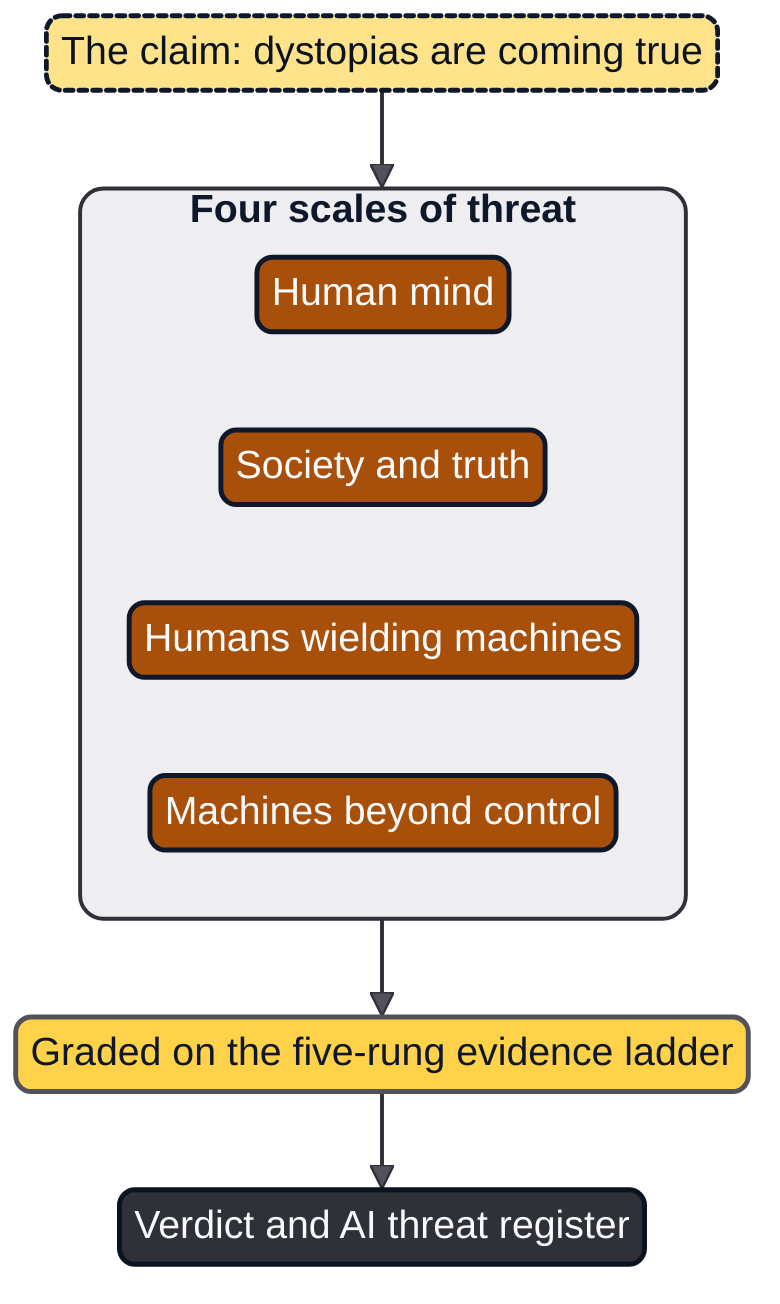
This book treats the dystopian claim as a hypothesis, splits it into testable parts, holds each against the evidence and draws conclusions that a board, a chief risk officer, a chief information security officer or a public authority can act on. This chapter introduces the claim, the scales of threat, the method and the two fictional organisations.
Primary topics explored
- The claim
- Why an investigation and not a verdict
- From the dulled mind to the end of the world
- What the series has already found
- How the book weighs evidence
- How the book conducts the debate
About AI Threat
AI Threat is Book 5 of The Transformed Architecture. It investigates whether the dystopias of science fiction, with AI as the threat, are coming true. It covers every scale of the threat, from the human mind and society to misuse, machines beyond control and the end of the world, stages every debate constructively, and turns the verdict into what individuals, European enterprises and public authorities can do.
It builds on the conclusions of Architecture as Code, AI Governance, AI Platform and Security and AI Red Team.
Boards, chief risk officers, CISOs, AI governance leads, architects and public-sector leaders.

Gunnar Nordqvist
Conceived, directed and published the books of The Transformed Architecture.
Continue with the full chapter
Chapter 1: Introduction: Are the Dystopias Coming True? in AI Threat gives the detailed explanations, practical examples and implementation patterns behind this summary.
This whitepaper belongs to “The Question” and is one of 39 drawn from the manuscript.