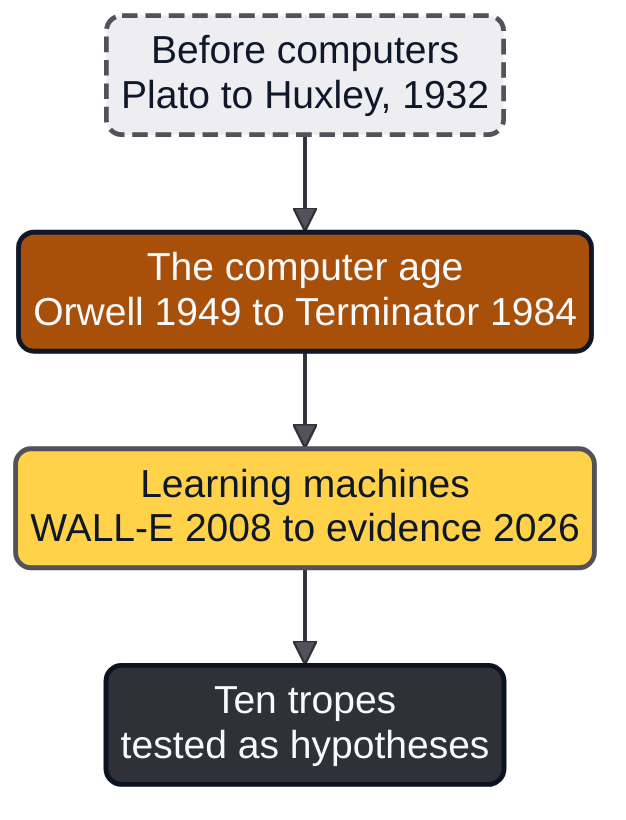
The claim that the dystopias are coming true presupposes that we know what they said. Most people remember an image: a red camera eye, a chrome skeleton walking through fire, a calm voice refusing to open a door. Yet several classic works are about people who become dependent, comfortable or deceived, or about those who own the machines, and the most famous, read closely, describe failures of specification and oversight that an engineer would recognise today.
This chapter therefore reads the canon as hypotheses. It follows the warnings from Plato to the films that fixed the public image of AI and distils them into ten tropes, T1 to T10, each with its mechanism and the evidence that would confirm it, because a trope stated precisely can be tested and a vague fear cannot. It also gives a first answer to the open question Q11 in SERIES_FOUNDATIONS.md: which harms that fiction attributes to machines have already happened through ordinary automation.
Table 2.1: Works of machine dystopia and the tropes they introduced or sharpened.
Primary topics explored
- An older fear than computers
- From Frankenstein to R.U.R.
- The Machine Stops and Brave New World
- Asimov and the rules that fail
- Nineteen Eighty-Four and the end of truth
- HAL 9000, Skynet and Ex Machina
About AI Threat
AI Threat is Book 5 of The Transformed Architecture. It investigates whether the dystopias of science fiction, with AI as the threat, are coming true. It covers every scale of the threat, from the human mind and society to misuse, machines beyond control and the end of the world, stages every debate constructively, and turns the verdict into what individuals, European enterprises and public authorities can do.
It builds on the conclusions of Architecture as Code, AI Governance, AI Platform and Security and AI Red Team.
Boards, chief risk officers, CISOs, AI governance leads, architects and public-sector leaders.

Gunnar Nordqvist
Conceived, directed and published the books of The Transformed Architecture.
Continue with the full chapter
Chapter 2: A Century of Machine Dystopias: What Science Fiction Actually Warned About in AI Threat gives the detailed explanations, practical examples and implementation patterns behind this summary.
This whitepaper belongs to “The Question” and is one of 39 drawn from the manuscript.