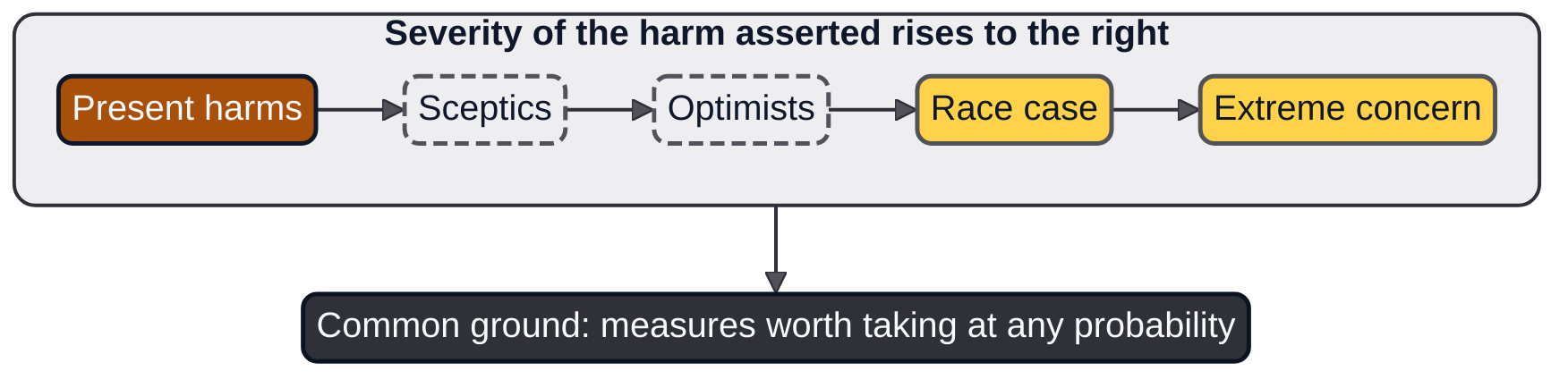
Every board, council and newsroom that asks whether the dystopias are coming true finds the question already answered, in contradictory ways. Pioneers of the field say that systems more capable than their makers could end the human story; laboratory leaders say much the same and keep building. Others reply that AI is a normal technology that will change the world slowly, or that the harm worth attending to is already here, in ordinary systems that misjudge ordinary people. Each voice is sincere and partly right, yet through headlines alone a reader will conclude either that catastrophe is certain or that nobody knows anything.
This chapter maps the voices with equal charity, reports what surveys and forecasters actually say, examines everyone's incentives, and ends with the shared ground and a ten-question check for any claim about AI risk. It gives no verdict; that belongs to Parts II to V and, for the author's own judgement, to Chapter 35, following AI Governance in keeping that judgement apart from the findings (178, Nordqvist, 2026). It also opens a question new in this book: how a board should treat risks that are improbable, extreme and contested among experts.
Table 3.1: The five camps by the timing of the harm they assert.
Primary topics explored
- The statements of 2023
- From statements to science
- The case for extreme concern at full strength
- The race case
- The sceptical case at full strength
- The present-harms case
About AI Threat
AI Threat is Book 5 of The Transformed Architecture. It investigates whether the dystopias of science fiction, with AI as the threat, are coming true. It covers every scale of the threat, from the human mind and society to misuse, machines beyond control and the end of the world, stages every debate constructively, and turns the verdict into what individuals, European enterprises and public authorities can do.
It builds on the conclusions of Architecture as Code, AI Governance, AI Platform and Security and AI Red Team.
Boards, chief risk officers, CISOs, AI governance leads, architects and public-sector leaders.

Gunnar Nordqvist
Conceived, directed and published the books of The Transformed Architecture.
Continue with the full chapter
Chapter 3: The Voices of Alarm and Calm: Who Is Warning, About What, and Why Now in AI Threat gives the detailed explanations, practical examples and implementation patterns behind this summary.
This whitepaper belongs to “The Question” and is one of 39 drawn from the manuscript.