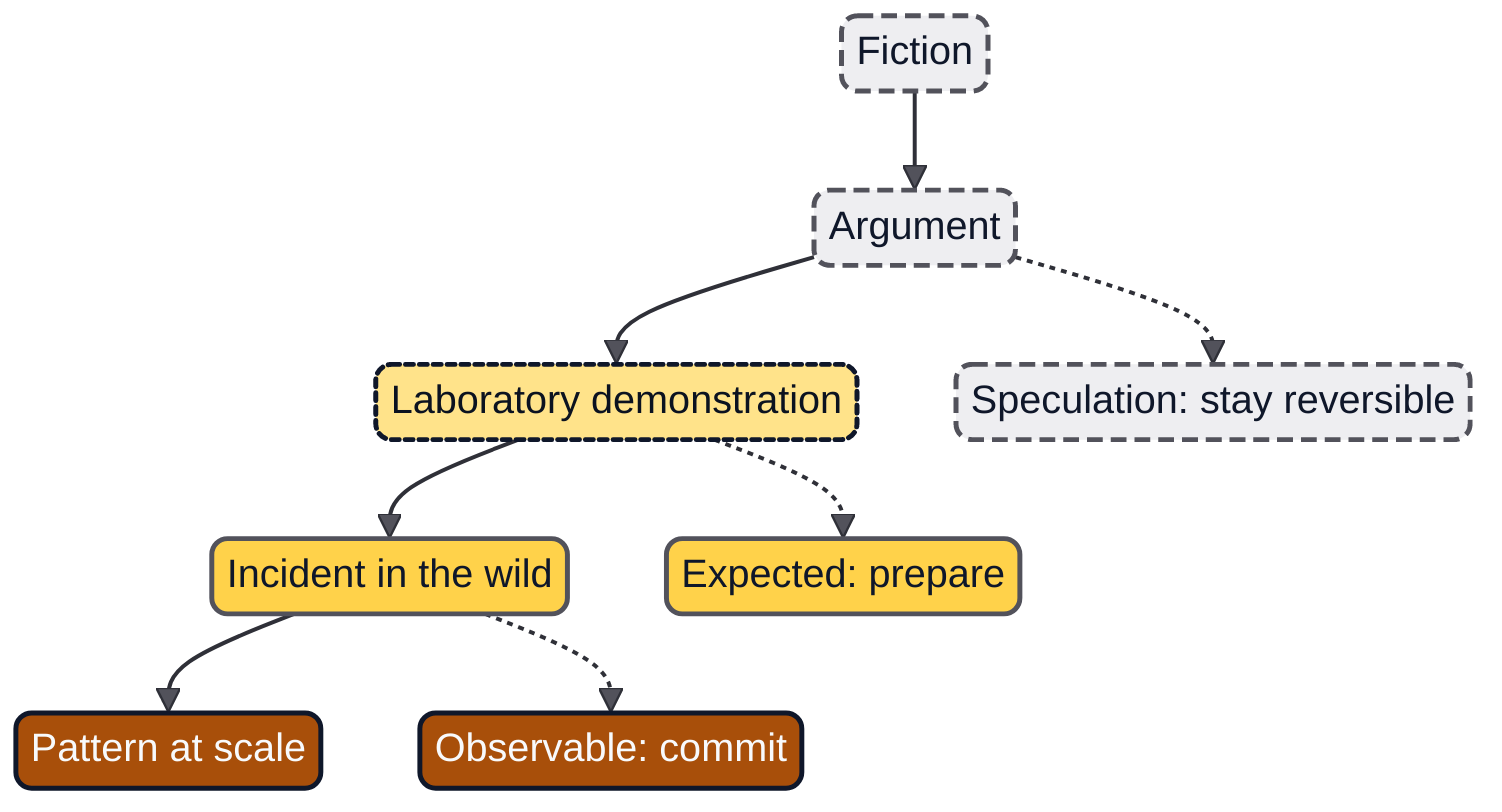
Every chapter that follows makes claims about AI threat, and every claim invites two questions: how do we know, and what should anyone do about it? The public debate answers neither well. A laboratory experiment in which a model produced a blackmail message is reported as proof that machines will turn on their makers, and in the next news cycle dismissed as theatre staged by a company with something to sell, so the organisations that must decide are left with noise.
This chapter sets out the method the book uses instead: the evidence ladder, the distinction between capability, propensity and harm, the labels observable, expected and speculation, the limits of contrived tests, the treatment of improbable, extreme and contested risks, the biases on both sides, and the practices that let people who differ decide together. The method matters more than any single verdict, because a reader who disagrees with a verdict in Chapter 24 or Chapter 27 should be able to see whether the disagreement lies in the evidence, its grading, the weight given to a consequence, or a value judgement.
Table 4.1: The debate cycle and the record that follows the grading.
Primary topics explored
- The evidence ladder
- Capability, propensity and harm
- Observable, expected, speculation
- Elicited behaviour and the problem of the contrived test
- Tail risks and the risk register
- Biases on both sides
About AI Threat
AI Threat is Book 5 of The Transformed Architecture. It investigates whether the dystopias of science fiction, with AI as the threat, are coming true. It covers every scale of the threat, from the human mind and society to misuse, machines beyond control and the end of the world, stages every debate constructively, and turns the verdict into what individuals, European enterprises and public authorities can do.
It builds on the conclusions of Architecture as Code, AI Governance, AI Platform and Security and AI Red Team.
Boards, chief risk officers, CISOs, AI governance leads, architects and public-sector leaders.

Gunnar Nordqvist
Conceived, directed and published the books of The Transformed Architecture.
Continue with the full chapter
Chapter 4: Weighing the Evidence and Disagreeing Well in AI Threat gives the detailed explanations, practical examples and implementation patterns behind this summary.
This whitepaper belongs to “The Question” and is one of 39 drawn from the manuscript.