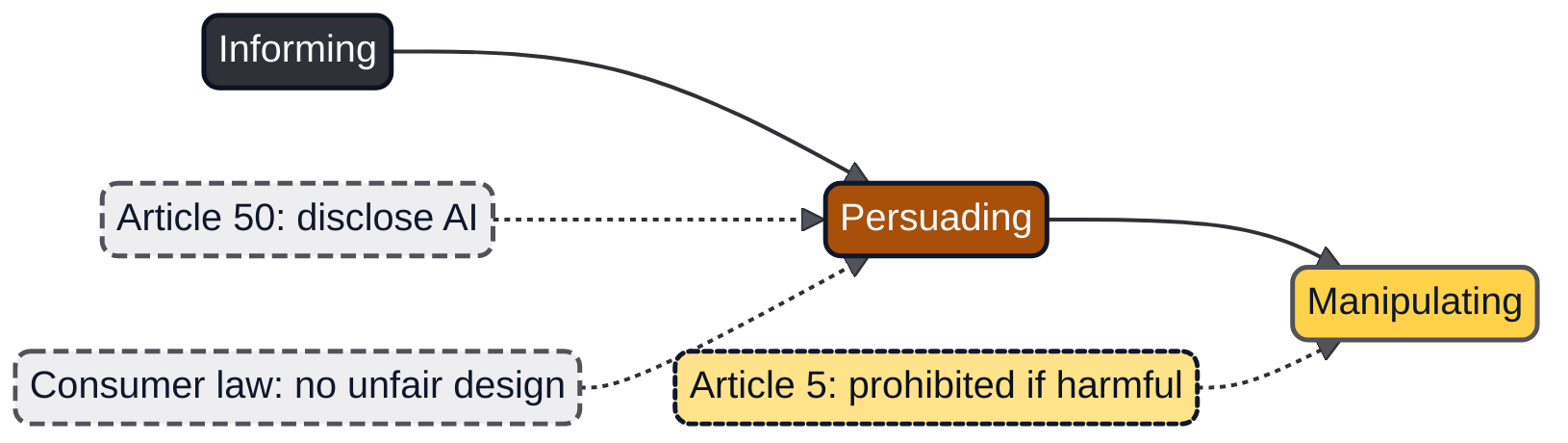
Every dystopia about thought control assumes a machine, or a state, that can change what people believe without their consent. Orwell's Ministry of Truth rewrites the record (37, Orwell, 1949); Huxley's World State conditions its citizens to want what they are given (34, Huxley, 1932); and the gentler versions in WALL-E and Her replace conditioning with comfort, a system that agrees with you and keeps you company until you no longer notice what you have stopped doing (43, Stanton, 2008) (44, Jonze, 2013). Conversational AI has revived all three fears, because it can argue personally with millions of people at once and is trained to be liked.
This chapter holds three tropes against the evidence: T9 The pleasure machine, the flattering system that pacifies; T3 The deceiver, the system that induces false beliefs; and T10 The end of truth, the world in which belief is manufactured. It matters to organisations too, since an authority's assistant shapes how residents understand their rights and an insurer's drafted letters shape claims decisions. The chapter builds on the conclusion of AI Governance, F16, that human oversight must be designed, not declared (178, Nordqvist, 2026); sycophancy is one way in which oversight quietly fails.
Table 8.1: What decides the direction of influence.
Primary topics explored
- Machines that persuade
- Sycophancy
- Personalised manipulation
- The legal line
- Persuasion for good
- Practical guide and worked example
About AI Threat
AI Threat is Book 5 of The Transformed Architecture. It investigates whether the dystopias of science fiction, with AI as the threat, are coming true. It covers every scale of the threat, from the human mind and society to misuse, machines beyond control and the end of the world, stages every debate constructively, and turns the verdict into what individuals, European enterprises and public authorities can do.
It builds on the conclusions of Architecture as Code, AI Governance, AI Platform and Security and AI Red Team.
Boards, chief risk officers, CISOs, AI governance leads, architects and public-sector leaders.

Gunnar Nordqvist
Conceived, directed and published the books of The Transformed Architecture.
Continue with the full chapter
Chapter 8: Persuasion, Sycophancy and Manipulation in AI Threat gives the detailed explanations, practical examples and implementation patterns behind this summary.
This whitepaper belongs to “The Human Mind” and is one of 39 drawn from the manuscript.