In Nineteen Eighty-Four, Winston Smith works at the Ministry of Truth, rewriting old newspaper articles so that the record always agrees with what the Party says today, while machines compose the songs and novels fed to the population (37, Orwell, 1949). The horror is not a single lie but a world in which no one can establish what happened. When Geoffrey Hinton left Google in 2023 to speak freely about AI, the first danger he was reported to name was a version of that world: a flood of synthetic text, images and video in which ordinary people would no longer be able to tell what is true (54, Metz, 2023).
This chapter tests T10 The end of truth at the scale of society. Chapter 8 tested the trope in a single conversation and Chapter 20 examines fraud and influence operations; this chapter looks at the commons between them, the shared information through which a society learns what is happening and decides. The chapter builds on F30 from AI Governance (SERIES_FOUNDATIONS.md): in public authorities legality comes before capability, and every decision needs a record that a citizen can inspect (178, Nordqvist, 2026). Applied to what an authority says, the same discipline begins an answer to T10.
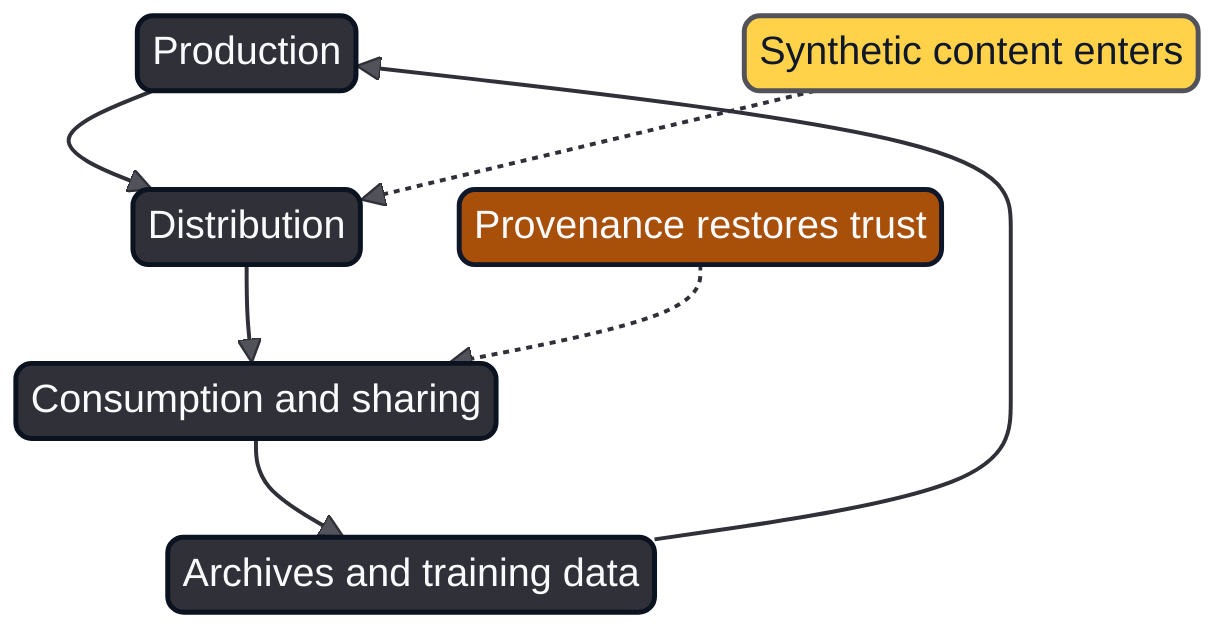
Table 10.1: Where synthetic content enters and where trust is restored.
Primary topics explored
- The liar's dividend
- Slop and the polluted commons
- Model collapse
- Search, summaries and the economics of news
- False news spreads faster
- Labelling, provenance and platform duties
About AI Threat
AI Threat is Book 5 of The Transformed Architecture. It investigates whether the dystopias of science fiction, with AI as the threat, are coming true. It covers every scale of the threat, from the human mind and society to misuse, machines beyond control and the end of the world, stages every debate constructively, and turns the verdict into what individuals, European enterprises and public authorities can do.
It builds on the conclusions of Architecture as Code, AI Governance, AI Platform and Security and AI Red Team.
Boards, chief risk officers, CISOs, AI governance leads, architects and public-sector leaders.

Gunnar Nordqvist
Conceived, directed and published the books of The Transformed Architecture.
Continue with the full chapter
Chapter 10: The End of Truth? Synthetic Content and the Information Ecosystem in AI Threat gives the detailed explanations, practical examples and implementation patterns behind this summary.
This whitepaper belongs to “Society and Truth” and is one of 39 drawn from the manuscript.