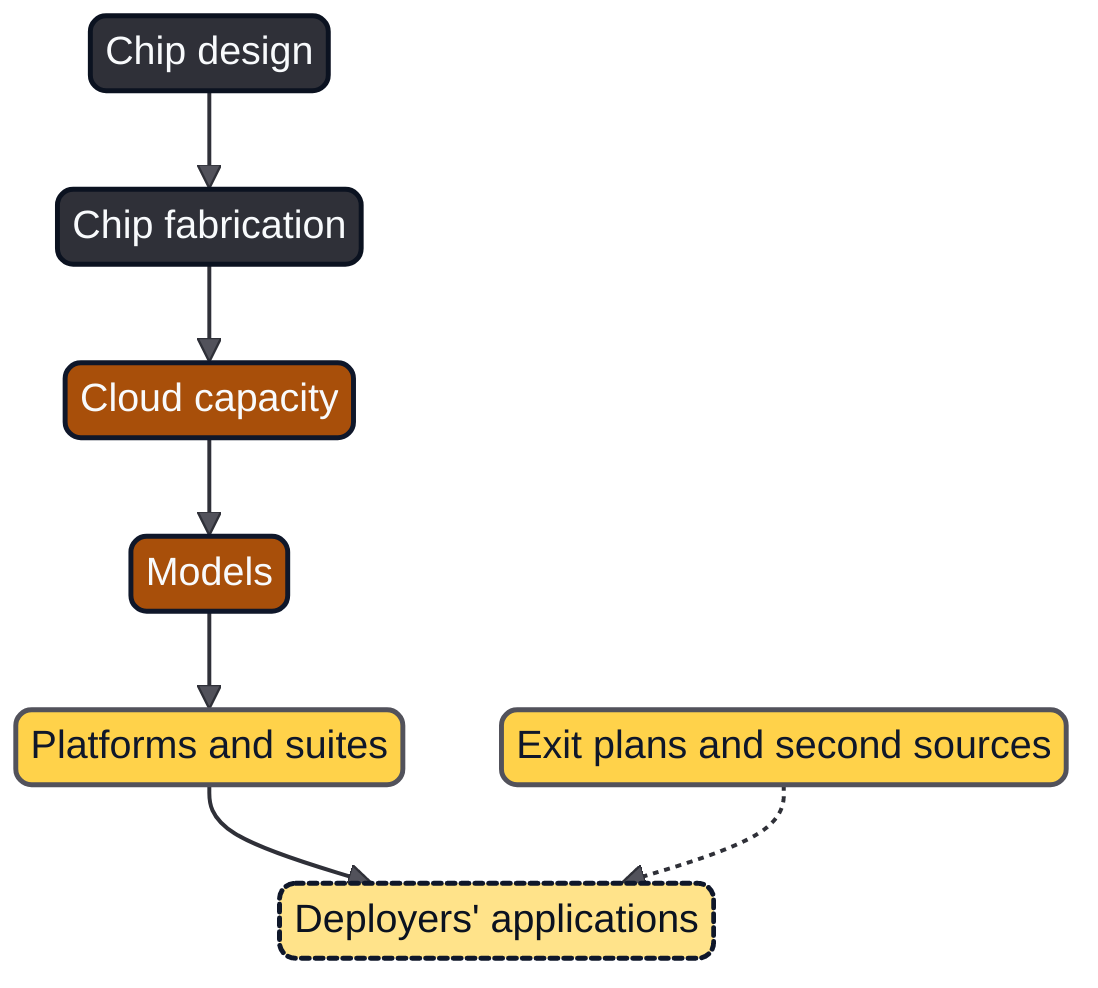
The dystopias of the previous chapters needed a machine that watched, judged or flattered. The one in this chapter needs only ownership. If the most capable AI systems are built by a handful of companies, on chips from a handful of suppliers, in data centres run by a handful of cloud providers and under the law of two or three states, then whoever controls that chain gains leverage over everyone who depends on it. Science fiction gave the fear the face of a state, the watching power of Nineteen Eighty-Four (37, Orwell, 1949); Shoshana Zuboff widened it to companies that accumulate behavioural data to predict and shape behaviour (170, Zuboff, 2019). AI adds dependence on systems that a few actors can price, change or withdraw.
The chapter tests two tropes from Chapter 2. T7 The watching state asks whether control of AI concentrates economic and political power beyond the reach of the institutions meant to hold it to account. T8 The machine that stops, and the humans who forgot is tested in its systemic form, in which many organisations rely on the same few systems and cannot continue when those systems fail, change or are withdrawn; Chapter 6 tested its individual form. The chapter also answers Q12 from the series foundations: what a single enterprise or public authority can do about risks that are systemic, international and decided by a handful of developers. No organisation can change the market's structure, but each can see its position in it and make its dependence visible and reversible.
Table 15.1: Concentration and levers by layer.
Primary topics explored
- Compute, data and capital
- Who gains
- States and strategies
- Dependence as a threat
- What sovereignty can achieve
- The debate
About AI Threat
AI Threat is Book 5 of The Transformed Architecture. It investigates whether the dystopias of science fiction, with AI as the threat, are coming true. It covers every scale of the threat, from the human mind and society to misuse, machines beyond control and the end of the world, stages every debate constructively, and turns the verdict into what individuals, European enterprises and public authorities can do.
It builds on the conclusions of Architecture as Code, AI Governance, AI Platform and Security and AI Red Team.
Boards, chief risk officers, CISOs, AI governance leads, architects and public-sector leaders.

Gunnar Nordqvist
Conceived, directed and published the books of The Transformed Architecture.
Continue with the full chapter
Chapter 15: Inequality and the Concentration of Power in AI Threat gives the detailed explanations, practical examples and implementation patterns behind this summary.
This whitepaper belongs to “Society and Truth” and is one of 39 drawn from the manuscript.