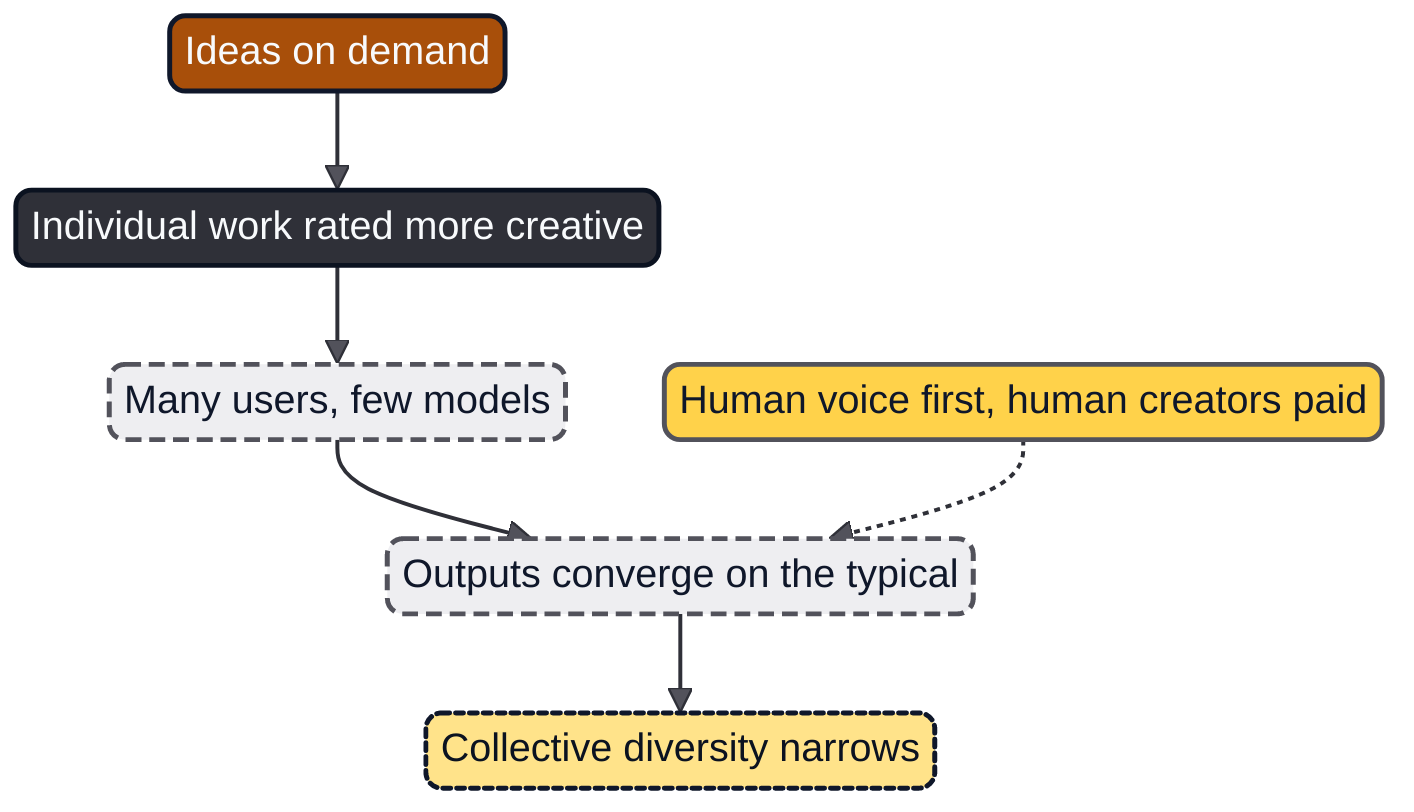
Culture is the slowest of the shared goods that Part III examines, and the hardest to measure. A society's stories, images, music and turns of phrase are made by many people over long periods, each borrowing from the others and adding something new. Generative AI enters that process at both ends: it is trained on the accumulated output of human culture, and it now produces a growing share of what people read and see. This chapter asks whether a tool that has learned from everything makes people more creative, or pulls what they make towards the average of everything it learned.
The chapter tests two tropes from Chapter 2. T9 The pleasure machine is the trope of comfort that crowds out effort, which Aldous Huxley gave a cultural form: the World State of Brave New World keeps its citizens content with synthetic entertainment and has given up difficult art as the price of stability (34, Huxley, 1932). T8 The machine that stops, and the humans who forgot here takes the form of creative skills and livelihoods that fade once a machine supplies the first draft. It matters to every authority that publishes in more than one language and every company that writes marketing copy, because each now decides, often unnoticed, whose work its tools were trained on. The chapter also answers part of Q11, because several cultural harms attributed to generative AI began earlier, with recommendation systems.
Table 16.1: Measures that counteract the narrowing.
Primary topics explored
- More creative, less diverse
- The average of everything
- Creative work and its economics
- Consent and copyright
- Small languages and cultures
- Supporting human creativity
About AI Threat
AI Threat is Book 5 of The Transformed Architecture. It investigates whether the dystopias of science fiction, with AI as the threat, are coming true. It covers every scale of the threat, from the human mind and society to misuse, machines beyond control and the end of the world, stages every debate constructively, and turns the verdict into what individuals, European enterprises and public authorities can do.
It builds on the conclusions of Architecture as Code, AI Governance, AI Platform and Security and AI Red Team.
Boards, chief risk officers, CISOs, AI governance leads, architects and public-sector leaders.

Gunnar Nordqvist
Conceived, directed and published the books of The Transformed Architecture.
Continue with the full chapter
Chapter 16: Culture, Creativity and the Homogenisation of Thought in AI Threat gives the detailed explanations, practical examples and implementation patterns behind this summary.
This whitepaper belongs to “Society and Truth” and is one of 39 drawn from the manuscript.