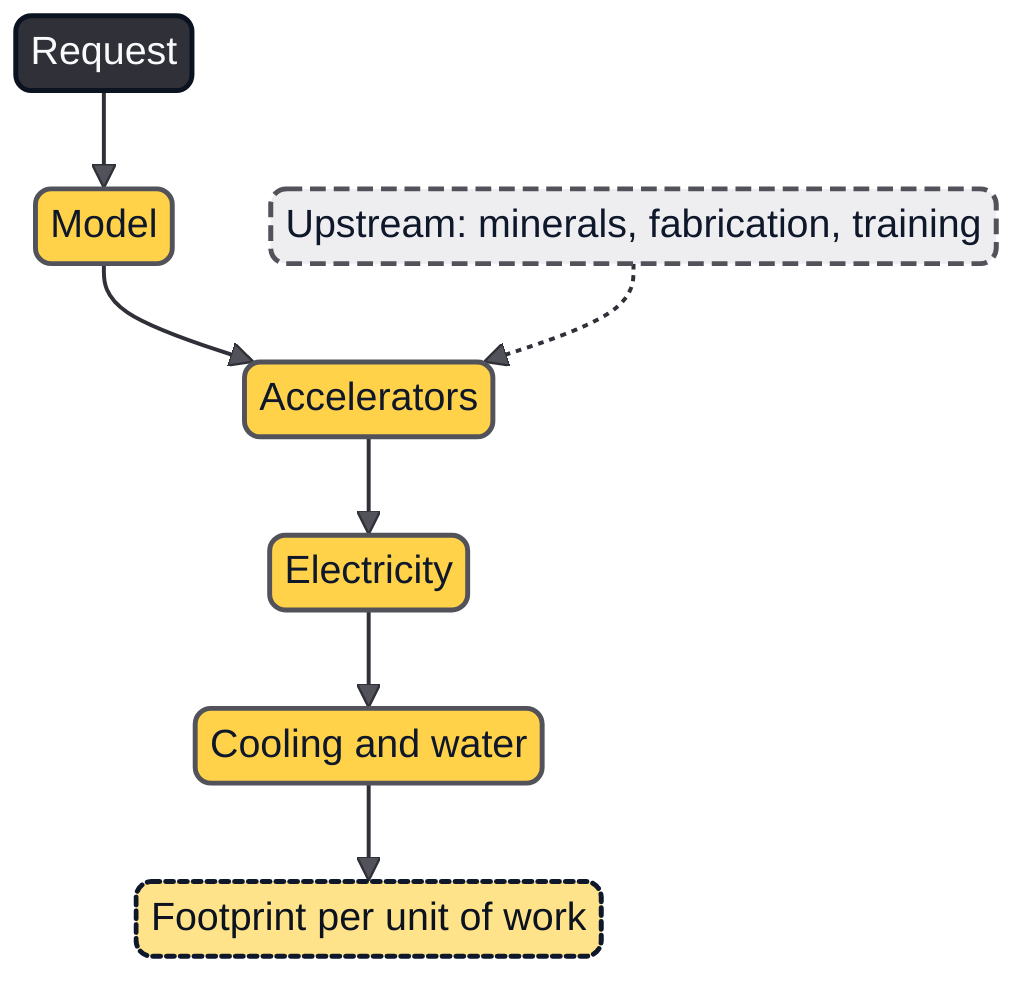
Most of the threats in this book are made of information: a persuasive answer, a biased score, a synthetic photograph. This chapter is about the part of AI that is made of matter. Every request to a model runs on accelerators fabricated from refined minerals, in buildings that draw electricity from a grid and reject heat through cooling systems that often consume water, on land that needed a grid connection and a permit. The cost is real, growing and often borne by people who never use the service, and it attracts confident claims in both directions.
The chapter builds on a conclusion of AI Platform and Security, recorded as F34 in this book: cost and energy are architectural characteristics of AI systems, and the footprint of training and inference varies by orders of magnitude with choices of model, hardware, location and time (179, Nordqvist, 2026). This chapter widens that view to the grid and the supply chain. The trope under test is T8 The machine that stops, and the humans who forgot, in its second half: the concentration of dependence on systems that can fail together. Forster's Machine stopped, and the people who lived inside it could neither repair it nor live without it (33, Forster, 1909). The physical version of the fear is that societies are building dependence on a service whose power, water and chips are concentrated in a few places, and that it may stop, or be rationed, when those limits bind.
Table 17.1: Choices that change each step and what is reported.
Primary topics explored
- Electricity
- Water and materials
- Training versus inference
- Reporting duties
- Choices that matter
- The debate
About AI Threat
AI Threat is Book 5 of The Transformed Architecture. It investigates whether the dystopias of science fiction, with AI as the threat, are coming true. It covers every scale of the threat, from the human mind and society to misuse, machines beyond control and the end of the world, stages every debate constructively, and turns the verdict into what individuals, European enterprises and public authorities can do.
It builds on the conclusions of Architecture as Code, AI Governance, AI Platform and Security and AI Red Team.
Boards, chief risk officers, CISOs, AI governance leads, architects and public-sector leaders.

Gunnar Nordqvist
Conceived, directed and published the books of The Transformed Architecture.
Continue with the full chapter
Chapter 17: The Physical Cost: Energy, Water and Materials in AI Threat gives the detailed explanations, practical examples and implementation patterns behind this summary.
This whitepaper belongs to “Society and Truth” and is one of 39 drawn from the manuscript.