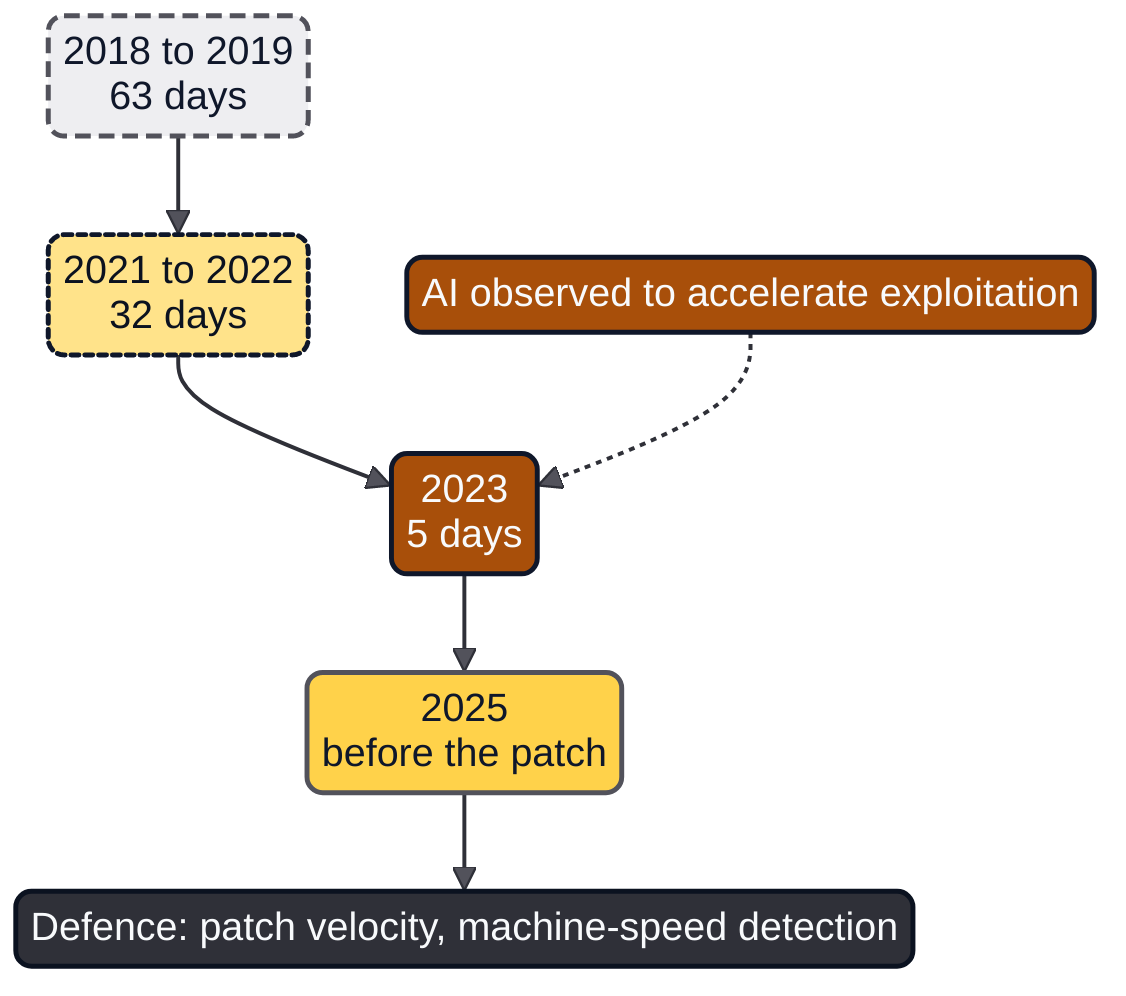
Part IV turns from what AI does to minds and societies to what people do with it. At this scale nothing escapes anyone's control: the machine obeys, and the harm comes from the people it obeys. Cyber offence is where the evidence is strongest. Two years of reports describe a movement from AI as a research assistant to AI running large parts of real intrusions, while the time from disclosure of a vulnerability to its exploitation has collapsed to less than nothing.
The chapter tests T6 The weapon in human hands, the trope of the machine as an instrument of war, terror and crime, in the domain where it can be tested best. It answers the series' open question Q7 on patch-to-exploit times measured in minutes as far as the evidence allows, and takes a first step on Q4, what machine-speed adversaries mean beyond security operations. It keeps the boundary set in Chapter 1 and in AI Red Team, Chapter 1 (F28): adversary behaviour is described at the level of what reports observed and what it means for defence, never as techniques, tools, prompts or steps (180, Nordqvist, 2026). It builds on AI Platform and Security, Chapter 18, which documented the same evidence for platform architects and set out four commitments against AI-enabled adversaries (F18, F19) (179, Nordqvist, 2026).
Table 18.1: The window and where AI has been observed to accelerate it.
Primary topics explored
- From misuse to orchestration
- Agentic offensive frameworks
- The exploitation window
- The defender's mirror
- Change of degree or of kind
- What Europe and the series have already settled
About AI Threat
AI Threat is Book 5 of The Transformed Architecture. It investigates whether the dystopias of science fiction, with AI as the threat, are coming true. It covers every scale of the threat, from the human mind and society to misuse, machines beyond control and the end of the world, stages every debate constructively, and turns the verdict into what individuals, European enterprises and public authorities can do.
It builds on the conclusions of Architecture as Code, AI Governance, AI Platform and Security and AI Red Team.
Boards, chief risk officers, CISOs, AI governance leads, architects and public-sector leaders.

Gunnar Nordqvist
Conceived, directed and published the books of The Transformed Architecture.
Continue with the full chapter
Chapter 18: Cyber Offence at Machine Speed in AI Threat gives the detailed explanations, practical examples and implementation patterns behind this summary.
This whitepaper belongs to “Humans Wielding Machines” and is one of 39 drawn from the manuscript.