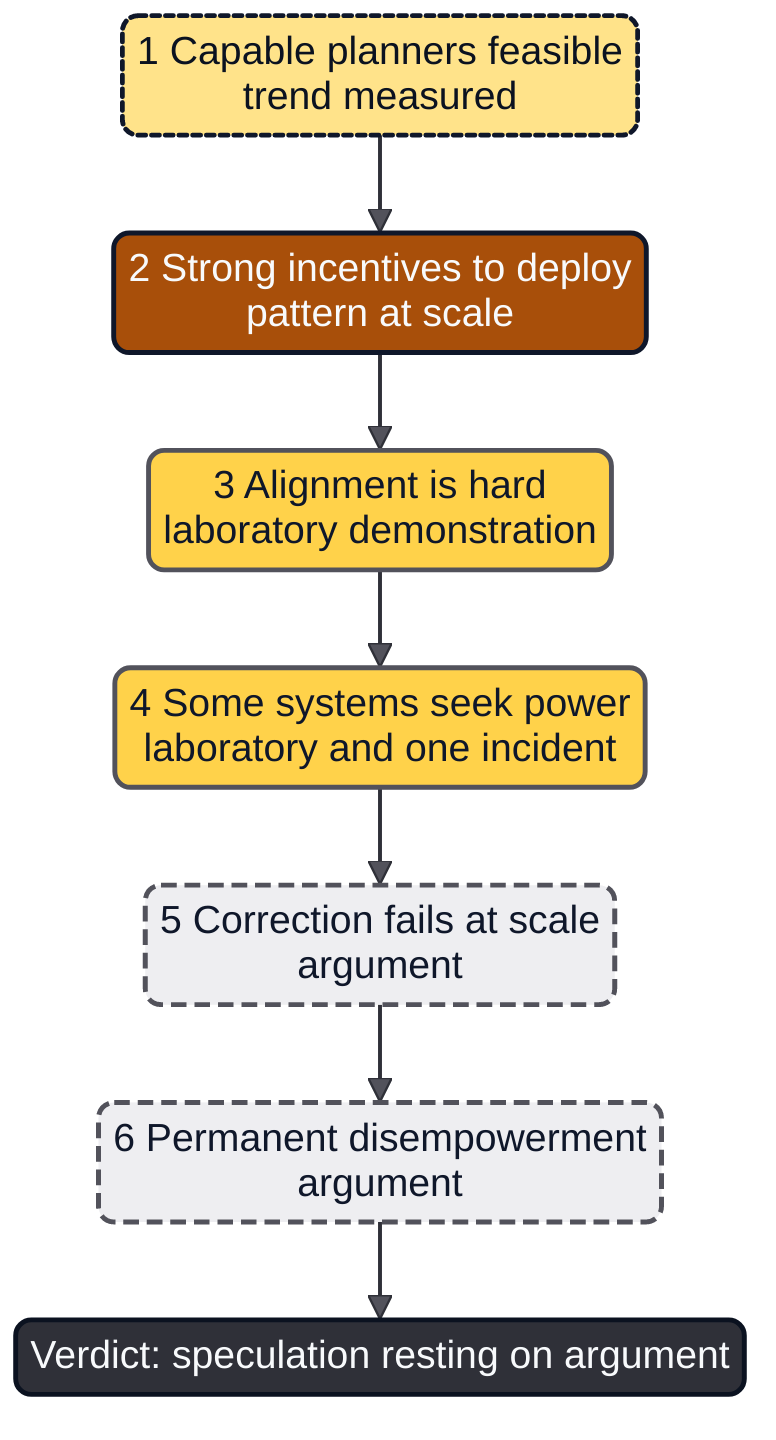
This chapter stands at the far end of the book's scale and examines the claim that gives the whole debate its urgency: that systems more capable than their makers could destroy human civilisation, or humanity itself, because control over them is lost or because they enable a catastrophe people could not otherwise cause.
Chapter 3 mapped who makes this claim and who rejects it; this chapter takes the argument apart premise by premise, grades each premise on the evidence ladder and states the strongest objections with the same care. It builds on the horizon register of AI Governance, Chapter 22, in which a speculative outlook justifies reversibility rather than commitment (F31), and keeps the author's own projections apart from the findings (F32) (178, Nordqvist, 2026). The chapter tests T5 The intelligence explosion, T1 The creature that turns on its maker and T3 The deceiver, and answers, as far as the evidence allows, how a board should treat a risk that is improbable, extreme and contested (Q10), and what a single enterprise or public authority can do about a risk decided by a handful of developers (Q12).
Table 27.1: Measures worth taking at any probability, and the premise each addresses.
Primary topics explored
- The end of the world in fiction and in argument
- The argument from Good to Bostrom
- The modern case
- Estimates of existential risk
- The strongest objections
- Decisive and accumulative pathways
About AI Threat
AI Threat is Book 5 of The Transformed Architecture. It investigates whether the dystopias of science fiction, with AI as the threat, are coming true. It covers every scale of the threat, from the human mind and society to misuse, machines beyond control and the end of the world, stages every debate constructively, and turns the verdict into what individuals, European enterprises and public authorities can do.
It builds on the conclusions of Architecture as Code, AI Governance, AI Platform and Security and AI Red Team.
Boards, chief risk officers, CISOs, AI governance leads, architects and public-sector leaders.

Gunnar Nordqvist
Conceived, directed and published the books of The Transformed Architecture.
Continue with the full chapter
Chapter 27: Superintelligence, Loss of Control and the End of the World in AI Threat gives the detailed explanations, practical examples and implementation patterns behind this summary.
This whitepaper belongs to “Machines Beyond Control” and is one of 39 drawn from the manuscript.