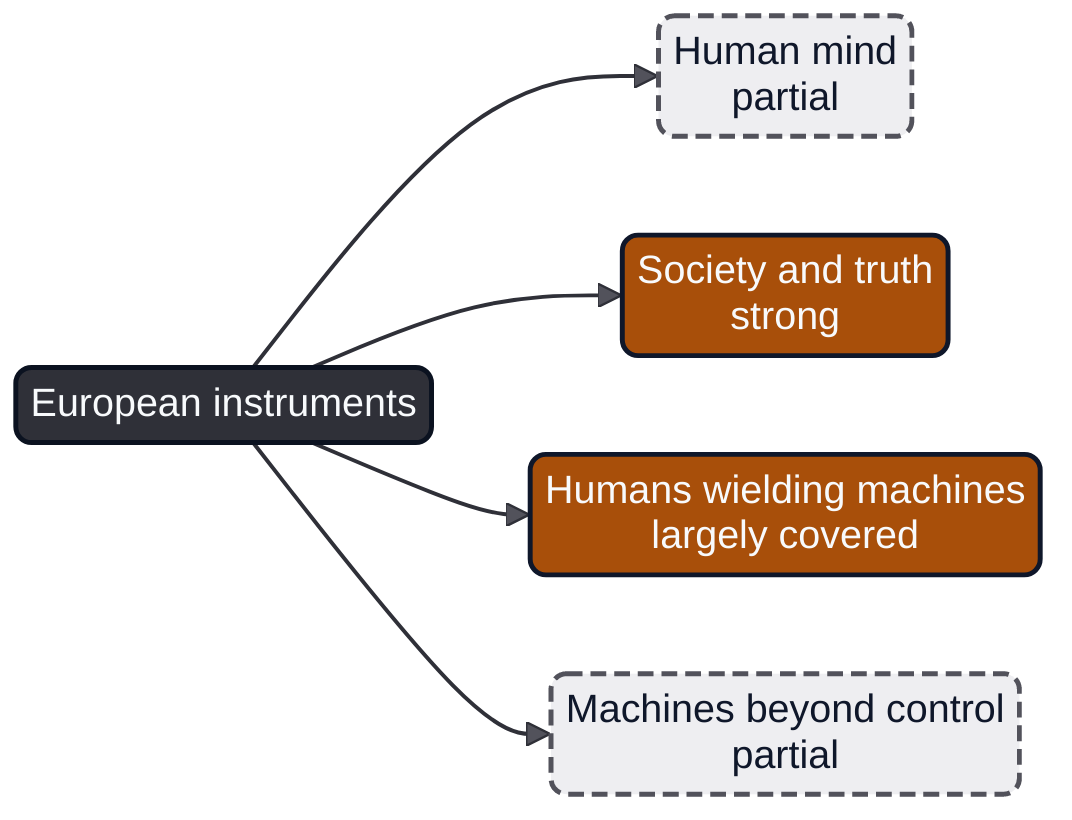
Parts II to V weighed the evidence for each scale of threat. This chapter turns to the response already written down, in the AI Act, the law that operates alongside it and the international instruments, maps it against the four scales of threat and shows where it leaves gaps. The reason is practical: an organisation with an AI threat register (Chapter 32) needs to know for each entry whether the law already requires a control, whether someone else carries the duty, or whether nothing addresses the threat at all. That answer is part of the answer to Q12, what a single enterprise or public authority can do about risks that are systemic, international and decided by a handful of developers.
Table 28.1: Instruments, coverage and gaps by scale.
The AI Act, Regulation (EU) 2024/1689, is a product-safety regulation with fundamental-rights objectives, not a response to science fiction (1, European Union, 2024). Read as a threat map, however, its four layers line up with the scales of this book in an instructive way, and so do its silences.
Primary topics explored
- The AI Act as a threat map
- General-purpose AI models with systemic risk
- Incident reporting
- Alongside the AI Act
- Beyond the Union
- The instruments against the four scales of threat
About AI Threat
AI Threat is Book 5 of The Transformed Architecture. It investigates whether the dystopias of science fiction, with AI as the threat, are coming true. It covers every scale of the threat, from the human mind and society to misuse, machines beyond control and the end of the world, stages every debate constructively, and turns the verdict into what individuals, European enterprises and public authorities can do.
It builds on the conclusions of Architecture as Code, AI Governance, AI Platform and Security and AI Red Team.
Boards, chief risk officers, CISOs, AI governance leads, architects and public-sector leaders.

Gunnar Nordqvist
Conceived, directed and published the books of The Transformed Architecture.
Continue with the full chapter
Chapter 28: What Europe and the World Have Decided in AI Threat gives the detailed explanations, practical examples and implementation patterns behind this summary.
This whitepaper belongs to “The Response” and is one of 39 drawn from the manuscript.